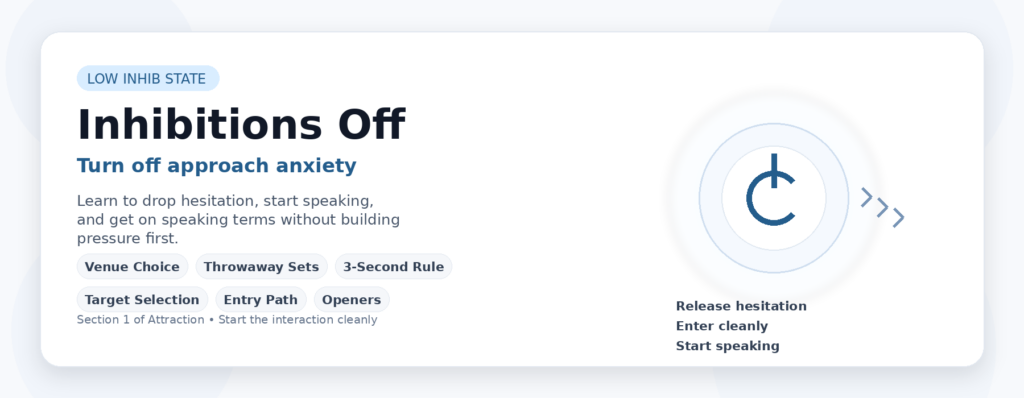
Venue choice
Best environments
Places where people are already standing, pausing, waiting, browsing, or socializing
- Best because the person is usually in a low-commitment attentional state. They are not deep inside a sequence they must protect, remember, and resume.
- When someone is between actions, the interruption cost is lower. They can lend attention without feeling like they are dropping a task mid-stream.
- Waiting areas, browsing zones, bar edges, patios, event spillover, display sections, and queue-adjacent pauses all create attentional slack. That slack is what makes a short first interaction feel easy instead of expensive.
- Browsing is especially useful because there is already a shared external object. The first thread can attach to something visible instead of forcing immediate personal intimacy.
- Socializing zones are strong because conversation is already part of the local norm. You are not introducing a new behavior; you are joining an existing one.
Places where conversation can actually be heard
- A1 weakens fast when the first sentence has to fight the room.
- High noise increases response time, lowers speech intelligibility, and raises the amount of effort needed just to decode what was said.
- That means the other person has less cognitive room left for curiosity, play, or smooth turn-taking because too much attention is being spent on basic hearing.
- In loud spaces, people compensate by raising vocal effort and adjusting distance. That is fine once a conversation already exists. It is bad for first contact because now the interaction has to solve an acoustics problem before it can become socially normal.
- Best zones are not usually the loudest part of the venue. They are the side pockets where normal-volume speech works on the first try.
Places with movement and natural mixing
- Good movement is not chaos. Good movement means people are circulating, crossing, pausing, reforming, and re-entering conversation naturally.
- That gives you repeated low-pressure entry windows because people are already changing orientation and attention.
- Social groups are organized spatially. If the room gives groups enough surrounding access space, you can enter without looking like you are breaking open a sealed unit.
- Natural mixing also gives social cover. A brief exchange looks like normal room behavior, not like a dramatic event everyone has to register.
- Best version: the room alternates between flow and pause. Too static and everything is closed. Too kinetic and nobody can allocate attention.
Worst environments
Places where you have to shout immediately
- Bad because the interaction starts with strain instead of ease.
- The other person has to work harder just to hear you, which makes the first seconds feel effortful rather than natural.
- Loud environments also push you toward two ugly compensations:
- speak much harder than normal
- stand closer than normal
- Both can raise intensity too early.
- If the opener cannot be heard at normal conversational effort, A1 starts under friction.
Places where the other person is clearly task-locked
- Task-locked means they are in the middle of something they must maintain: ordering, paying, carrying, navigating, coordinating, reading, typing, searching, managing children, handling staff.
- Interruptions impose resumption cost. The person has to suspend the current task, remember where they were, then re-enter it correctly.
- That makes even a decent opener feel expensive because the real issue is not the line; it is the timing burden.
- Task-locked people often answer minimally not because they hate the approach, but because they are protecting cognitive bandwidth.
- Approaching someone who is between actions is not the same thing as approaching someone in the middle of one.
Places where your approach forces them to physically stop what they are doing
- Bad because you are creating immediate behavioral and spatial friction.
- If they must stop walking, turn sharply, remove attention from where they were headed, or reorganize their body just to receive your first sentence, the cost of giving you a fair shot is already too high.
- Forced stopping also tends to compress distance too quickly, which can increase discomfort and arousal.
- With groups, it is even worse: if your entry requires them to break their existing spatial formation just to accommodate you, the approach feels heavier than the same words would feel in a more open setup.
- Best entries fit into existing movement. Worst entries demand a reconfiguration.
Throwaway Approaches for first contact stiffness
- This is warm-up work, not to be counted as a real approach, its job is to remove first-contact stiffness before the interaction you actually care about, so the real opener is not also your first vocal onset, first eye contact, first turn-taking sequence, and first test of composure. The idea is it creates new nonthreat learning that its okay to begin being social instead of letting avoidance keep teaching the old lesson.
- In conversation experiments, self-focused attention and safety behaviors—monitoring how you are coming across, rehearsing before speaking, talking less, staying on the edge, avoiding eye contact—raise anxiety and make people come across worse to partners and observers. Warm-up contacts work because they force attention back onto another person and a simple task instead of letting you stay trapped in impression-management mode.
- First-contact stiffness is not just “being nervous.” It is the visible bundle of self-protective behaviors that show up when the first interaction feels too important: softer vocal amplitude, fewer and shorter turns, less movement, rehearsing sentences, watching yourself too closely, hanging back on the edge, and trying to control the impression instead of joining the exchange. Research on nervousness cues and safety behaviors maps closely onto this exact pattern.Warm-up contacts help because they attack those processes directly instead of asking you to abstractly “be more confident.”
- The goal is also not to collect mini-wins for ego. If you turn warm-up contacts into a referendum on how well liked you are, you keep the same performance pressure and merely change the venue. Exposure logic only helps when the interaction displaces avoidance and safety behaviors; it fails when “preparation” becomes a more respectable way to keep hiding.
Warm-up approaches
Ask staff a simple question
- This is usually the best first warm-up because the interaction already has a role-justified script. Research on stranger conversation suggests that contexts with some built-in reason to speak lower the barrier to engagement and help people calibrate their expectations through actual experience instead of anxious guessing. A staff interaction gives you vocal onset, eye contact, audibility, one clean response, and an easy exit with almost zero ambiguity about why you opened your mouth.
- The question should be real, concrete, and quickly answerable. The benefit is not the information; the benefit is that you initiate, receive, and close an interaction without giving self-focus time to build. That matters because the research is very consistent that self-monitoring and safety behaviors worsen both felt anxiety and how you come across.
- What this trains is very specific: audible first words, neutral eye contact, calm listening, one clean acknowledgment, then release. It also strips the brain of the excuse that every initiated exchange has to carry social risk or romantic meaning. Since even minimal social contact can increase positive affect, the staff question works as a state reset without asking the interaction to be anything more than it is.
- What not to do: do not ask something fake, do not linger after the answer, and do not turn a service interaction into a covert full set. The strength of this warm-up is that it is low-ambiguity and low-load; once you force more out of it than the context naturally supports, you reintroduce the same pressure you were trying to dissolve. That last point is a practical inference from the role-clarity and low-friction logic in the stranger-interaction findings.
Next Make a casual comment to a passerby
- This is the next level up because it removes most of the script while keeping the stakes low. The function is not to hook; the function is to prove that a short social bid can be brief, normal, and disposable, which fits the finding that people routinely expect stranger contact to be less pleasant than it actually is. A casual comment is useful precisely because the interaction can be successful even if it only lasts one exchange.
- The comment should attach to something shared and immediate: line movement, venue confusion, a tiny absurdity, timing, signage, weather spillover, something both people are already dealing with. That design matters because it keeps the interaction externally anchored instead of forcing you back into self-conscious performance. When self-focus rises and impression management takes over, anxiety and apparent awkwardness rise with it.
- The success metric here is not whether the other person stops and invests. The success metric is whether you can make a clean, socially normal bid, receive whatever comes back, and keep moving without collapse, rumination, or emotional over-interpretation. That is exactly the kind of small expectancy violation exposure work relies on: you approach, the feared catastrophe does not happen, and your system learns that brief contact is tolerable.
- This warm-up is best when you notice overselection and outcome dependence. If you are mentally sorting the room, waiting for the perfect target, or inflating the next approach into a high-stakes event, a passerby comment breaks the spell because the interaction is intentionally non-precious. It resets the premise from “this has to matter” to “I can speak normally to a human and keep going.”
Greet people without agenda
- This is the cleanest version of the warm-up because it attacks the underlying distortion directly: the idea that social initiation must always serve a larger objective. Research on minimal social interactions found that even very small exchanges—greeting, thanking, wishing someone well—can raise momentary positive affect, and weak-tie work found that brief genuine interactions can increase positive affect and belonging. Greeting without agenda is valuable because it normalizes contact without asking the interaction to perform.
- Greeting also trains non-predatory presence. Instead of staring, choosing, hovering, and then “making a move,” you become a person who can acknowledge others without loading the moment with hidden intent. That matters because people often avoid stranger contact due to mistaken expectations about how it will feel; repeated ordinary greetings help recalibrate that expectation through direct low-cost experience.
- This is especially useful when your issue is more physical than verbal. If your face is flat, your voice starts too small, or your body feels brittle before the first words, a simple greeting lets you practice onset, eye contact, micro-expression, and release without also having to build a conversation. The likely gain is not charisma; it is reducing the nervousness profile associated with smaller amplitude and fewer conversational turns.
Practical ladder
- Start with the lowest-ambiguity rep and move up. Staff question first, then greeting without agenda, then a casual situational comment, then the actual set. This ladder makes sense because research suggests people connect more easily in contexts with some built-in reason to speak, and because even minimal interactions have measurable subjective benefits.
- Do not stay in warm-up mode too long. The point is to erase the “first interaction” problem, not to build a separate ritual you hide inside. If the warm-up becomes a long prelude you must complete before you feel allowed to act, then it has turned into avoidance with better branding. Exposure logic only helps when it moves you toward the real feared situation, not when it becomes a substitute for it.
What to notice while doing it
- Watch for a shift from self-observation to outward contact. You are looking for less mental rehearsal, less urge to control every sentence, less inner commentary about how you look, and more simple attention to the other person’s actual response. Those are exactly the processes the self-focus and safety-behavior research identifies as the difference between worsening and improving social performance.
- Watch for a shift in turn-taking ease. The contact should start to feel less like you are launching words into a void and more like you can speak, pause, hear, and answer without mechanical effort. The joint-action findings suggest this kind of coordination matters for how positively the interaction is experienced. The connection to warm-up is an inference, but it is the right operational one.
- Watch for a shift in threat prediction. If the room stops feeling like a place where every contact might go badly and starts feeling like a place where most tiny interactions are fine, the warm-up has done its job. That matches the stranger-conversation research almost exactly: people predict more awkwardness than they actually encounter.
Common mistakes
- Using warm-up contacts to test your worth. That keeps the same performance anxiety alive and merely relocates it. The research-backed direction is the opposite: less self-evaluation, less impression management, more external engagement.
- Trying to make every throwaway contact impressive. The whole point is low load. Once you start trying to be memorable in the warm-up, you are rebuilding the same self-focus that was making the first contact stiff in the first place.
- Treating a weak response as evidence that the room is hostile. The stranger-interaction data show that people systematically mispredict these exchanges, usually in the negative direction. A single flat response is bad sampling, not good science.
- Warming up forever and never transitioning. That is still avoidance. If the low-stakes contacts are not making the real approach easier, you are no longer warming up; you are hiding in repetition.
Bottom-line function
- Warm-up contacts are throwaway repetitions used to erase first-contact stiffness, not to manufacture a huge social state. They work because they cut self-focus, interrupt safety behaviors, update bad predictions about stranger contact, and restore normal turn-taking before outcome dependence locks in. The useful standard is simple: by the time you open the real set, it should no longer feel like your first human interaction of the day.