Welcome to the Seduction / Intimacy System

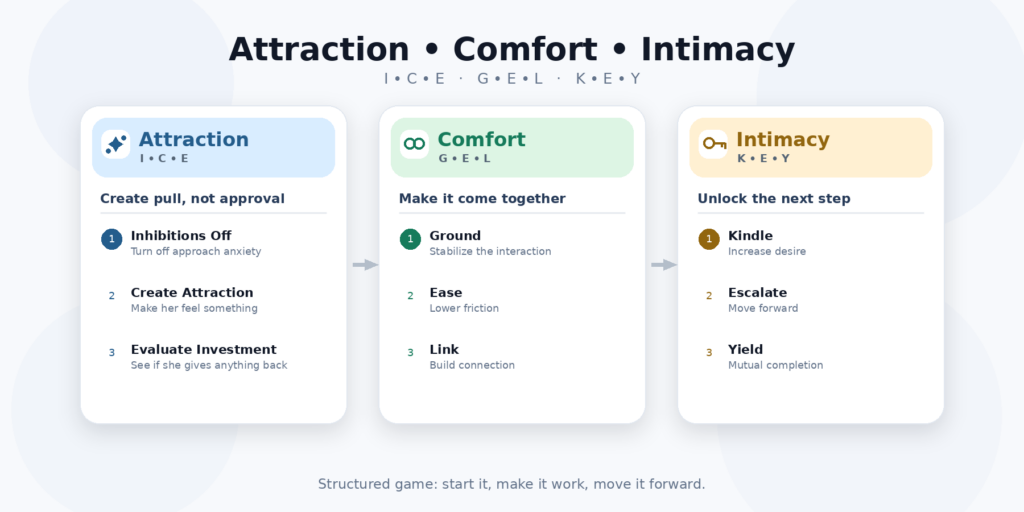
A Complete Map of STRUCTURED GAME

Structured Game has 3 Parts. This page covers Seduction / Intimacy, the final section where comfort becomes physical, mutual, embodied, and clearly chosen. This page maps the 18 Seduction modules across S1 AROUSE, S2 SAFETY, and S3 UNISON.

S1 — AROUSE

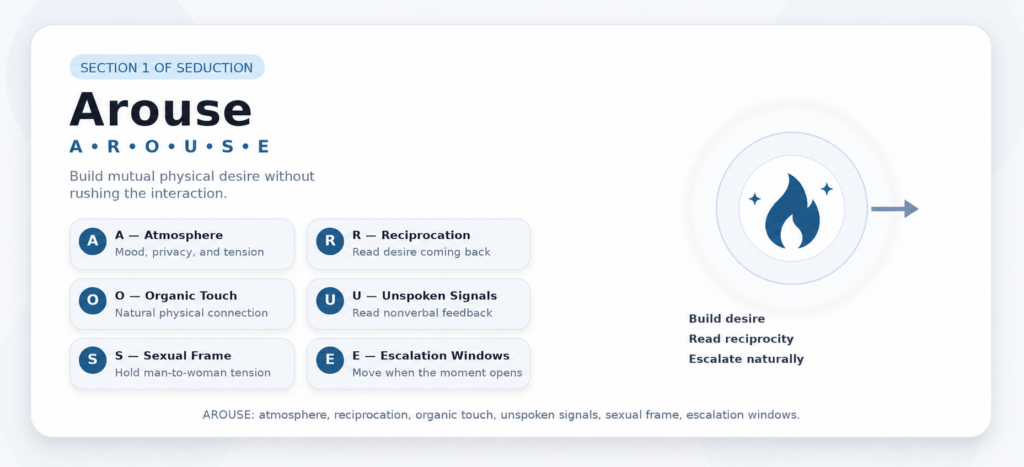
S1 — AROUSE overview

AROUSE stands for:

A — Atmosphere
R — Reciprocation
O — Organic Touch
U — Unspoken Signals
S — Sexual Frame
E — Escalation Windows

What “Atmosphere” actually means

Atmosphere means the setting, mood, privacy level, physical spacing, and emotional temperature are suitable for desire to start becoming real.

A lot of men try to escalate while the atmosphere is completely wrong. The room is too loud. The group is too exposed. Her friends are watching too closely. The lighting is harsh. The seating is awkward. The physical distance is too strange. The moment has no privacy, no calm, and no reason to become more intimate.

Then they blame the line, the girl, or the “technique.”

But the real problem was the container.

Attraction can happen in a chaotic room. Comfort needs a better pocket. Seduction needs a container where physical tension can rise without making her feel watched, judged, cornered, rushed, or unsafe.

The simplest way to understand it is this:

Bad atmosphere makes desire defend itself.
Good atmosphere lets desire breathe.

A woman should come away feeling:

this place makes sense for the moment
I do not feel hidden or trapped
I do not feel socially exposed
I can relax without feeling rushed
if things become more physical, it will not feel abrupt or weird

That is the goal of S1.1.

What good atmosphere includes

Good atmosphere includes:

enough privacy to reduce social pressure
enough visibility to preserve safety
enough quiet to hear each other
enough comfort that the body can relax
enough physical spacing that closeness can be chosen
enough continuity that the interaction does not keep resetting

enough reason for being there so the move does not feel suspicious

This is important: privacy and isolation are not the same thing.

Privacy means the interaction has space to breathe.
Isolation means she may feel cut off from options.

You want privacy without making her feel trapped.

What good atmosphere sounds like

“This place is too loud for the interesting part. Come over here.”

“We’re not doing the real version of this conversation in the doorway.”

“Sit here. I want to hear this properly.”

“This corner is less chaotic. I’m upgrading the conversation.”

“Stand on this side. You’re getting attacked by foot traffic.”

What atmosphere is not

Atmosphere is not dragging her somewhere private before she is ready.

It is not hiding her from her friends.

It is not using logistics to pressure her.

It is not choosing a place where she feels she cannot easily leave.

It is not trying to manufacture intimacy through isolation alone.

Bad atmosphere feels like:

“Why are we here?”

Good atmosphere feels like:

“This makes sense.”

The beginner mistake

The beginner usually makes atmosphere either too casual or too intense.

Too casual means he tries to create a seductive moment while everything around them is fighting the moment.

Too intense means he tries to move her too far, too privately, too soon.

Both fail.

The sweet spot is a small upgrade.

A better seat.
A quieter edge.
A side pocket.
A moment away from the group but still socially normal.
A position where she can hear you and still feel free.

Practical drill

In every venue, identify three intimacy-friendly pockets before you need them.

Ask:

Where could a conversation become more personal without looking weird?
Where could physical tension rise without making her feel watched?
Where can she still see her group, exit easily, and relax?

Beginner rule

Do not try to escalate in a setting that makes her nervous.

Fix the atmosphere first.

Bottom line

Atmosphere is the first seduction variable.

If the container is wrong, even good desire can become defensive.

Create the right pocket before you ask the moment to become more physical.

That is S1.1.
What “Reciprocation” actually means

Reciprocation means her desire is participating.

This is one of the most important seduction principles because seduction is not a one-man performance. It is not you doing things to her. It is not you pushing the interaction forward while she merely tolerates it.

The beginner question is usually:

“How do I escalate?”

The better question is:

“Is she escalating back?”

That one question changes everything.

Reciprocation means she is not just being polite. She is not just staying because the situation is socially awkward. She is not just laughing because she does not want to be rude. She is giving energy back.

She is helping the interaction become more charged.

The simplest way to understand it is this:

Passive tolerance is not desire.
Active participation is desire.

What reciprocation can look like

Reciprocation can show up through:

stronger eye contact
staying close
touching back
asking more personal questions
leaning in
teasing more physically
not breaking the moment
returning after pauses
following small leads
creating her own excuses for closeness
becoming quieter but more present
smiling in a way that holds tension

None of these alone means “do anything.”

They are signals that the current is alive.

What good reciprocation feels like

You move slightly closer and she does not stiffen.

You touch lightly and she touches back later.

You slow the conversation and she stays in the silence.

You make the vibe more charged and she helps carry it.

You create a small physical frame and she participates instead of merely accepting.

That is the difference.

A woman can smile and still not be ready.
A woman can be polite and still not be physically engaged.
A woman can stay in the conversation and still be uncertain.

So read what she is doing, not just what you want the moment to mean.

What good reciprocation language sounds like

“You keep acting innocent, but you’re not exactly helping your case.”

“You’re giving me mixed evidence. I’m going to need a better sample.”

“You’re leaning into this more than your words are admitting.”

“That look was not as neutral as you think it was.”

“Careful. Your face is disagreeing with your story.”

What reciprocation is not

Reciprocation is not you imagining she wants it because you want it.

It is not reading politeness as desire.

It is not treating nervous laughter as permission.

It is not assuming silence means yes.

It is not pushing harder because she has not stopped you.

The beginner mistake

A beginner often treats lack of rejection as green light.

That is not good enough.

The standard is not:

“She did not stop me.”

The standard is:

“She is clearly with me.”

That means words, body, and energy start lining up.

Practical drill

After every interaction, write down three things:

What did I do to move the interaction forward?
What did she do to move it forward?
Where did I confuse politeness with participation?

This trains you to stop projecting and start reading.

Beginner rule

Do not escalate based on hope.

Escalate based on reciprocation.

Bottom line

Reciprocation is the difference between performance and mutual desire.

If she is not participating, slow down.

If she is helping the moment, continue with awareness.

That is S1.2.

What “Organic Touch” actually means

Organic touch means physical contact enters the interaction in ways that fit the moment.

Touch should not feel like a random technique.

It should not feel like a sudden test.

It should not feel like a man trying to “get kino.”

It should feel like the body naturally joining a conversation that already has life in it.

The point is not touch itself.

The point is the meaning of the touch.

Good touch says:

“Physical closeness belongs in this interaction.”

Bad touch says:

“I am trying to take something.”

That difference is huge.

How organic touch begins

The best early touch often begins through normal social moments:

high fives
brief hand contact
guiding through a crowded space
a playful hand check
a shoulder tap during a joke
light elbow contact while moving
a hand read
dancing
sitting closer
comparing hands
brief contact during a callback

These moments work because they have a reason.

They do not appear out of nowhere.

They are attached to movement, humor, logistics, or a live thread in the interaction.

What early touch should be

Early touch should be:

brief
clean
easy to exit
socially normal
connected to the moment
released quickly

The release matters.

A beginner often touches and then holds too long because he is afraid the moment will disappear if he lets go.

That makes the touch feel sticky.

Good touch has release built into it.

Touch.
Let go.
Read.

If she re-enters, good.
If she stiffens, slow down.
If she seems unsure, reset to comfort.

The release tells you the truth.

What good organic touch sounds like

“Give me your hand. I’m checking if you’re actually as innocent as you claim.”

“Come here two seconds. I can’t hear your lies from over there.”

“High five. That answer barely saved you.”

“Stand on this side. You’re getting attacked by foot traffic.”

“Wait, show me that reaction again. That was too honest.”

What organic touch is not

Organic touch is not:

grabbing
hovering
lingering too long
touching to test power
touching when the vibe is not there
forcing physicality to create chemistry
using touch to override uncertainty

If the touch is the only thing creating tension, it is probably too early.

Touch should express chemistry that already exists.

It should not be used to manufacture chemistry through pressure.

The beginner mistake

The beginner either avoids touch forever or jumps into it awkwardly.

Avoiding touch forever makes the interaction too verbal and friendly.

Jumping into touch too fast makes the interaction feel invasive.

The sweet spot is clean, moment-based physicality.

Physicality enters, creates information, then releases.

Practical drill

Practice three kinds of clean touch:

movement touch: guiding through space for a real reason
playful touch: high five, hand check, or brief reaction touch
callback touch: a brief physical beat tied to an earlier joke or read

After each touch, release and watch.

Beginner rule

Touch should feel like the body joining the conversation.

Not like the conversation being interrupted by your agenda.

Bottom line

Organic touch is not about grabbing momentum.

It is about letting physicality enter naturally, briefly, and cleanly so the interaction can tell you whether the body is ready to join the vibe.

That is S1.3.

What “Unspoken Signals” actually means

Unspoken signals are the nonverbal signs that tell you whether physical desire is rising, neutral, mixed, or dropping.

A man who cannot read nonverbal feedback is dangerous to his own results.

He either misses opportunities because he is too cautious, or he pushes through discomfort because he is too self-absorbed.

Both are bad.

Seduction requires reading the room, the body, the face, the rhythm, and the energy.

Words matter, but bodies speak first.

What to read

Unspoken signals include:

eye contact
breathing
body angle
distance
leaning in or away
tone softening
touching back
whether she stays after release
whether she reopens the thread
whether she becomes more physically present
whether she seems relaxed or guarded
whether her body matches her words

The key is not one signal.

The key is pattern.

One smile means little.
A pattern of staying close, touching back, holding eye contact, and re-entering after release means much more.

Green signals

Green signals usually look like:

she moves closer
she stays close
she touches back
she smiles and holds eye contact
she follows small leads
she re-enters after release
she seems relaxed in the slower moments
she keeps the interaction private even in public
she lets tension exist without breaking it

Green does not mean “do anything.”

Green means:

“The current is alive. Continue carefully.”

Yellow signals

Yellow signals usually look like:

mixed eye contact
nervous laughter
hesitation
stiffness
half-compliance
changing topic
looking toward friends
giving verbal warmth but physical distance
seeming interested but not relaxed

Yellow means:

“Slow down. Clarify. Rebuild comfort.”

Do not treat yellow like green.

That is where beginners create problems.

Red signals

Red signals include:

pulling away
freezing
saying no
avoiding touch
looking uncomfortable
trying to leave
going quiet in a closed way
moving your hand away
creating distance repeatedly
showing fear, disgust, or shutdown

Red means:

“Stop that lane immediately.”

Do not argue with red.
Do not analyze red.
Do not try to charm red into green.

Stop, release pressure, and return to safety or exit cleanly.

What good signal-reading sounds like

“We can slow down.”

“Relax, no rush.”

“You got quiet. I’m not trying to make this weird.”

“We don’t have to move fast.”

“Stay honest with me. I like clear energy.”

“If you’re unsure, we slow down.”

The beginner mistake

A beginner reads the signal that supports his desire and ignores the signal that challenges it.

She smiles but leans away.
He notices the smile.

She says yes but her body tightens.
He notices the word.

She stays in the room but stops participating.
He notices that she stayed.

That is not calibration.

Calibration means reading the whole pattern, especially the signals that are inconvenient to your ego.

Practical drill

After each interaction, write down:

One green signal I saw
One yellow or red signal I may have ignored
One moment where her body gave more information than her words

This builds real-world reading.

Beginner rule

Green means continue with awareness.

Yellow means slow down.

Red means stop.

Bottom line

Unspoken signals protect the interaction.

They tell you when desire is rising, when comfort needs rebuilding, and when a lane must end.

A man who can read signals becomes safer, smoother, and more effective.

That is S1.4.

What “Sexual Frame” actually means

Sexual frame means the interaction is no longer pretending to be neutral.

This does not mean explicit sexual talk.

It does not mean dirty jokes.

It does not mean becoming vulgar, aggressive, or weird.

It means the energy now has adult charge.

The interaction is not just friendly.
It is not just personal.
It is not just comfortable.

There is man-woman tension in it.

The simplest way to understand it is this:

Comfort says, “I can relax with him.”
Sexual frame says, “I can feel desire with him.”

A woman should come away feeling:

he is not afraid of desire
he is not rushing me
he is not hiding behind friendship
he is not being crude
this has charge without pressure

That is the goal of S1.5.

Why sexual frame matters

A lot of men build comfort and then accidentally become a friend.

They ask personal questions.
They listen well.
They validate.
They create safety.

But they never let desire enter.

The interaction becomes emotionally nice but physically dead.

Other men do the opposite.

They try to sexualize too suddenly, too directly, or too crudely.

That makes the interaction feel cheap and unsafe.

The sweet spot is this:

Let desire be present without making it vulgar, needy, or forced.

How sexual frame shows up

Sexual frame can come through:

tone
eye contact
slower pacing
selective directness
charged teasing
physical closeness
light innuendo
holding silence
not over-explaining attraction
letting tension breathe

It is often more about how you say something than what you say.

What good sexual frame sounds like

“You’re not as innocent as you look.”

“That look was dangerous.”

“Careful. You’re becoming less believable.”

“You’re trouble, but the interesting kind.”

“I like your energy. It is not as harmless as you pretend.”

“We should not be trusted with this much eye contact.”

Notice the pattern.

These lines are not explicit.
They are not crude.
They are not asking for sex.

But they allow desire to exist.

What kills sexual frame

Sexual frame dies when you:

act like a platonic interviewer
avoid all tension
over-apologize for desire
compliment too safely
make everything emotional but never physical
treat her like a delicate object
become crude too early
make sexual jokes with no calibration
try to sound dominant instead of being grounded

The beginner mistake

A beginner often thinks the choice is between “nice guy” and “dirty guy.”

Wrong.

The real choice is between neutral and charged.

You can be warm and charged.
You can be respectful and charged.
You can be calm and charged.
You can be clean and charged.

That is the skill.

Practical drill

Take five neutral lines and add light charge without becoming explicit.

Neutral:
“You’re funny.”

Charged:
“You’re funnier than your innocent face suggested.”

Neutral:
“You seem confident.”

Charged:
“You seem confident in a way that probably causes problems.”

Neutral:
“I like your energy.”

Charged:
“I like your energy. It is not fully safe.”

Beginner rule

Do not sexualize from nowhere.

Let comfort become charged.

Bottom line

Sexual frame keeps comfort from becoming friendship.

It lets desire enter without making the woman feel rushed, cheapened, or pressured.

That is S1.5.

What “Escalation Windows” actually means

An escalation window is a moment where the interaction naturally allows a step forward.

This can be a step toward closer proximity, a more private conversation, a stronger physical beat, a kiss, a move to another spot, or a more honest man-woman moment.

The beginner escalates based on impatience.

The better man escalates based on timing.

Timing matters because the same move can feel good or bad depending on the window.

A kiss can feel natural in one moment and awkward ten seconds later.
A move can feel smooth when the thread is alive and strange when the vibe has already dropped.
A touch can feel welcome when reciprocation is active and invasive when she is distracted.

The simplest way to understand it is this:

Do not escalate to create the window.

Escalate when the window is already open.

What creates an escalation window

A window appears when:

comfort is present
reciprocation is active
the atmosphere supports it
the physical frame is already warm
there is a pause that can hold tension
she is not distracted
the move has a reason
the moment feels more natural continuing physically than staying purely verbal

The best escalation does not feel like a sudden jump.

It feels like the obvious next beat.

What good timing looks like

You do not escalate in panic.

You do not escalate because the set is dying.

You do not escalate because you want proof.

You escalate when the interaction has already created the next step.

Good timing feels like:

“This is where the moment wants to go.”

Bad timing feels like:

“I am trying to force the moment to become something.”

What good escalation window language sounds like

“Come here.”

“You’re making this difficult in a good way.”

“I want the real version of this conversation.”

“You’re too close to keep pretending you’re neutral.”

“We should not be trusted with this much eye contact.”

“Okay, we need a better place for this conversation.”

What ruins escalation windows

Men ruin windows by:

talking through them
joking away every silence
waiting too long
moving too fast
asking for reassurance too much
getting visibly nervous
escalating when she is distracted
trying to escalate after the vibe already dropped
turning every physical moment into a big event

The most common beginner problem

He talks through the window.

The moment gets quiet.
The eye contact holds.
There is physical closeness.
The vibe is alive.

And he panics.

So he says another joke.
Then another question.
Then another explanation.

The window closes.

Do not talk because you are afraid of the moment.

Let the moment exist long enough to reveal what it wants.

Practical drill

After an interaction, identify one window you used or missed.

Ask:

What created the window?
What did I do when it appeared?
Did I move, talk through it, or freeze?
Did she help the moment or pull away?

This trains timing.

Beginner rule

Move when the moment naturally opens.

Do not force the opening.

Bottom line

Escalation windows are about timing, not courage alone.

A man who can recognize the window does not need to rush.

He simply moves when the interaction is already asking to move.

That is S1.6.

S2 — SAFETY

S2 — SAFETY overview

SAFETY stands for:

S — Slow Down
A — Acknowledge
F — Freedom
E — Emotional Check
T — Tempo Reset
Y — Yes-Only Continuation

What “Slow Down” actually means

Slow Down means the moment hesitation appears, you reduce speed before you increase pressure.

This is the opposite of what many men do.

A beginner feels hesitation and immediately tries to fix it by pushing forward.

He explains.
Persuades.
Touches more.
Talks faster.
Acts wounded.
Acts confused.
Tries to recover the previous intensity.

That creates pressure.

Slow Down means you do not chase the moment.

You let the moment breathe.

You lower the intensity enough that she can locate herself again.

The simplest way to understand it is this:

When uncertainty appears, pressure is not leadership.

Calm is leadership.

Why this matters

A woman who feels rushed often cannot tell whether she wants to continue or whether she just wants the pressure to stop.

Those are not the same thing.

Slowing down gives her space to choose.

It also gives you better information.

If she re-enters after you slow down, that means something.
If she relaxes after you slow down, that means something.
If she uses the space to create more distance, that also means something.

Slowing down does not kill seduction.

It reveals the truth of the moment.

What slowing down looks like

You pause.

You release touch.

You soften intensity.

You stop escalating.

You stop trying to convince.

You return to grounded presence.

You let the nervous system settle.

You do not make hesitation a disaster.

What good slowing down sounds like

“No rush.”

“We can slow down.”

“Relax. I’m not trying to pressure you.”

“It’s fine. We don’t need to move fast.”

“Stay with me. We can just chill for a second.”

“If you’re unsure, we slow down.”

What slowing down is not

Slowing down is not giving up.

It is not apologizing for normal desire.

It is not becoming weak.

It is not acting ashamed.

It is not sulking.

It is not emotionally collapsing because she paused.

A strong man can slow down without losing himself.

The beginner mistake

A beginner thinks hesitation means he is losing.

So he tries to win the moment back.

That is the wrong frame.

Hesitation is information.

Treat it as information.

Do not fight it like an enemy.

Practical drill

Practice three pressure-reduction responses:

“No rush.”
“We can slow down.”
“You’re allowed to be unsure.”

Say them with calm, not apology.

The goal is to be able to reduce pressure without dropping frame.

Beginner rule

When hesitation appears, reduce pressure first.

Do not argue with the body.

Bottom line

Slow Down is the first safety move.

It prevents you from turning uncertainty into pressure and gives the interaction a chance to become clear again.

That is S2.1.

What “Acknowledge” actually means

Acknowledge means you recognize what is happening instead of pretending it is not happening.

A lot of men ignore hesitation because they are afraid that naming it will kill the vibe.

But often the opposite is true.

When a woman feels hesitation and the man pretends not to notice, her nervous system often becomes more guarded.

She feels:

“He is not reading me.”

That is bad.

Acknowledgment shows awareness.

It tells her:

“I see you. I am not just chasing my own desire.”

That can make the moment safer and more attractive at the same time.

What good acknowledgment sounds like

“You got a little in your head.”

“That felt fast for a second.”

“You’re thinking.”

“Something shifted.”

“I can feel you slowing down.”

“You don’t have to pretend you’re not hesitating.”

“Your body got quieter than your words.”

Why this works

Good acknowledgment does not accuse.

It does not dramatize.

It does not make her explain everything immediately.

It simply names the reality lightly enough that honesty becomes available.

A man who can acknowledge hesitation without becoming needy or defensive feels more grounded than a man who tries to bulldoze through it.

What acknowledgment is not

Acknowledgment is not:

interrogating
guilt-tripping
demanding an explanation
saying “what’s wrong with you?”
making her comfort about your ego
turning hesitation into a debate
trying to get her to justify herself

Bad:

“Why are you being weird?”

Better:

“You got a little in your head. We can slow down.”

Bad:

“What changed? I thought you liked me.”

Better:

“Something shifted. No pressure.”

The beginner mistake

A beginner often takes her hesitation personally.

He hears:

“She is rejecting me.”

So he either attacks, collapses, or over-explains.

A more grounded man hears:

“The moment changed. Let me read it.”

That keeps him present.

Practical drill

Write five neutral acknowledgment lines that do not blame her.

Examples:

“You got thoughtful.”
“That pace changed.”
“You went quiet for a second.”
“You’re deciding something.”
“We can slow down.”

Practice saying them calmly.

They should sound like awareness, not complaint.

Beginner rule

Name the shift without making her wrong for it.

Bottom line

Acknowledgment keeps the interaction honest.

It shows you are reading the person in front of you, not just pushing through your script.

That is S2.2.

What “Freedom” actually means

Freedom means she feels free to stop, slow down, pause, leave, change her mind, or say no without being punished.

This is the core of S2.

A woman cannot truly say yes if she does not feel safe saying no.

A lot of men hate this because they think freedom weakens their frame.

It does not.

Freedom strengthens your frame because it proves you are not dependent on coercion.

Weak men need pressure.

Stronger men can handle choice.

Freedom says:

“I want you willing, not cornered.”

That is a much more powerful masculine frame than trying to trap the moment.

What freedom looks like

You do not block exits.

You do not punish hesitation.

You do not guilt-trip.

You do not act offended.

You do not make her responsible for your ego.

You do not treat a pause like betrayal.

You do not keep touching after she clearly pulls back.

You let her slow down and still remain warm.

What good freedom language sounds like

“No pressure.”

“We don’t have to do anything.”

“You’re allowed to slow down.”

“I like clear yes energy.”

“I don’t want you doing anything just because the moment is moving.”

“Relax. You’re not trapped in some dramatic decision.”

“If you’re unsure, we slow down. Simple.”

Why freedom increases desire

Pressure makes desire defensive.

Freedom lets desire breathe.

When she feels free, any movement toward you becomes more real.

If she comes closer after freedom, that means something.

If she re-enters after you release pressure, that means something.

If she chooses the moment when she did not have to, that is actual buy-in.

The beginner mistake

A beginner thinks:

“If I give her freedom, I lose the moment.”

Wrong.

If the only thing keeping the moment alive is pressure, the moment is not alive.

Freedom does not destroy real desire.

It exposes whether desire is real.

What freedom is not

Freedom is not disengaging coldly.

It is not pretending you do not care.

It is not acting morally superior.

It is not turning the interaction sterile.

You can keep warmth, attraction, and sexual frame while making freedom available.

That is the skill.

Practical drill

Practice releasing pressure without changing personality.

Example:

“No pressure. I like willing participants.”

Say it warmly.
Say it with a small smile.
Say it without collapse.

Beginner rule

Freedom is not the enemy of seduction.

Freedom is what makes seduction real.

Bottom line

Freedom makes her choice meaningful.

If she is free to leave and still chooses to stay, that is much stronger than forced compliance.

That is S2.3.

What “Emotional Check” actually means

Emotional Check means you verify the emotional reality of the moment.

Not just verbally.
Not just logically.
Not just physically.

Emotionally.

A woman may be physically present but emotionally uncertain.

She may be attracted but conflicted.

She may like you but not like the pace.

She may want closeness but not want the next step.

If you only read the surface, you will miss the truth.

An emotional check asks:

“Where are you really?”

Sometimes this can be spoken.
Sometimes it is read through her body.
Sometimes it is a pause.
Sometimes it is a simple question.

The point is to stop treating arousal like the only signal that matters.

Read readiness too.

What good emotional checks sound like

“Are you comfortable?”

“Is this pace good?”

“You with me?”

“Do you want to slow down?”

“What are you thinking?”

“Be honest — good nervous or bad nervous?”

“Does this feel good, or too fast?”

How to read the answer

A good answer feels clear.

Not necessarily loud.

But clear.

If she says yes but her body says no, believe the body enough to slow down.

If she says “I don’t know,” slow down.

If she says “maybe,” slow down.

If she avoids answering, slow down.

If she clearly says yes, remains relaxed, and keeps moving with you, then you have better information.

What emotional check is not

It is not asking for constant permission in a nervous way.

It is not making her manage your anxiety.

It is not killing the vibe with repeated insecurity.

It is not saying:

“Are you sure? Are you sure? Are you sure?”

That becomes weak.

Good emotional checking is calm, direct, and grounded.

Why this matters

Arousal can rise faster than readiness.

That is why this module exists.

A woman can be turned on and still not emotionally ready for the next step.

If you ignore readiness, you create regret, resistance, shutdown, or mistrust.

If you read readiness well, you become the man who can handle desire without becoming reckless.

The beginner mistake

A beginner sees physical signs and assumes the whole person is ready.

That is too shallow.

The body, emotions, logistics, safety, and social context all matter.

Seduction is not just chemistry.

It is chemistry plus readiness.

Practical drill

Practice three simple emotional checks:

“Is this pace good?”
“You with me?”
“Good nervous or bad nervous?”

The tone should be calm, not insecure.

Beginner rule

Do not just read arousal.

Read readiness.

Bottom line

Emotional Check protects the quality of the moment.

It lets desire become clear instead of rushed.

That is S2.4.

What “Tempo Reset” actually means

Tempo Reset means if the pace gets ahead of readiness, you shift back to a safer rhythm without killing the connection.

This is a big skill.

A lot of men only know two modes:

escalate or stop.

But there is a third mode:

reset.

A reset means:

“We can return to comfort without making the moment awkward.”

This protects the entire interaction.

If you escalate, hit hesitation, and then become weird, you may damage everything.

If you escalate, hit hesitation, reset smoothly, and stay warm, you often preserve the connection.

Sometimes desire comes back stronger after a good reset because she now trusts your restraint.

What tempo reset looks like

You release touch.

You shift the topic lightly.

You sit back.

You make a joke.

You return to comfort.

You include warmth.

You stop making the next step the focus.

You show her nothing bad happens when she slows down.

What good tempo reset sounds like

“Okay, we’ll behave for thirty seconds.”

“Come here, let’s just sit.”

“You got too serious. I’m resetting you.”

“We’re not rushing. Tell me the part you skipped earlier.”

“Fine, I’ll pretend to be responsible for a minute.”

“Let’s go back to the story before your brain started doing legal paperwork.”

Why this works

Tempo reset removes the emergency.

It tells her:

“This does not have to escalate right now for the connection to remain good.”

That is important.

A man who cannot reset feels needy.

A man who can reset feels safe and steady.

What ruins tempo reset

Men ruin it by:

pouting
withdrawing coldly
acting rejected
over-apologizing
trying again immediately
becoming fake polite
turning the whole mood heavy
pretending they do not care when they clearly do

Reset should feel smooth.

Not wounded.
Not dramatic.
Not punitive.

The beginner mistake

The beginner takes a slowdown as failure.

So the vibe collapses.

A better man treats slowdown as part of the rhythm.

Not every moment has to intensify.

Sometimes the move is:

charge → pause → comfort → charge again

That rhythm feels much more natural than constant pressure.

Practical drill

Write five reset lines that match your voice.

Examples:

“We’re behaving for one minute.”
“Back to the story.”
“I’m resetting the room before you become dangerous.”
“We can slow it down.”
“Good. Now breathe.”

Beginner rule

When the pace gets ahead of comfort, reset the tempo.

Do not make hesitation the end of the vibe.

Bottom line

Tempo Reset is how you preserve attraction when the pace got ahead of readiness.

It keeps the connection alive by making slowing down feel normal.

That is S2.5.

What “Yes-Only Continuation” actually means

Yes-Only Continuation means the interaction only moves forward when there is clear willingness.

Not pressure.

Not persuasion.

Not ambiguity.

Not “she did not stop me.”

Clear willingness.

This is not just moral.

It is also practical.

The best intimacy happens when both people are actively there.

Not when one person is pushing and the other is managing discomfort.

A man who teaches himself to continue only on clear willingness becomes cleaner, more confident, and more trustworthy.

His energy changes because he is no longer trying to sneak past uncertainty.

He is looking for real participation.

What clear willingness can look like

Clear willingness can look like:

she says yes clearly
she moves closer
she touches back
she re-enters after release
she asks to continue
she helps the moment
she stays relaxed
she shows active desire, not passive tolerance
her words and body match

The key is the match.

Words, body, and energy should not be telling three different stories.

What is not clear willingness

These are not clear willingness:

uncertainty
silence
freezing
nervous compliance
pulling away
avoiding eye contact in a closed way
saying “I don’t know”
saying “maybe”
saying yes while looking uncomfortable
going along because she feels pressure

If you are unsure, slow down.

That is the rule.

What good yes-only language sounds like

“I like clear yeses.”

“We only move if you actually want to.”

“I’m not interested in convincing you.”

“I want you here because you want to be here.”

“If you’re unsure, we slow down.”

“Clear is better than pressured.”

Why this is powerful

A lot of men think this kills the vibe.

It does the opposite when delivered correctly.

It makes the vibe cleaner.

It removes the hidden fight.

It lets her desire become active instead of defensive.

The man becomes more attractive because he is not afraid of a real answer.

The beginner mistake

A beginner continues because he has momentum.

A better man continues because both people have willingness.

Momentum is not enough.

Arousal is not enough.

Opportunity is not enough.

The standard is clear mutual participation.

Practical drill

Before any bigger escalation, ask internally:

Is this clear?
Is she helping this moment?
Would she feel safe slowing this down?
Are her words and body aligned?

If the answer is not clear, do not continue that lane.

Beginner rule

Do not continue because she has not stopped you.

Continue because she is clearly with you.

Bottom line

Yes-Only Continuation is the final standard of S2.

It turns seduction from pressure into mutual choice.

That is S2.6.

S3 — UNISON

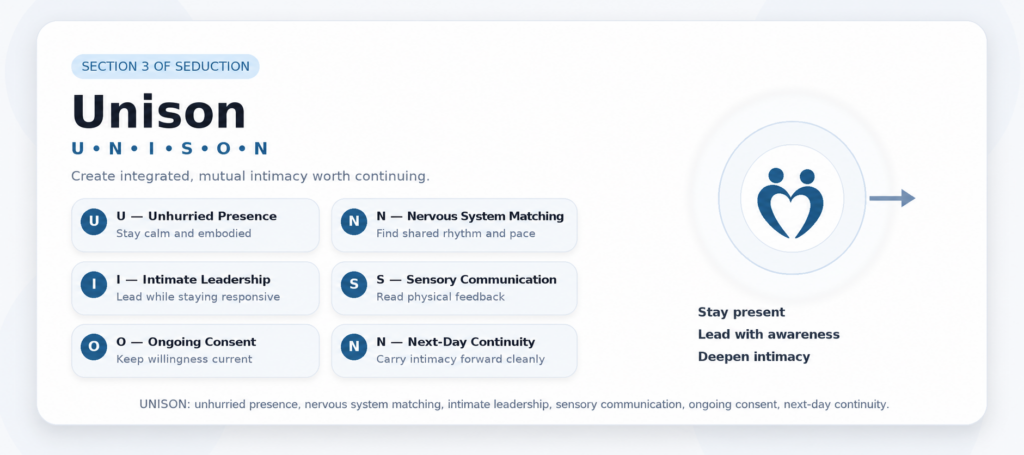
S3 — UNISON overview

UNISON stands for:

U — Unhurried Presence
N — Nervous System Matching
I — Intimate Leadership
S — Sensory Communication
O — Ongoing Consent
N — Next-Day Continuity

What “Unhurried Presence” actually means

Unhurried Presence means you do not enter intimacy with frantic energy.

This matters because a lot of men become visibly outcome-driven once intimacy becomes real.

Their breathing changes.
Their mind races.
Their touch gets urgent.
Their attention narrows.
They stop reading.
They start performing.

That kills the quality of the moment.

Unhurried presence says:

“I am here. I am not rushing. I can handle this.”

This is one of the strongest masculine signals in physical intimacy.

Not slowness for the sake of slowness.

Not passivity.

Presence.

What unhurried presence looks like

You breathe.

You slow down enough to feel.

You do not rush through stages.

You do not treat intimacy like a checklist.

You do not race to the next thing.

You remain aware of her.

You remain aware of yourself.

You let the moment deepen instead of only accelerate.

What good unhurried presence sounds like

“No rush.”

“Stay here.”

“I like this pace.”

“We don’t need to hurry.”

“You’re good. Just relax.”

“Slow is better right now.”

Why this matters

Speed is often anxiety disguised as passion.

A man can be passionate without being frantic.

Unhurried presence makes the experience feel safer, more sensual, and more real.

It also makes you better at reading because you are not rushing past the feedback.

A rushed man misses signals.

A present man catches them.

What kills unhurried presence

Unhurried presence dies when you:

think too much
try to impress
rush because you fear losing the moment
go mechanical
get goal-obsessed
use every pause as a reason to panic
mistake urgency for masculinity

The beginner mistake

A beginner treats intimacy like proof.

Proof that he is desired.
Proof that he is masculine.
Proof that the night worked.
Proof that he is enough.

That pressure makes him rush.

A mature man does not need intimacy to validate his identity.

He can actually be inside the experience.

Practical drill

Practice slowing your speech, breath, and movement in charged moments.

Before moving forward, ask:

Am I rushing because the moment wants it, or because my anxiety wants proof?

If it is anxiety, slow down.

Beginner rule

Do not rush because you are excited.

Stay present because you are capable.

Bottom line

Unhurried Presence is the first part of real intimacy.

It turns physical escalation from performance into shared experience.

That is S3.1.

What “Nervous System Matching” actually means

Nervous System Matching means you pay attention to pace, tension, relaxation, breath, and emotional state.

This is deeper than technique.

A woman’s body may be telling you:

slower
closer
pause
continue
soften
change
stay
too much
not yet
more

If you are stuck in your head, you miss that.

Nervous system matching means you are not forcing your rhythm onto her.

You are finding the rhythm that both bodies can enter.

This is one of the biggest differences between a man who is physically present and a man who is just acting out desire.

What matching looks like

You notice if she relaxes or tenses.

You notice if breathing deepens or tightens.

You notice if she moves toward you or away.

You notice if she becomes more present or more absent.

You notice if her words and body match.

You do not demand that her body keep up with your desire.

You adjust without becoming weak.

What good matching sounds like

“This pace is better.”

“You relaxed there.”

“We can stay here.”

“That was too fast. We’ll slow it down.”

“You’re in your head again. Come back.”

“Right there. That pace works.”

Why this matters

A lot of men think physical intimacy is about moves.

But moves without rhythm feel mechanical.

Rhythm is what makes the experience feel shared.

If your nervous system is rushing and hers is guarding, you are not in unison.

If your rhythm is calm enough for her body to relax into it, intimacy becomes much better.

What matching is not

Matching is not becoming passive.

It is not asking her to lead everything.

It is not losing your own desire.

It is not becoming clinical.

It is not making intimacy feel like a medical check-in.

You can be masculine and responsive at the same time.

In fact, that is the point.

The beginner mistake

A beginner thinks responsiveness means weakness.

Wrong.

Responsiveness is control of yourself plus awareness of her.

The weak man either forces or freezes.

The stronger man leads while adjusting.

Practical drill

Train yourself to read three simple things:

breath
tension
movement toward or away

If all three move toward relaxation, continue.
If any of them tighten sharply, slow down.

Beginner rule

Do not impose rhythm.

Find rhythm.

Bottom line

Nervous System Matching is how intimacy becomes shared instead of one-sided.

It is the skill of leading while listening to the body in real time.

That is S3.2.

What “Intimate Leadership” actually means

Intimate Leadership means you can guide the experience without making it about control.

This is a delicate but important distinction.

Leadership in intimacy is not domination by default.

It is not bossing.

It is not forcing.

It is not acting out a porn script.

It is the ability to create direction while staying responsive.

A lot of women do not want a man who asks nervously about every micro-step because he is afraid to lead.

They also do not want a man who ignores feedback and just does whatever he wants.

The sweet spot is:

Lead clearly. Read constantly. Adjust cleanly.

What intimate leadership looks like

You choose pace.

You create calm.

You initiate cleanly.

You guide without force.

You notice feedback.

You can pause without insecurity.

You can say what you want without pressure.

You can redirect without making it weird.

You can hold the emotional frame.

What good intimate leadership sounds like

“Come here.”

“Slow down.”

“Stay with me.”

“I like when you’re honest.”

“We’re not rushing.”

“Tell me if you want slower.”

“This pace is better.”

What intimate leadership is not

It is not:

ordering without consent
trying to overpower hesitation
treating her body like an object
copying porn behavior
being rough without agreement
acting like dominance means ignoring her
needing to prove you are in charge

Real leadership creates more safety and more desire.

Fake leadership creates pressure.

Why this matters

Intimacy needs direction.

But direction without responsiveness becomes control.

Responsiveness without direction becomes passivity.

Intimate Leadership is the integration of both.

The beginner mistake

A beginner either asks for permission so nervously that the vibe collapses, or he avoids asking entirely and tries to push through ambiguity.

Both are weak.

A better man can be direct and clean.

He can lead.
He can check.
He can adjust.
He can stop.

That is real confidence.

Practical drill

Practice simple leadership language:

“Come here.”
“Slow down.”
“Stay with me.”
“Tell me if this is too fast.”
“We can stop.”

Say these without anxiety.

They should feel grounded, not desperate.

Beginner rule

Lead the experience.

Do not dominate the person.

Bottom line

Intimate Leadership is the ability to guide intimacy without force.

It is direction plus awareness.

That is S3.3.

What “Sensory Communication” actually means

Sensory Communication means intimacy is guided by physical feedback, not just talking or guessing.

This includes:

breath
sound
movement
relaxation
tension
eye contact
touching back
stillness
pulling closer
pulling away
verbal feedback
micro-reactions

This is where many men fail because they think intimacy is something they do, not something they communicate through.

Sensory communication means every part of the interaction is giving information.

A good man listens with more than his ears.

What sensory communication looks like

You notice what creates relaxation.

You notice what creates tension.

You notice what she repeats.

You notice what she avoids.

You notice what makes her more present.

You notice what makes her leave the moment.

You change based on feedback.

You do not need everything explained verbally, but you also do not avoid verbal clarity when needed.

What good sensory communication sounds like

“Like that?”

“Slower?”

“Good?”

“Stay honest.”

“Tell me.”

“That worked.”

“Right there?”

These are short.

Grounded.

Not needy.

Not clinical.

Why this matters

Technique without feedback is blind.

A man who only acts from memory treats each woman like a template.

That makes intimacy generic.

Sensory communication makes it specific.

It lets you respond to the person in front of you.

What sensory communication is not

It is not:

guessing blindly
performing from memory
copying generic technique
asking constant anxious questions
ignoring obvious discomfort
assuming what worked before works now
treating all women the same

The beginner mistake

The beginner wants a script because scripts feel safe.

But intimacy is live.

A script cannot read breath.
A script cannot feel tension.
A script cannot notice when a pause is good or when a pause means stop.

Presence reads that.

Practical drill

Pick one channel to track at a time:

breath
movement
tension
sound

Do not overthink all of them at once.

Start with one, then build awareness.

Beginner rule

The body is communicating.

Listen.

Bottom line

Sensory Communication turns intimacy from performance into feedback.

It lets the experience be guided by what is actually happening, not what you assumed should happen.

That is S3.4.

What “Ongoing Consent” actually means

Ongoing Consent means willingness is not checked once and then forgotten.

Consent continues.

This is especially important in intimacy because desire can change.

Pace can become too fast.

A moment can become emotionally loaded.

Something can feel good at first and then not.

Something can feel okay verbally but not physically.

Ongoing consent means:

“We keep choosing this as it unfolds.”

This does not have to be awkward.

It does not need to kill the vibe.

When done well, consent can actually make the experience hotter because it makes both people feel safer and more present.

What ongoing consent looks like

You keep reading.

You check when something changes.

You stop if she says stop.

You slow down if she hesitates.

You do not punish a boundary.

You do not argue with discomfort.

You do not treat earlier willingness as a permanent contract.

You keep the experience mutual.

What good ongoing consent sounds like

“Is this good?”

“Do you want to keep going?”

“Tell me if you want to slow down.”

“We can stop.”

“I like clear yes.”

“You’re allowed to change your mind.”

“Stay honest with me.”

What ongoing consent is not

It is not nervous permission-seeking every two seconds.

It is not making her feel like she must manage your fear.

It is not killing the mood with formality.

It is not making consent sound like a legal form.

Good ongoing consent is confident and simple.

Why this matters

Consent is not a box you check at the beginning.

It is the current running through the interaction.

When the current is clear, intimacy can deepen.

When the current becomes unclear, slow down.

When the current stops, stop.

The beginner mistake

A beginner thinks earlier willingness means he can stop reading.

Wrong.

The more intimate the moment becomes, the more important reading becomes.

Earlier yes does not erase later no.
Earlier desire does not erase later hesitation.
Earlier comfort does not erase later discomfort.

The standard remains mutual willingness.

Practical drill

Practice short, confident consent language:

“Good?”
“Slower?”
“Keep going?”
“We can stop.”
“Clear yes only.”

These should feel simple, not dramatic.

Beginner rule

Consent is not a checkpoint.

It is the current.

Bottom line

Ongoing Consent keeps intimacy mutual as it unfolds.

It protects the connection and makes desire cleaner, safer, and more real.

That is S3.5.

What “Next-Day Continuity” actually means

Next-Day Continuity means intimacy does not end with the physical act.

How you behave afterward determines what the experience means.

A lot of men destroy their own frame after intimacy.

They become cold.

Or needy.

Or weird.

Or over-attached.

Or they disappear because they think it makes them powerful.

Or they text like a completely different person.

This breaks trust.

S3 is not just the act itself.

It is how the act is integrated afterward.

Next-Day Continuity says:

“The man you were intimate with is still the same man afterward.”

That matters.

What good continuity looks like

You stay warm.

You do not overpromise.

You do not vanish to look powerful.

You do not become clingy.

You do not act ashamed.

You do not make her feel used.

You keep your frame.

You follow up in a way that matches the connection.

You remain clean.

What good next-day language sounds like

“I liked being with you.”

“You were fun last night.”

“I’m glad we didn’t rush the earlier part.”

“You have dangerous calm energy. I’m still diagnosing it.”

“I liked your softness more than you probably expected.”

“Still deciding whether you are safe for civilization.”

What continuity is not

It is not:

love-bombing
fake boyfriend behavior
cold withdrawal
pretending it meant nothing if it did
promising commitment you do not mean
using silence to create insecurity
texting nonstop because you need reassurance

Why this matters

A woman remembers how she felt after.

Not just during.

If you are warm during intimacy and cold after, the whole experience can be reinterpreted negatively.

If you are intense during intimacy and clingy after, the experience can feel emotionally unsafe.

If you are steady before, during, and after, trust deepens.

That is masculine continuity.

The beginner mistake

The beginner either disappears to look powerful or over-texts to secure the bond.

Both are insecure.

A grounded man does neither.

He does not need to punish her with distance.

He does not need to beg for reassurance.

He stays congruent.

Practical drill

Create three follow-up styles:

warm and light
threaded callback
specific next-step if appropriate

Examples:

“Your calm personality is still under investigation.”

“You still owe me the uncensored version of that story.”

“Thursday works. I’ll pick the place.”

Beginner rule

Do not become a different man after intimacy.

That is where trust either deepens or breaks.

Bottom line

Next-Day Continuity completes S3.

Intimacy should not create a split between who you were before and who you become after.

Be consistent.
Be warm.
Be clean.

That is S3.6.

Seduction / Intimacy Module Map

S1 — AROUSE: Atmosphere, Reciprocation, Organic Touch, Unspoken Signals, Sexual Frame, Escalation Windows

S2 — SAFETY: Slow Down, Acknowledge, Freedom, Emotional Check, Tempo Reset, Yes-Only Continuation

S3 — UNISON: Unhurried Presence, Nervous System Matching, Intimate Leadership, Sensory Communication, Ongoing Consent, Next-Day Continuity

Seduction is the bridge where comfort becomes embodied, physical, mutual, and clearly chosen. Do not force the moment. Arouse it, make it safe, and bring it into unison so intimacy feels shared instead of performed.