What “Setting” actually means
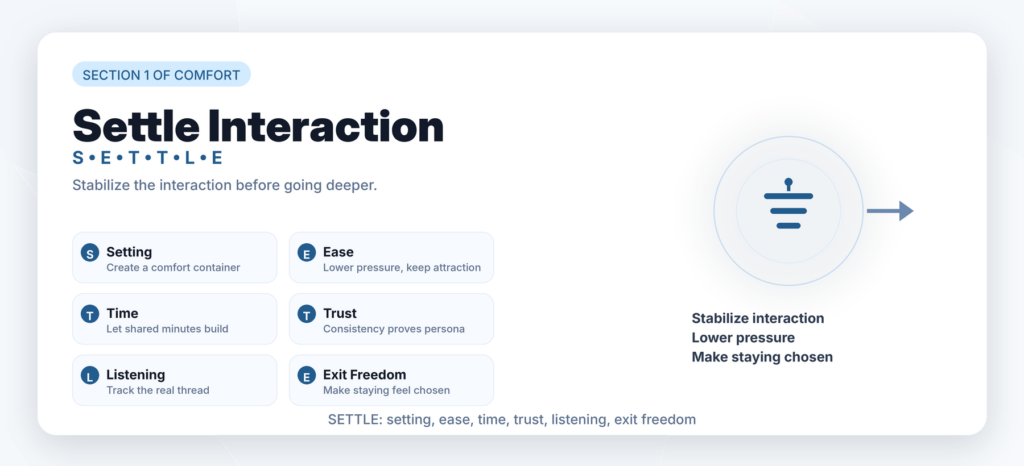
Setting means moving the interaction into a place where comfort can actually happen.
A spark can happen in a loud room for thirty seconds. Comfort usually cannot. Comfort needs a little space, a little audibility, a little lower pressure, and enough social normalcy that the woman does not feel hidden, rushed, or trapped.
This does not mean dragging her away. It does not mean isolating her in a weird way. It means improving the container of the interaction so real conversation has room to breathe.
A beginner usually gets this wrong in one of two ways. He either keeps talking in a terrible spot because he is afraid to lead, or he tries to move her too far too fast and makes the move feel suspicious. Both fail.
The sweet spot is this:
move only as much as the moment needs.
A better angle, a quieter edge, one step away from traffic, a side pocket near the group, or a place where both of you can hear each other is usually enough.
Why setting matters
Comfort is not just words. Comfort is also environment.
If she has to yell, protect her space, watch her friends, guard her drink, or keep checking whether the move is safe, she cannot fully relax into the interaction. Her attention is split. Part of her is talking to you. Part of her is managing the room.
Good setting reduces that split.
A good comfort container gives her:
enough sound control to hear you
enough visibility to feel socially safe
enough space to breathe
enough normalcy that the move makes sense
enough continuity that the conversation does not reset
That is why setting comes first in C1. Before you ask for deeper conversation, create a place where deeper conversation is possible.
What good setting sounds like
“Come over here two seconds, I want to hear the real version without yelling.”
“This spot is chaos. Let’s move three feet before we both start reading lips.”
“I’m relocating us from loud to slightly less criminally loud.”
“Stand on this side. You’re getting attacked by foot traffic.”
“We can keep talking, just not from the worst place in the building.”
What setting is not
Setting is not:
pulling her somewhere hidden
moving without a reason
trying to separate her from her friend too fast
making the move bigger than the moment supports
acting disappointed if she hesitates
using “comfort” as a cover for pressure
Bad setting makes her wonder what you are trying to do.
Good setting makes her feel the move is obvious.
Beginner rule
Do not move her because you want control.
Move the interaction because the current environment is making comfort harder.
Practical drill
Next time you are in a venue, do not just look for women. Look for comfort pockets.
Find three places where normal conversation would be easier:
a quieter edge
a bar corner
a patio side
a standing pocket near the group
a place with enough light and space
Then practice saying one simple movement line out loud:
“Let’s stand here. I can actually hear you.”
The goal is to make movement feel normal before you need it.
Bottom line
Setting is the first comfort skill because comfort needs a container.
If the room is fighting the interaction, fix the room before blaming the conversation.
Create the pocket.
Keep it socially safe.
Make the move obvious.
That is C1.1.