Skip to main contentSkip to footer

double back up

Welcome to the Attraction System

A Complete Map of STRUCTURED GAME

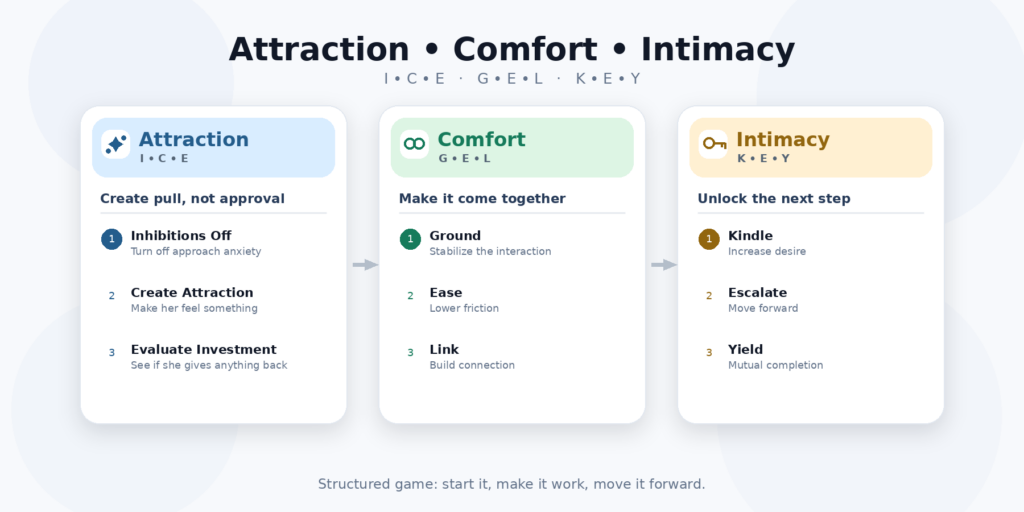
Structured Game has 3 Parts Attraction, Comfort, Intimacy. Each of which has 18 Modules for a Total of 54 Modules in Structured Game Altogether. The First 6 Parts of Attraction is what is beyond most peoples comfort zone, and responsible of all the scarcity, one-itis and overall go aceeptance of gold diggers choosing them, starting conversation with them or making it easy for them to start conversations. Mastery of the first 6 are more important that other module in the game

This table shows how Man – Woman Relationships will look without any Game

Stage Core Mindset View of Women / Society Core Drive Emotion Tone Shadow / Trap Example Voice
Traditionalist A man’s duty is to protect, provide, and obey structure. Women need leadership and provision. Society rewards honor. Duty, stability Pride, guilt Suppressed emotion, blind obedience “Work hard, marry right, don’t complain.”
Romantic Love or destiny will define me. Women are salvation or validation. Connection, idealism Longing, heartbreak Fantasy, neediness “If she just sees the real me, everything changes.”
Achiever / Modernist Value = success and results. Women respect competence; society is a meritocracy. Ambition, mastery Confidence, anxiety Burnout, emptiness “If I win, I’ll finally feel enough.”
Rational Cynic (Red-Pill / MGTOW) The system is corrupt; feelings are traps. Women and institutions exploit male effort. Control, protection Anger, resentment Isolation, bitterness “Never trust. Walk away. Be self-sufficient.”
Performer (Status / Looksmax) Life is a simulation; visibility is survival. Women mirror social proof; attention is currency. Optimization, fame Envy, pressure Insecurity, addiction to validation “Numbers don’t lie—followers = value.”
Structured Planned and Canned Game (Understanding Abundance) Reality is built, so build it consciously. Women are mirrors and co-creators, not prizes. Presence, coherence Curiosity, grounded joy Over-intellectualizing growth “I lead with awareness, not control.”
Informal Flow State Game / (Committed Relationship) We’re parts of one living system. Women and men evolve the tribe together. Purpose, stewardship Gratitude, awe Detachment if mission overtakes intimacy “I create spaces where others rise too.”

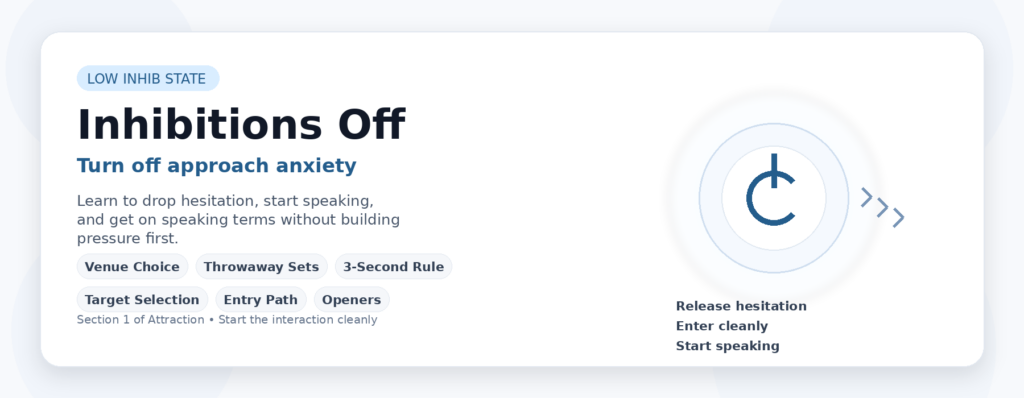
SECTION 1

Venue choice

Best environments

Places where people are already standing, pausing, waiting, browsing, or socializing

  • Best because the person is usually in a low-commitment attentional state. They are not deep inside a sequence they must protect, remember, and resume.
  • When someone is between actions, the interruption cost is lower. They can lend attention without feeling like they are dropping a task mid-stream.
  • Waiting areas, browsing zones, bar edges, patios, event spillover, display sections, and queue-adjacent pauses all create attentional slack. That slack is what makes a short first interaction feel easy instead of expensive.
  • Browsing is especially useful because there is already a shared external object. The first thread can attach to something visible instead of forcing immediate personal intimacy.
  • Socializing zones are strong because conversation is already part of the local norm. You are not introducing a new behavior; you are joining an existing one.

Places where conversation can actually be heard

  • A1 weakens fast when the first sentence has to fight the room.
  • High noise increases response time, lowers speech intelligibility, and raises the amount of effort needed just to decode what was said.
  • That means the other person has less cognitive room left for curiosity, play, or smooth turn-taking because too much attention is being spent on basic hearing.
  • In loud spaces, people compensate by raising vocal effort and adjusting distance. That is fine once a conversation already exists. It is bad for first contact because now the interaction has to solve an acoustics problem before it can become socially normal.
  • Best zones are not usually the loudest part of the venue. They are the side pockets where normal-volume speech works on the first try.

Places with movement and natural mixing

  • Good movement is not chaos. Good movement means people are circulating, crossing, pausing, reforming, and re-entering conversation naturally.
  • That gives you repeated low-pressure entry windows because people are already changing orientation and attention.
  • Social groups are organized spatially. If the room gives groups enough surrounding access space, you can enter without looking like you are breaking open a sealed unit.
  • Natural mixing also gives social cover. A brief exchange looks like normal room behavior, not like a dramatic event everyone has to register.
  • Best version: the room alternates between flow and pause. Too static and everything is closed. Too kinetic and nobody can allocate attention.

Worst environments

Places where you have to shout immediately

  • Bad because the interaction starts with strain instead of ease.
  • The other person has to work harder just to hear you, which makes the first seconds feel effortful rather than natural.
  • Loud environments also push you toward two ugly compensations:
    • speak much harder than normal
    • stand closer than normal
  • Both can raise intensity too early.
  • If the opener cannot be heard at normal conversational effort, A1 starts under friction.

Places where the other person is clearly task-locked

  • Task-locked means they are in the middle of something they must maintain: ordering, paying, carrying, navigating, coordinating, reading, typing, searching, managing children, handling staff.
  • Interruptions impose resumption cost. The person has to suspend the current task, remember where they were, then re-enter it correctly.
  • That makes even a decent opener feel expensive because the real issue is not the line; it is the timing burden.
  • Task-locked people often answer minimally not because they hate the approach, but because they are protecting cognitive bandwidth.
  • Approaching someone who is between actions is not the same thing as approaching someone in the middle of one.

Places where your approach forces them to physically stop what they are doing

  • Bad because you are creating immediate behavioral and spatial friction.
  • If they must stop walking, turn sharply, remove attention from where they were headed, or reorganize their body just to receive your first sentence, the cost of giving you a fair shot is already too high.
  • Forced stopping also tends to compress distance too quickly, which can increase discomfort and arousal.
  • With groups, it is even worse: if your entry requires them to break their existing spatial formation just to accommodate you, the approach feels heavier than the same words would feel in a more open setup.
  • Best entries fit into existing movement. Worst entries demand a reconfiguration.

    Throwaway Approaches for first contact stiffness

    • This is warm-up work, not to be counted as a real approach, its job is to remove first-contact stiffness before the interaction you actually care about, so the real opener is not also your first vocal onset, first eye contact, first turn-taking sequence, and first test of composure. The idea is it creates new nonthreat learning that its okay to begin being social instead of letting avoidance keep teaching the old lesson.
    • In conversation experiments, self-focused attention and safety behaviors—monitoring how you are coming across, rehearsing before speaking, talking less, staying on the edge, avoiding eye contact—raise anxiety and make people come across worse to partners and observers. Warm-up contacts work because they force attention back onto another person and a simple task instead of letting you stay trapped in impression-management mode.
    • First-contact stiffness is not just “being nervous.” It is the visible bundle of self-protective behaviors that show up when the first interaction feels too important: softer vocal amplitude, fewer and shorter turns, less movement, rehearsing sentences, watching yourself too closely, hanging back on the edge, and trying to control the impression instead of joining the exchange. Research on nervousness cues and safety behaviors maps closely onto this exact pattern.Warm-up contacts help because they attack those processes directly instead of asking you to abstractly “be more confident.”
    • The goal is also not to collect mini-wins for ego. If you turn warm-up contacts into a referendum on how well liked you are, you keep the same performance pressure and merely change the venue. Exposure logic only helps when the interaction displaces avoidance and safety behaviors; it fails when “preparation” becomes a more respectable way to keep hiding.

    Warm-up approaches

    Ask staff a simple question

    • This is usually the best first warm-up because the interaction already has a role-justified script. Research on stranger conversation suggests that contexts with some built-in reason to speak lower the barrier to engagement and help people calibrate their expectations through actual experience instead of anxious guessing. A staff interaction gives you vocal onset, eye contact, audibility, one clean response, and an easy exit with almost zero ambiguity about why you opened your mouth.
    • The question should be real, concrete, and quickly answerable. The benefit is not the information; the benefit is that you initiate, receive, and close an interaction without giving self-focus time to build. That matters because the research is very consistent that self-monitoring and safety behaviors worsen both felt anxiety and how you come across.
    • What this trains is very specific: audible first words, neutral eye contact, calm listening, one clean acknowledgment, then release. It also strips the brain of the excuse that every initiated exchange has to carry social risk or romantic meaning. Since even minimal social contact can increase positive affect, the staff question works as a state reset without asking the interaction to be anything more than it is.
    • What not to do: do not ask something fake, do not linger after the answer, and do not turn a service interaction into a covert full set. The strength of this warm-up is that it is low-ambiguity and low-load; once you force more out of it than the context naturally supports, you reintroduce the same pressure you were trying to dissolve. That last point is a practical inference from the role-clarity and low-friction logic in the stranger-interaction findings.

    Next Make a casual comment to a passerby

    • This is the next level up because it removes most of the script while keeping the stakes low. The function is not to hook; the function is to prove that a short social bid can be brief, normal, and disposable, which fits the finding that people routinely expect stranger contact to be less pleasant than it actually is. A casual comment is useful precisely because the interaction can be successful even if it only lasts one exchange.
    • The comment should attach to something shared and immediate: line movement, venue confusion, a tiny absurdity, timing, signage, weather spillover, something both people are already dealing with. That design matters because it keeps the interaction externally anchored instead of forcing you back into self-conscious performance. When self-focus rises and impression management takes over, anxiety and apparent awkwardness rise with it.
    • The success metric here is not whether the other person stops and invests. The success metric is whether you can make a clean, socially normal bid, receive whatever comes back, and keep moving without collapse, rumination, or emotional over-interpretation. That is exactly the kind of small expectancy violation exposure work relies on: you approach, the feared catastrophe does not happen, and your system learns that brief contact is tolerable.
    • This warm-up is best when you notice overselection and outcome dependence. If you are mentally sorting the room, waiting for the perfect target, or inflating the next approach into a high-stakes event, a passerby comment breaks the spell because the interaction is intentionally non-precious. It resets the premise from “this has to matter” to “I can speak normally to a human and keep going.”

    Greet people without agenda

    • This is the cleanest version of the warm-up because it attacks the underlying distortion directly: the idea that social initiation must always serve a larger objective. Research on minimal social interactions found that even very small exchanges—greeting, thanking, wishing someone well—can raise momentary positive affect, and weak-tie work found that brief genuine interactions can increase positive affect and belonging. Greeting without agenda is valuable because it normalizes contact without asking the interaction to perform.
    • Greeting also trains non-predatory presence. Instead of staring, choosing, hovering, and then “making a move,” you become a person who can acknowledge others without loading the moment with hidden intent. That matters because people often avoid stranger contact due to mistaken expectations about how it will feel; repeated ordinary greetings help recalibrate that expectation through direct low-cost experience.
    • This is especially useful when your issue is more physical than verbal. If your face is flat, your voice starts too small, or your body feels brittle before the first words, a simple greeting lets you practice onset, eye contact, micro-expression, and release without also having to build a conversation. The likely gain is not charisma; it is reducing the nervousness profile associated with smaller amplitude and fewer conversational turns.

    Practical ladder

    • Start with the lowest-ambiguity rep and move up. Staff question first, then greeting without agenda, then a casual situational comment, then the actual set. This ladder makes sense because research suggests people connect more easily in contexts with some built-in reason to speak, and because even minimal interactions have measurable subjective benefits.
    • Do not stay in warm-up mode too long. The point is to erase the “first interaction” problem, not to build a separate ritual you hide inside. If the warm-up becomes a long prelude you must complete before you feel allowed to act, then it has turned into avoidance with better branding. Exposure logic only helps when it moves you toward the real feared situation, not when it becomes a substitute for it.

    What to notice while doing it

    • Watch for a shift from self-observation to outward contact. You are looking for less mental rehearsal, less urge to control every sentence, less inner commentary about how you look, and more simple attention to the other person’s actual response. Those are exactly the processes the self-focus and safety-behavior research identifies as the difference between worsening and improving social performance.
    • Watch for a shift in turn-taking ease. The contact should start to feel less like you are launching words into a void and more like you can speak, pause, hear, and answer without mechanical effort. The joint-action findings suggest this kind of coordination matters for how positively the interaction is experienced. The connection to warm-up is an inference, but it is the right operational one.
    • Watch for a shift in threat prediction. If the room stops feeling like a place where every contact might go badly and starts feeling like a place where most tiny interactions are fine, the warm-up has done its job. That matches the stranger-conversation research almost exactly: people predict more awkwardness than they actually encounter.

    Common mistakes

    • Using warm-up contacts to test your worth. That keeps the same performance anxiety alive and merely relocates it. The research-backed direction is the opposite: less self-evaluation, less impression management, more external engagement.
    • Trying to make every throwaway contact impressive. The whole point is low load. Once you start trying to be memorable in the warm-up, you are rebuilding the same self-focus that was making the first contact stiff in the first place.
    • Treating a weak response as evidence that the room is hostile. The stranger-interaction data show that people systematically mispredict these exchanges, usually in the negative direction. A single flat response is bad sampling, not good science.
    • Warming up forever and never transitioning. That is still avoidance. If the low-stakes contacts are not making the real approach easier, you are no longer warming up; you are hiding in repetition.

    Bottom-line function

    • Warm-up contacts are throwaway repetitions used to erase first-contact stiffness, not to manufacture a huge social state. They work because they cut self-focus, interrupt safety behaviors, update bad predictions about stranger contact, and restore normal turn-taking before outcome dependence locks in. The useful standard is simple: by the time you open the real set, it should no longer feel like your first human interaction of the day. 


What the rule actually is

  • The 3-second rule is best treated as a decision cutoff, not as a claim that the brain has a magical 3.0-second threshold. The science supports three separate ideas: first impressions form extremely fast, pre-event rumination before a social-evaluative moment raises anxiety and can damage performance, and if–then plans make action initiation faster and more automatic. The practical reason to use 3 seconds is that it is short enough to interrupt rumination but long enough to orient, choose angle, and begin moving.

Why overthinking gets worse, not better, with delay

  • Experimental work on anticipatory processing shows that dwelling on an upcoming social-evaluative task, rather than distracting oneself, increases self-reported anxiety. In the Wong and Moulds study it strengthened maladaptive beliefs in high-social-anxiety participants, and it was indirectly associated with poorer speech performance through increased anxiety.

In a controlled conversation experiment, participants told to focus on themselves, think about how they were coming across, and decide whether what they were about to say was “good enough” before saying it felt more anxious, looked more anxious, and performed worse. Those effects were not limited to the highly anxious group; self-focus and safety behaviors undermined performance for all participants. The 3-second rule matters because it cuts off this self-editing loop before it has time to contaminate the entry. It shifts the task from “monitor myself and manage the impression” to “orient, move, and make contact.”

Make the interaction feel socially normal within seconds

  • Social normality in first contact is not created by a clever line; it is created by keeping self-focus low and external attention high. The conversation experiment on self-focus and safety behaviors showed that when people monitor how they are coming across and filter their speech in real time, they come across worse and are rated more critically. The 3-second rule helps because it forces an outward task—move, orient, enter—before internal image management becomes the dominant process. That makes the first exchange feel more like conversation and less like performance.

Get the group or person to stop treating you like an interruption

  • An interruption stops feeling like an interruption when the first exchange is low-friction and the other person gets an easy reason to stay in it. Anticipatory-processing research shows that pre-event rumination raises anxiety and can degrade performance before the social task even starts, while voice research shows that nervousness leaks most through the same channels people hear first. The 3-second rule reduces the amount of pre-contact mental loading that can make the opener sound strained, overinvested, or oddly heavy. That gives the other person a cleaner first-response window, which is the real bridge from interruption to interaction.

What the rule is supposed to trigger

  • The rule should trigger movement initiation, not verbal blurting. The implementation-intention literature shows immediate and efficient response initiation, not random impulsivity; the useful translation is to commit body direction, lane, angle, and distance before rumination starts stacking. That preserves spontaneity without forcing sloppy speech.

What usually goes wrong after the window closes

  • The main failure mode after the 3-second window is not “low confidence” in the abstract; it is a shift into self-focused attention and safety behavior. The research version of that shift sounds like “monitor how I’m coming across,” “be careful what I say,” and “decide if this is good enough before I say it.” The real-world version looks like delaying the first step, searching for a better line, waiting for a clearer signal, re-checking expression and posture, and trying to edit the whole interaction before it exists. The scientific point is that this mode reliably makes people look more anxious and perform worse.

Why 3 is better than 10

  • Ten seconds feels harmless to the person hesitating, but the science says those seconds are not empty. First impressions are already forming within milliseconds and seconds, while anticipatory processing and self-monitoring have more time to increase anxiety and degrade delivery. More delay often buys more visible leakage than social benefit. The 3-second rule is valuable because it shortens the window in which anxiety can become the actual opener.

Why 3 is better than zero

  • Zero seconds would be random. The value of 3 seconds is that it still allows a brief orienting step—choose angle, path, audibility, and distance—without reopening the internal debate.

    Positioning

    Stay in motion before the approach; do not hover nearby

    • Motion helps because it keeps your presence looking like part of the venue rather than a buildup to a social event.
    • Hovering creates pre-contact pressure. It gives the other person extra time to notice that you are deciding whether to approach.
    • Once that happens, they are no longer receiving a spontaneous interaction. They are receiving your hesitation first.
    • Staying in motion also protects your own state. Standing still increases the chance of rumination, over-monitoring, and awkward delayed entry.
    • Movement should look casual and directional, not prowling.

    Do not stand still scanning people

    • Scanning is bad because it makes your attention look evaluative and selective rather than situational.
    • From their side, scanning can feel like they are being assessed before any social normalcy has been established.
    • From your side, scanning often turns into hesitation, self-editing, and over-selection.
    • Socially, it removes the naturalness of the interaction because your eventual entry now looks like the end of a visible decision process.
    • Better pattern: move through the room, notice windows, act. Do not plant yourself and visually sort human beings.

    Do not orbit around a target waiting for a perfect moment

    • Orbiting creates the worst of both worlds:
      • too much pre-exposure
      • no actual action
    • The person may notice you more than once before you speak, which makes the eventual approach feel overcooked.
    • Orbiting also wastes the most important part of first contact: spontaneity.
    • The longer you circle, the more likely the approach reads as calculated, over-invested, or predatory.
    • Better to leave the area and come back later naturally than to linger in a weird holding pattern.

    Do not stand with closed shoulders and a drink or phone protecting your chest

    • Closed shoulders and chest-shielding objects signal withdrawal, self-protection, and low readiness for social exchange.
    • The body is telling two contradictory stories at once:
      • “I want to approach”
      • “I am bracing myself from the room”
    • That contradiction often leaks as stiffness and caution before a word is spoken.
    • A drink or phone held across the chest also limits gesture freedom, makes the torso look closed, and reduces visible openness.
    • Better posture: shoulders open, chest unshielded, arms free enough to gesture lightly, hands not busy protecting the centerline.

    Keep hands visible

    • Visible hands reduce ambiguity and make your body easier to read.
    • Hidden or occupied hands create unnecessary uncertainty and weaken social clarity.
    • Visible hands also improve your own delivery because they allow natural gesture, which supports rhythm and vocal ease.
    • In groups especially, visible hands help the whole set process you faster because there is less visual mystery in the approach.
    • Hands do not need to be animated. They need to be readable.

    Avoid looking like you are choosing prey

    • The whole point of logistics is to make the interaction feel locally normal, not like a hunt sequence.
    • Predatory-looking behavior usually includes:
      • repeated scanning
      • stopping and staring
      • orbiting
      • angle changes without action
      • visible fixation on one person while ignoring the room
    • This creates a selection narrative before the interaction even begins.
    • Better frame: you are a socially mobile person moving through a room with awareness, not a sniper waiting for certainty.
    • If your pre-approach behavior looks heavy, the opener starts from a deficit even when the line itself is fine. 

Core rule

  • For beginners approaches, although following the 3s rule still and warmed up, if you continuously choose the wrong target you can be shooting yourself in the foot. This is usually  because of an attention-and-access problem. Best early targets, for beginners guys leaning to be social,  are the ones that can spare attention, keep a usable entry lane open, and let the interaction begin without forcing a restart of task flow, body orientation, or turn-taking. Interruption research shows that breaking into an ongoing task produces resumption lag and performance costs, while group-formation research shows that social groups maintain a shared interaction space that can be either open or effectively sealed off.

Best early targets

Groups already talking lightly

  • Light conversation is better than deep conversation because the group is usually running a looser coordination loop. Shared attention and gaze coordination are still present, but the interaction is not yet so locked that a new participant has to break a tightly synchronized exchange. Research on conversation shows that eye contact tracks shared attention and that gaze helps regulate turn yielding, monitoring, and repair; the less tightly the group is locked into those processes, the easier the entry.
  • “Talking lightly” usually means the group is still partly aware of the room. Practical signs are short turns, intermittent laughter, members glancing outward between turns, partial rather than fully sealed circles, and no single speaker holding the floor with full group commitment. Those signs matter because they suggest the group’s shared interaction space is still permeable rather than defended.
  • Early on, you want a set that can absorb a new turn without everyone having to mentally switch modes. A lightly talking group can usually do that; a highly engaged group often cannot, because the existing exchange already has stronger shared attention and smoother internal turn regulation than a cold entrant can match in the first seconds.

People near transition points: bar, hallway, queue, entrance, patio, shared display, waiting area

  • Transition points are strong because people there are often between actions, not deep inside one. That means the interruption cost is lower: they do not have to preserve as much task state, resume as many steps, or recover from a mid-sequence break. Interruption studies consistently find slower resumption and more errors after task breaks, which is exactly why “between actions” is such an advantage.
  • These locations also provide shared external reference points. A bar edge, queue, entrance bottleneck, patio opening, display, or waiting area gives both people something already in view, which lets the first exchange attach to the environment instead of demanding instant personal intensity. That lowers friction because the interaction can begin on the situation rather than on mutual evaluation. This is an inference from interruption-cost research and group-space research, not a claim about one single venue study.
  • Transition points also produce better timing windows. People pause, reorient, check where they are going next, or wait for the next micro-event. That pause matters because even a short approach is much easier to receive when attention is temporarily free than when it is fully assigned to movement or task completion.

Mixed groups when social ease matters

  • Mixed groups are often easier early because you can address the set instead of collapsing the first seconds into a hard one-on-one frame. That reduces immediate evaluative intensity. Research on social evaluation shows that fear of evaluation and social-anxiety symptoms are associated with stronger neural responses to both criticism and praise, so reducing instant person-to-person spotlight can make the entry feel lighter.
  • A mixed group also distributes attention. One person can answer first while others observe, warm up, or join later, which is usually smoother than forcing one person to carry the entire first-contact burden alone. In group-space terms, you are entering a shared interaction field rather than demanding immediate dyadic commitment. That is an inference from the social-evaluation findings plus the F-formation model of shared interaction space.
  • The real advantage is not “more people = better.” The advantage is that the opener can stay socially framed, with less instant pressure on any one person to decide what you mean, whether to validate you, or whether to carry the exchange by themselves.

Sets with open body language and space around them

  • Open body language matters because social groups organize themselves spatially. F-formation research shows that groups maintain an o-space—a shared interaction zone with direct and equal access for members. If the group is arranged in a way that leaves a usable entry lane, you are fitting into the geometry of the interaction instead of forcing a breach.
  • Space around the set matters because distance is not cosmetic. Experimental work on interpersonal distance found that closer interactions were rated as more arousing, less pleasant, and less natural, and also produced more avoidance, especially when social anxiety was higher. A set with physical space around it lets you enter from a more normal distance and avoid that early “too close, too soon” problem.
  • “Open body language” in target selection does not mean decoding people like body-language fortune telling. It means simple logistical signs: shoulders not fully closed inward, feet not all locked away from the room, no hard back-wall seal, and enough surrounding space that you do not have to crowd or interrupt the whole formation to speak.

Worse early targets

Person clearly rushing

  • A rushing person is usually under time pressure, and time pressure changes cognition in exactly the wrong direction for first contact. Research shows that high time pressure can induce perceptual narrowing, reduce vigilance, reduce working memory, and reduce the use of available cues; even perceived time pressure alone can increase stress and impair cognitive inhibition.
  • In practice, that means the person’s attention is already committed to task completion, route maintenance, or deadline pressure. Your opener is not joining spare attention; it is competing with urgency. Even good content lands poorly when the person’s cognitive system is prioritizing speed, filtering aggressively, and protecting the next action.
  • Early game should avoid making the other person choose between politeness and momentum. If they are clearly rushing, you are asking them to absorb both the social decision and the time cost at once, which is bad target selection even if the opener itself is fine.

Tight closed circle with backs outward

  • This is one of the clearest bad targets because it is almost the textbook form of an externally closed interaction. F-formation research describes groups as arranging themselves around a shared space while excluding outside distractions with their backs. If the group is tight and outward-sealed, your first problem is not charm; your first problem is that the geometry is already telling outsiders to stay out.
  • Tight circles are hard because there is no clean access lane. To enter, you usually have to invade distance, force a reorientation, or make the whole group break formation just to acknowledge you. That adds spatial cost before the social content has any chance to work.
  • Early on, avoid formations that require a breach. The same words said to a loose horseshoe or side-open group can feel normal, while said to a sealed outward-back circle they feel intrusive, because one entry fits the space and the other violates it.

Person buried in phone, laptop, earbuds, or intense conversation

  • Devices are bad early targets because they are not just “rude”; they are attention sinks. Smartphone-use research shows reduced situational awareness and inattentional blindness, including failures to notice unusual events while engaged in device tasks. If someone is deep in a phone or laptop, your opener first has to beat divided attention before it can become socially normal.
  • Earbuds are usually poor targets for the same reason. The strongest support here is attentional, not symbolic: if the person is actively listening, monitoring an audio stream, or screening environmental sound, first contact has to overcome a sensory filter as well as a social one. The Taipei pedestrian study included music listening among the phone-related activities linked to lower situational awareness.
  • Intense conversation is bad because conversation is already a coordinated system of shared attention, eye contact, and turn regulation. Research shows that eye contact tracks peaks in shared attention and that gaze helps yield turns, monitor speech, and repair breakdowns. When two people are deeply engaged, you are not interrupting empty time; you are interrupting a live coordination loop.

Group in serious emotional discussion

  • Serious emotional discussion is a worse target because the group is usually carrying higher attentional engagement and tighter internal relevance than a casual social exchange. Shared-attention research shows that engaged conversation is not random talk; attention becomes coordinated, and gaze helps hold the interaction together. The more emotionally loaded the discussion, the less likely the group is to have spare bandwidth for a light external entry.
  • The problem here is not just interruption cost; it is value conflict. Your opener is asking people to drop content that already matters to them more than you do. Even if the group is physically approachable, the attentional door is usually closed, and early game should respect that. The science here is an inference from conversation-coordination findings plus the well-established costs of interrupting active cognitive sequences.
  • Practical read: serious emotional groups usually show longer floor-holding turns, stronger eye lock, less room-scanning, more protective body orientation, and less casual turn-sharing. Those are all signs that the set is already occupied at a level you do not want to fight in A1.

Seated set with no available way to equalize height

  • This is a poor early target because the spatial geometry is bad from the start. If there is no clean way to sit, kneel naturally, or otherwise normalize the interaction, you end up looming, bending, or hovering. That often compresses distance or creates a top-down angle that feels less natural than a level interaction.
  • Distance research matters here too. Close approach increases arousal, reduces pleasantness, and increases avoidance. A seated set with no height-equalization option often forces exactly that: you either stay too far for normal conversation or come too close in a physically awkward way.
  • The issue is not that seated sets are always bad. The issue is that unequal geometry plus no correction path makes the first seconds too expensive. If the layout gives you no clean lateral entry, no available seat, and no way to avoid looming, it is a weak early target even if the people themselves seem friendly. 

Entry path

Best approach angle


  • Front side approaches,  this angle gives the other person immediate access to your face, eyes, torso, and distance. Those are the main channels people use to decide whether an interaction is open, neutral, warm, tense,aggresive  or intrusive.
  • A rear entry removes the other person’s main social-decoding channels until they physically reorient. That means the first thing you create is not conversation; it is surprise, detection, and reorientation. This is an inference from the social-cue literature, but it is a strong one.
  • Natural conversation relies on very fast gaze shifts and brief mutual face-gaze episodes, not on big corrective body turns before meaning can even start.
  • Practical translation: choose an entry lane where they only need a small head turn or partial torso turn, not a full-body reset. A good opener should not require a motor correction before it can become social.

Stop distance

Close enough to be heard

  • Why it matters: if the first sentence is not heard clearly, the interaction starts with repair instead of momentum. Repetition, “what?”, and forced projection all make the first seconds feel heavier.
  • When background noise appears, conversational partners rapidly adjust speech level and interpersonal distance just to re-establish intelligibility. In noisy public spaces, intelligibility drops and response time rises as ambient noise increases.

Far enough to avoid invasion

  • Why it matters: distance is not cosmetic. Too close too soon increases arousal and makes the interaction feel less natural.
  • Real-time interaction studies found that closer interpersonal distances were rated as more arousing, less pleasant, and less natural, with stronger avoidance at shorter distances. Stop-distance work on conversation with strangers repeatedly lands around about 1 meter as a comfortable reference point, adjusted by context and person.

Let them invite closeness with lean-in, not the other way around

  • Why it works: closeness lands better when it is reciprocal rather than imposed. If you unilaterally add distance-reduction cues too early, the other person may compensate by pulling back.

Body angle

Do not square up fully on contact

  • Why it matters: a fully squared stance increases social intensity immediately. It tells the other person the interaction is already highly directed at them before they have reciprocated anything.
  • Body orientation and distance are core nonverbal cues, and higher immediacy can produce aversive arousal or compensatory behavior rather than smooth reciprocity. Closed versus open posture also changes first impressions in measurable ways.
  • Practical translation: full square-up is for later, once the interaction is already being carried by both people. On first contact, too much frontal commitment can feel like pressure, not confidence.

Keep one foot free as though leaving is normal

  • Why it works: it reduces perceived trap pressure. The body reads as mobile, not planted.
  • Nonverbal exchange theories show that people regulate distance and immediacy dynamically rather than passively accepting whatever the other person imposes. A stance that already looks “stuck” raises the interactional stakes before there is social permission for that.
  • Practical translation: planted feet say “I’m here until this works.” A free foot says “this can continue if it feels good.” That is the better signal in A1.

Full front-facing commitment comes after hook begins

  • Why that sequence matters: full frontal alignment, closer distance, and sustained gaze all increase immediacy. Those cues are stronger when they arrive after reciprocation, not before it.
  • Science tie-in: because early increases in immediacy can trigger compensation instead of reciprocity, stronger commitment cues work better once the interaction has already become mutual.
  • Practical translation: first get attention, then acceptance, then alignment. Do not spend full-body commitment before the set has bought in.

First 3 seconds of body language

Eyes up

  • Why it matters: eyes are one of the first places people read for attention and communicative availability. Looking at the person helps open the channel; looking everywhere else delays it.

Chin level

  • Why it matters: head posture changes trait perception fast. Too far up or too far down distorts the face socially.
  • Head-level posture is judged as more trustworthy than a notably raised or lowered head; both upward and downward tilts were rated as less trustworthy and more dominant than head-level posture.
  • Practical translation: chin level reads cleaner than “chin up” swagger or “chin down” submission. Neutral head position is the safest first-contact setting.

Small smile or warm neutral face

  • Why it matters: the opening face should reduce ambiguity, not add threat. A tiny positive expression does that better than a blankly intense face.
  • Happy expressions are judged as more trustworthy, competent, warm, and friendly than disgusted expressions. You do not need a giant grin; you do need to avoid accidentally broadcasting coldness or dominance.
  • Practical translation: use a small real smile if it comes naturally; otherwise use a warm neutral. Dead-serious is too expensive for first contact.

Shoulders down

  • Why it matters: shoulder tension is part of the nervousness profile. Relaxed posture reads more composed than braced posture.
  • Composure is associated with relaxed posture, relaxed face and head, while anxiety cues include more constricted or jittery presentation. Open postures are also rated more positively than closed postures in first-impression research.
  • Practical translation: shoulders down is not “alpha posture.” It is simply removing unnecessary threat and self-protection from the first frame.


No hard stare

  • Why it matters: direct gaze is powerful, but too much of it raises arousal and can read as scrutiny.
  • Live eye contact increases skin-conductance arousal, socially anxious people are especially sensitive to direct gaze, and natural conversation does not consist of uninterrupted eye-lock. Mutual eye contact in real conversation is brief and sparse; mutual face-gaze episodes average around 2.2 seconds, while actual mutual eye-contact episodes average about 0.36 seconds.


Entry-path summary

  • Angle first: visible early, not rear, not intercepting.
  • Distance second: audible without crowding; conversation distance, not invasion distance.
  • Orientation third: slightly angled at first; full commitment only after reciprocity starts.
  • First 3 seconds: calm eyes, level head, warm face, relaxed shoulders, still hands, no stare, no reach-for-approval body language.

I’m only giving you a few openers here on purpose, because when you’re already a little nervous or in your head, a big list of tusually does not help — it just gives you twenty-five more ways to think and hesitate. The goal is not to become a collector of lines. The goal is to take one or two of these and use them enough that they start to feel natural in your mouth. These actually work when delivered with the points before a1.1- A.1.4 Once that happens, you can begin to shape them around your own style: shorten them, make them more playful, more direct, more opinionated, or more specific to the venue. So you are not memorizing seven rigid scripts — you are learning seven solid templates you can keep tweaking without having to reinvent the wheel every time you walk up.

1) The verdict opener

Line
“What’s your verdict on this place so far?”

Use it when
Bars, lounges, rooftops, parties, events, anywhere both of you are already sharing the same environment.

Why it works
It asks for taste, not biography. It gets the person talking about something immediate and gives you an instant direction: they like it, hate it, or are undecided.

Second line
“So it earned that, or you’re being generous?”
“Okay, what’s the one thing it gets wrong?”
“So you’re tough to impress, got it.”

Delivery
Say it like you are comparing notes, not seeking approval. Slight smile. Easy pace. Then shut up and let them answer.

How men ruin it
They ask it flat, like customer-service small talk. Or they get the answer and jump straight into résumé questions.

2) The expert opener

Line
“You look like you’d know — what’s actually worth getting here?”

Use it when
Menus, wine lists, food stalls, record stores, bookshops, market tables, event booths, anything with an actual choice in front of you.

Why it works
It is rooted in the moment and lightly flattering without being thirsty. You are giving them an expert frame instead of putting them on a pedestal.

Second line
“That’s a confident answer. Sell me on it.”
“Bold pick. Why that one?”
“Alright, I respect the conviction.”

Delivery
Glance at the object first, then at them. Make it feel like a real question, not a setup.

How men ruin it
They use it where nothing is actually being chosen, or they ask it and then abandon the topic immediately.

3) The story opener

Line
“You two look like there’s a story here — how do you know each other?”

Use it when
Pairs and small groups.

Why it works
This is a stronger version of the plain group-connector opener. It starts with a read, which gives the line more texture and more pull.

Second line
“Knew it. That has exactly that energy.”
“Alright, which one of you is the bad influence?”
“So this was planned, or you all just collided into the same night?”

Delivery
Address the whole pair or group. Use your eyes on everyone, not just the one person you are most attracted to.

How men ruin it
They open the group, then instantly tunnel onto one person and socially drop everyone else.

4) The role opener

Line
“Quick read: who’s the planner and who’s the bad influence?”

Use it when
Groups at bars, house parties, birthdays, patios, friend clusters.

Why it works
It gets multiple people talking at once. People love assigning roles, disagreeing, and defending themselves. That gives you energy fast.

Second line
“That answer came way too fast.”
“Yeah, I believed that immediately.”
“So who’s the one who turns ‘one drink’ into four?”

Delivery
Playful tone, a little amused, not overperformed. Ask the whole set and let them fight over it.

How men ruin it
They try to sound witty instead of sounding relaxed. Or they deliver it like a rehearsed trick.

5) The direct opener

Line
“You seemed fun, so I wanted to come say hi.”

Use it when
Clean eye contact, calmer venues, solo sets, smaller groups, or any moment where directness fits the vibe.

Why it works
It is honest, clear, and has zero gimmick. When delivered well, this is stronger than most indirect material because it feels adult.

Second line
“I’m [name]. What’s your name?”
“What’s your story tonight?”
“You from around here, or just passing through?”

Delivery
Say it once. No apology. No long explanation. No stack of compliments. Deliver it, hold eye contact, and let the moment breathe.

How men ruin it
They panic and add three more sentences, which instantly makes it feel needy.

6) The repeat-proximity opener

Line
“We keep crossing paths, so I should probably at least introduce myself.”

Use it when
Parties, networking events, campuses, recurring venues, weddings, anywhere you have already been in each other’s orbit more than once.

Why it works
It names the obvious and removes the weirdness. You are not pretending there was no pattern.

Second line
“I’m [name].”
“So what’s your connection here?”
“Have you been hiding in the good part of this place all night?”

Delivery
Light grin. Matter-of-fact. Like this is the natural next step.

How men ruin it
They use it when there was no actual prior awareness at all.

7) The save-the-night opener

Line
“Is tonight already good, or does it still need saving?”

Use it when
Evening venues, after-work environments, early party energy, lounges, social events that have not peaked yet.

Why it works
It is much better than “How was your day?” because it creates a frame and emotion. People can answer with optimism, boredom, frustration, or curiosity.

Second line
“Okay, so what’s missing?”
“That’s fixable.”
“Strong answer. I respect high standards.”

Delivery
Say it with a slight smile, as if you are inviting a verdict, not performing a line.

How men ruin it
They ask it, get an answer, and then fail to build on the mood they just uncovered.

8) The taste opener

Line
“That’s either a great choice or a terrible one. Which is it?”

Use it when
Drinks, food, records, books, jackets, market items, desserts, anything visible and concrete.

Why it works
It creates instant play. Now they have to defend a choice, which is more alive than answering a generic question.

Second line
“Bold. I respect the confidence.”
“Interesting. That tells me things.”
“Alright, now defend it properly.”

Delivery
Point to the actual thing. Keep the tone light. This is teasing, not challenging.

How men ruin it
They argue too hard over something low-stakes, or they use it when there is no clear object in play.

The delivery that makes any opener work

The opener is only the wrapper. Delivery is the product. The old archive obsession with fast approaches survives for a reason: hesitation shows before words do.

1) Move before your brain starts negotiating

Do not stand there building tension in your own body. Decide, go, open. Slow buildup makes even a decent line feel creepy.

2) Walk in like talking is allowed

Not sneaking. Not lunging. Not circling forever. Just a normal approach, shoulders down, hands calm, body relaxed.

3) Open at conversational volume

Too soft reads as nervous. Too loud reads as performative. Aim for the volume you would use with someone you already know.

4) Ask one line, then hold

Most men ruin the opener by stacking three extra sentences on top of it. Say the line. Pause. Let the other person step in.

5) React before you re-question

Their answer is not a box to tick. It is your material. Respond to it first. Then branch.

A simple bridge looks like this:
You: “What’s your verdict on this place so far?”
Them: “It’s alright.”
You: “Alright is diplomatic. What’s the thing it gets wrong?”

That is already a real conversation. Most men skip that middle reaction and kill the flow.

6) End your sentences like you mean them

Do not make every line sound like a request for permission. Even when you are asking a question, the frame should be relaxed and grounded, not approval-seeking.

7) Be willing to leave cleanly

A strong opener includes the willingness to eject. If they give you two dry answers, keep it graceful:
“Alright, enjoy your night.”
“Good talking to you.”
That protects your vibe and keeps the whole thing socially clean.

What I would demote or cut from the current draft

Use these less, or only in the right niche moments:

How’s your day been?
Too service-counter unless the energy is already warm.

You look familiar.
Only use when it is actually plausible.

Is this seat taken?
That is logistics, not conversation.

Hey.
Fine as a launcher, but not strong enough as the featured example unless the next line is immediate.

The simplest rule

A good opener sounds like something a normal person would actually say, but with a little more direction, a little more intent, and a much better second line.

Useful A1 diagnostic map

If they hear you but do not engage

  • Problem likely: weak root, weak pressure control, or weak group management.
  • What that usually means: the opener was understandable, but it did not give them a good reason to join. They gave you social acknowledgment, not conversational buy-in.
  • Why it happens: people can answer a line politely while still feeling that the topic is floating, the pressure is a little high, or the set has not been opened as a set. In groups, gaze and addressee-selection matter; if your eyes and body only invite one person, everyone else stays passive and the interaction never spreads.
  • Immediate fix: shorten the opener, root it harder in the moment, open the group first, and pause after the first response instead of stacking extra words.
  • What to test next session: run the same environment with two versions only:
    • floating opener
    • rooted opener tied to the room, activity, or group
      Compare which one gets longer second replies.

If they seem startled or guarded immediately

  • Problem likely: bad angle, bad distance, too much intensity, or too much directness.
  • What that usually means: the interaction was felt first as a physical event, not a social one.
  • Why it happens: short distance increases arousal and reduces pleasantness; frontal/rear surprises and heavy direct gaze raise alertness before the content can soften the moment. If they have to reorient their body fast or protect their space, you are already behind.
  • Immediate fix: front-side entry, clearer stop distance, softer face, shorter first line, no full square-up on contact.
  • What to test next session: keep the exact same opener, but change only:
    • angle
    • distance
    • eye intensity
      If reactions improve, the problem was logistics, not words.

If the first reply is okay but the set dies instantly

  • Problem likely: no second thread, interview mode, or an overlong pause with no direction.
  • What that usually means: your opener did its job, but your handoff failed.
  • Why it happens: conversation depends on fast turn-regulation, turn-yielding, and next-speaker selection. If you get the first answer and then either freeze, ask a dead biography question, or leave too much empty space, the interaction loses momentum before it stabilizes.
  • Immediate fix: prepare one connected second branch before you open. Not three. One.
  • What to test next session: before every set, know:
    • opener
    • likely first reply
    • one connected follow-up

If the group responds but only one person keeps it alive

  • Problem likely: poor inclusion.
  • What that usually means: one person is carrying a conversation that should have been socially distributed.
  • Why it happens: in multiparty conversation, gaze helps assign turns and select who is expected to speak next. If your eyes, chest, and follow-ups keep selecting the same person, the rest of the group correctly reads that they are not being invited in.
  • Immediate fix: group first, responder second, group again. Let at least one additional person get a turn before you narrow.
  • What to test next session: in every group opener, deliberately include three people with your eyes/body before settling on the strongest responder.

If solo sets react better than groups

  • Problem likely: you are tunneling badly or mishandling group logistics.
  • What that usually means: you can handle one-on-one attention, but you are not yet managing audience design, turn flow, and distributed attention.
  • Why it happens: groups require more than confidence. They require addressee clarity, shared attention, and turn management. If you behave in a group like it is a dyad, pressure rises on the addressed person and everyone else drifts or resists.
  • Immediate fix: use group-safe openers, spread eye contact, and stop trying to “lock on” during the first 20–30 seconds.
  • What to test next session: spend one entire session opening only groups with set-directed lines.

If day approaches feel better than nightlife

  • Problem likely: voice/volume/state control is breaking down under noise.
  • What that usually means: your actual content may be fine, but the room is exposing weak audibility and rushed delivery.
  • Why it happens: as background noise rises, speech intelligibility drops, response time increases, and listening difficulty rises. In louder venues, weak volume and blurred articulation punish you far more than in daytime settings.
  • Immediate fix: increase first-sentence volume, slow the first line slightly, sharpen consonants, and choose quieter pockets instead of acoustic war zones.
  • What to test next session: run the same opener in:
    • loud center-room zone
    • side-pocket / quieter edge
      If the edge performs much better, the issue is not “nightgame”; it is audibility and delivery.

If you keep getting “polite but flat”

  • Problem likely: your entry is acceptable, but not vivid enough to create hook.
  • What that usually means: nothing is offensively wrong, but nothing is pulling them out of passive politeness.
  • Why it happens: pressure may be low enough to avoid rejection, but the opener may not be rooted, specific, or alive enough to generate shared attention. Another common cause is self-protective delivery: externally okay, internally guarded. Self-focused attention and safety behaviors increase visible anxiety and reduce conversational quality even when the person is “doing everything right.”
  • Immediate fix: add more specificity, more context-root, better first-sentence clarity, and one stronger second branch.
  • What to test next session: keep pressure low, but upgrade:
    • specificity
    • vocal energy
    • second-thread quality

Training drills For More Solid Opens

Drill 1: two-thread drill

  • Purpose: stop dying after the first reply.
  • Why this drill matters: conversation survives on short turn transitions and usable next turns. If you cannot move from opener to one connected branch, the set goes flat fast.
  • Rule: every rep has only three required steps:
    1. open
    2. get reply
    3. build one connected second thread
  • Rep target: 10 reps where you are not allowed to ask random biography questions after the opener.
  • Pass: second line clearly grows out of their first answer.
  • Fail: you freeze, switch topics abruptly, or fall into interview mode.
  • Exit rule: if there is no hook after the second thread, exit.
  • What it trains: handoff control, responsiveness, non-robotic continuation.
  • Common mistake: preparing five follow-ups and then not being able to use even one cleanly.

Drill 2: Pressure-control drill

  • Purpose: learn how to feel easy without looking hesitant.
  • Why this drill matters: distance, angle, gaze, and lean all change social intensity. Shorter distance and stacked immediacy cues raise arousal and reduce naturalness.
  • Rule set for every rep:
    • one foot free
    • slight body angle
    • no forward lean
    • no immediate closeness
  • Rep target: 10–15 opens where you care more about pressure control than clever content.
  • Pass: they do not step back, tense up, or visibly protect space.
  • Fail: you leaned first, crowded first, squared up too early, or stared too hard.
  • What it trains: non-threatening entry, reversible interaction, cleaner first seconds.
  • Common mistake: men overcorrect and become too withdrawn. Low pressure is not low presence.

Drill 3: Clean-exit drill

  • Purpose: remove the ego crash that makes men overstay weak sets.
  • Why this drill matters: exposure gets better when you stop using avoidance and safety behaviors to protect yourself. One common safety behavior in social settings is staying too long, explaining, or trying to salvage what is already dead because leaving feels like failure.
  • Rule: if there is no hook after the second exchange, leave cleanly.
  • Rep target: 8–10 deliberate clean exits in one session.
  • Pass: you leave without apology, irritation, collapse in posture, or weird extra lines.
  • Fail: you linger, negotiate, over-explain, or drop your energy on exit.
  • What it trains: detachment, emotional recovery, better set selection, better pacing.
  • Common mistake: pretending a dead set is “still warming up” just to avoid ending it.

Short operating standard

If the problem is logistics

  • change angle
  • change distance
  • change venue pocket
  • change target type

If the problem is pressure

  • shorten opener
  • reduce eye intensity
  • open the set, not one person
  • stop leaning and stop crowding

If the problem is momentum

  • improve the second thread
  • stop interviewing
  • stop pausing too long after the first reply

If the problem is consistency

  • run drills, not moods
  • score reps, not fantasies
  • diagnose by pattern, not by one set

SECTION 2

2.1 Show Value

What “show value” actually means

Show value does not mean bragging, listing achievements, flexing money, or trying to prove you are important. It means that as the interaction continues, she starts to feel that there is more weight, more range, more steadiness, more social ease, or more real-world substance to you than she first assumed. A beginner usually gets this wrong in one of two ways. He either hides all value because he is afraid of sounding arrogant, or he overcompensates and starts pitching himself like a résumé. Both fail. The sweet spot is this: your value becomes visible through what you naturally imply, reveal, or demonstrate while talking.

The simplest way to understand it is this:

  • bragging says, “Look how valuable I am.”
  • showing value says, “You can tell.”

A woman should come away thinking:

  • this guy has a real life
  • this guy is not socially desperate
  • this guy has stories, options, standards, and range
  • this guy is used to people
  • this guy is not trying to buy approval
  • this guy seems like he could handle life, rooms, people, pressure, and himself

That is the goal of this section.


The seven value channels inside “show value”

This section includes:

  • DHV
  • DHV story
  • DHV spike inside a story
  • social-proof display
  • preselection display
  • leader-of-men / social-center display
  • strong-frame / unaffected display

They all do the same larger job from different angles: they make you feel more substantial than the average stranger who walked up.


1. DHV

What it is

DHV means demonstration of higher value. In plain English, it means some part of your speech, behavior, presence, or story signals that you are more grounded, more capable, more socially fluent, more interesting, or more desired than she expected.

A DHV is not just “being good.” It is the part that becomes visible inside the interaction.

What counts as DHV

A DHV can come from:

  • social ease
  • comfort in the room
  • leadership
  • having standards
  • good instincts
  • humor under pressure
  • emotional control
  • being well-liked
  • being interesting without forcing it
  • having a life with texture, movement, and stories
  • competence in some real area
  • protecting, guiding, hosting, handling, deciding
  • being wanted by others without begging for attention

What does not count as DHV

These are fake or weak value:

  • saying your salary
  • naming your car with no relevance
  • listing places you travelled with no energy
  • telling her people want you
  • saying “I’m different”
  • overexplaining your discipline or ambition
  • dropping status labels with no story behind them
  • trying to sound deep instead of sounding alive

Strong beginner understanding

A man often thinks value is the object itself:

  • the money
  • the job
  • the body
  • the social media
  • the connections

But in live conversation, value is usually felt through:

  • how little you need to push it
  • how naturally it comes out
  • how it affects your tone
  • how much life seems to have happened to you
  • how normal attention feels around you
  • how unbothered you are

That means a man with less raw status can outperform a man with more raw status if he carries himself better and reveals value more cleanly.

Beginner rule

Do not try to announce value.
Try to let value leak.


2. DHV story

What it is

A DHV story is a story that naturally reveals something attractive about you without sounding like self-praise. The story is not there to entertain for its own sake. It is there to let her experience your value instead of hearing your claim.

The four best beginner DHV story types

A. Social proof story

This shows that you move well with people, are known, are included, or are naturally part of social environments.

Example:

“I went out with two friends last week for one drink and somehow ended up being the one trying to get everybody into an Uber by 2 a.m. because one of them thought he was suddenly a philosopher.”

What it shows:

  • you have friends
  • you go out
  • people are around you
  • you are socially in the mix
  • you were the one handling things

It does not sound like:

“I’m really popular and everyone wants to be around me.”

B. Adventure / texture story

This shows that your life has movement, unpredictability, and texture.

Example:

“I only went there to grab food and somehow ended up helping these people carry a cake through the rain because the box was collapsing.”

What it shows:

  • things happen around you
  • your life has scenes, not just routines
  • you are someone things happen with, not just someone who comments from the sidelines

C. Leadership / responsibility story

This shows composure, decision-making, and the ability to handle people or situations.

Example:

“Any time I’m with my friends and nobody can decide where to go, I already know I’m going to be the one making the final call because otherwise we’ll still be standing outside at midnight pretending to be democratic.”

What it shows:

  • leadership
  • decisiveness
  • social ease
  • mild dominance without theatrics

D. Protector / grounded man story

This shows calm under pressure, awareness, or care for others.

Example:

“One of my friends gets weird in crowded places, so I’m usually the one checking that everybody’s good before I fully relax.”

What it shows:

  • emotional steadiness
  • social responsibility
  • protective instinct
  • maturity

The structure of a usable DHV story

A good DHV story is usually:

  1. simple setup
  2. one human detail
  3. one value reveal
  4. one clean ending

Example:

“I was supposed to be there for twenty minutes. Then one friend got too ambitious, another one lost his card, and somehow I turned into event manager for the night.”

Why it works:

  • short
  • visual
  • human
  • reveals leadership and social proof
  • not trying too hard

What ruins a DHV story

  • too long
  • too many details
  • no point
  • too obviously designed to impress
  • no human messiness
  • trying to make yourself look flawless
  • sounding like LinkedIn
  • forcing a punchline that is not there

Rule

A good DHV story makes you look real and high-value.
A bad DHV story makes you look edited and needy.


3. DHV spike inside a story

What it is

A DHV spike is a small moment inside a larger story that makes your value pop without you stopping to explain it.

The whole story does not need to be a DHV story. Sometimes one line inside an ordinary story does the work.

Why this matters

A beginner often thinks every story must be about showing value. That makes him unnatural. Better is this: tell normal stories, but let little spikes reveal things about you.

Types of DHV spikes

Social spike

“I got there late and they were already waving me over.”

What it signals:

  • you are expected
  • people want you there
  • you are not socially ignored

Preselection spike

“One of my female friends was already roasting me before I even sat down.”

What it signals:

  • women are already comfortable around you
  • female attention is not rare to you
  • you are not trying to impress women from scratch every time

Leadership spike

“Everybody looked at me to decide where we were going next.”

What it signals:

  • you naturally become the decision point
  • people defer to your sense of direction

Strong-frame spike

“They were all panicking and I was the only one laughing.”

What it signals:

  • you do not fold under minor chaos
  • your mood is not easily stolen

Adventure / lifestyle spike

“I somehow ended up on a rooftop with people I’d met twenty minutes earlier.”

What it signals:

  • your life has movement
  • you are socially fluid
  • you are not stuck in dead routines

Strong beginner habit

Learn to tell ordinary stories with one clean value spike inside instead of trying to make every story a full-blown “impressive man speech.”

Example:

“I went out for one drink, bumped into three people I knew, got dragged into another group’s birthday photos for no reason, and then somehow ended up being the one organizing the food run.”

This has:

  • social proof
  • preselection-adjacent energy
  • leadership
  • fun
  • normalcy

That is much stronger than:

“I’m always the leader in my friend group.”


4. Social-proof display

What it is

Social proof means she can feel that other people already like, include, respect, or enjoy you.

This is one of the fastest attraction builders because it solves a silent question in her mind:
“How do other humans experience this guy?”

If the answer seems to be:

  • people like him
  • people include him
  • people greet him
  • he seems expected in rooms
  • people relax around him

then attraction rises faster.

What social proof looks like in real life

  • people greet you first
  • staff know you
  • friends pull you in
  • people laugh with you easily
  • you are not socially isolated in the venue
  • your stories include other people naturally
  • you speak as someone used to being around groups
  • women hearing you can tell you are not a stranger to social environments

What strong social proof sounds like in conversation

“I can’t go anywhere with him without him knowing someone.”

“I was just supposed to stop by and then people kept pulling me into different conversations.”

“I already know if I stay too long here I’m not leaving early because I’ve seen too many people.”

These lines imply:

  • you are socially embedded
  • you are known
  • you have movement
  • attention is normal to you

What fake social proof sounds like

“Everybody knows me here.”
“I’m always the center of attention.”
“Girls are always around me.”
“I’m basically the VIP everywhere.”

That is not social proof. That is self-advertising.

Rule

Social proof is best when it is:

  • implied
  • observed
  • casually mentioned
  • supported by the room

Not when it is:

  • claimed
  • repeated
  • defended
  • exaggerated

5. Preselection display

What it is

Preselection means a woman can feel that other women already find you acceptable, comfortable, or attractive.

This matters because men who seem completely starved for female attention often feel riskier than men who seem familiar with it.

What healthy preselection looks like

  • women are comfortable teasing you
  • women are already in your stories naturally
  • you mention female friends without weirdness
  • you move around women like it is normal, not like it is holy
  • you do not become overeager just because a woman is attractive

What good preselection sounds like

“One of my female friends told me I was absolutely not allowed to wear that jacket, which of course made me wear it more.”

What it shows:

  • women exist in your life
  • they are familiar enough to tease you
  • you are not starving for female contact

Another:

“I already know if I ask two of my female friends that question, I’m getting two completely opposite answers and both of them will act offended.”

This shows:

  • comfort with women
  • familiarity
  • social range
  • normalcy

What bad preselection sounds like

“Girls always love me.”
“My exes still want me.”
“Women always chase me.”
“I’m used to female attention.”

That sounds defensive, thirsty, or fake.

Strong beginner rule

Use preselection as background texture, not as a headline.

Women in your stories should feel like a natural part of your world, not props you drag onstage to impress the woman in front of you.


6. Leader-of-men / social-center display

What it is

This is value that comes from feeling like a man who can handle groups, decide things, host energy, and keep motion going.

This is not about barking orders or pretending to be alpha. It is about seeming like someone people naturally orient around.

What it looks like

  • you make decisions without drama
  • you can steer energy without forcing it
  • you are good in groups
  • your stories show that people default to you at times
  • you are not socially timid around men
  • you do not seem like a guy trying to hide behind one woman

What it sounds like

“If nobody makes a decision in a group within ten seconds, I already know I’m going to end up doing it.”

“I’m usually the one who turns ‘what should we do’ into an actual plan before the night dies.”

“He’s fun, but if I leave anything logistical to him we are absolutely not making it there on time.”

The value there is:

  • leadership
  • social role
  • decisiveness
  • masculine usefulness

The wrong version

“I’m the leader in every group.”
“Everyone follows me.”
“I dominate every room.”

That sounds insecure.

Strong beginner understanding

A social-center display is often better when it is lightly funny.

Why?
Because humor softens the value signal and keeps it from sounding self-important.

Example:

“I’ve accepted that if I go out with indecisive people, my true role in life is just emergency coordinator.”

That is much better than:

“I always take charge.”


7. Strong-frame / unaffected display

What it is

This is one of the most misunderstood attraction tools.

Strong frame means:

  • your mood is not easily hijacked
  • you do not overreact
  • you do not collapse under teasing
  • you do not become needy when challenged
  • you do not chase approval
  • you stay steady when the interaction gets uncertain

This is huge because many men lose value not because they lack status, but because they react too much.

What strong frame looks like

  • she teases you and you stay relaxed
  • she gives a mild challenge and you do not scramble
  • the group laughs at something and you do not become self-conscious
  • she does not reward something and you do not panic
  • you can hold a pause
  • you can disagree lightly
  • you can let tension exist without rushing to repair it

What strong frame sounds like

She says:

“You’re trouble.”

Weak response:

“No no, I’m actually really nice.”

Strong-frame response:

“That depends how boring your standards are.”

Why it works:

  • playful
  • unbothered
  • does not defend
  • does not collapse

Another:
She says:

“You probably say that to everyone.”

Weak:

“No, seriously, I don’t.”

Stronger:

“Only the ones who look like they can handle it.”

Again:

  • no panic
  • no overexplaining
  • no defensive energy

What destroys strong frame

  • overexplaining
  • apologizing for normal masculinity
  • immediately proving sincerity
  • trying to clean up every ambiguous moment
  • getting visibly relieved when she responds well
  • getting visibly thrown when she does not

Strong beginner rule

Do not aim to look “dominant.”
Aim to look unrattled.

That is more attractive, more believable, and easier to sustain.


8. How to combine all seven without sounding fake

A beginner reads this section and thinks:
“Okay, now I have to DHV, tell a story, spike value, show social proof, show preselection, show leadership, and hold frame.”

That mindset will make him terrible.

The right understanding is:
one good interaction may only need two or three of these to show up.

Example:
You open. The conversation starts breathing. Then:

  • you tell a short story with one leadership spike
  • you mention a female friend naturally
  • you tease her once without overreacting
  • you stay calm when she pushes back

That already covers:

  • DHV story
  • preselection
  • strong frame

You do not need to perform the whole chapter.


9. What showing value should sound like in live interaction

Example 1 — social proof + leadership

Her:

“So what were you doing before this?”

You:

“I was supposed to leave after one drink, but I ran into too many people and then somehow became the one making sure everybody had an actual plan.”

What that shows:

  • social proof
  • leadership
  • active life
  • not needy

Example 2 — preselection + strong frame

Her:

“You seem like trouble.”

You:

“That’s usually said by women who later ignore their own warning.”

What that shows:

  • confidence
  • comfort with women
  • frame
  • light tension

Example 3 — DHV spike inside a casual story

You:

“I went with a friend to this event for twenty minutes and ended up staying three hours because people kept dragging me into stuff.”

What that shows:

  • social proof
  • ease
  • in-demand energy
  • not trying hard

Example 4 — leader-of-men display

You:

“If I go out with friends who can’t decide anything, I already know I’m becoming project manager for the night.”

What that shows:

  • direction
  • capability
  • humor
  • leadership

Example 5 — strong-frame response

Her:

“That was a terrible joke.”

Weak:

“Haha yeah maybe.”

Stronger:

“Good. I was worried your standards were too low.”

What that shows:

  • composure
  • playfulness
  • no flinch
  • no need to be instantly liked

10. The three biggest beginner mistakes in Show Value

Mistake 1: Bragging instead of implying

Bragging is too eager.
Implication is stronger.

Bad:

“I’m very social.”
Good:
“I was supposed to leave, but I got pulled into three different conversations.”

Bad:

“Women love me.”
Good:
“One of my female friends still thinks she can dress me better than I can.”

Bad:

“I’m a leader.”
Good:
“If nobody decides, I usually end up deciding.”

Mistake 2: Making every story about status

That makes you predictable and try-hard.

Not every value display needs to be:

  • money
  • business
  • travel
  • gym
  • women

Sometimes better value is:

  • composure
  • social fluency
  • perspective
  • humor
  • leadership
  • emotional control
  • a textured life

Mistake 3: Showing value with no emotional texture

A value statement alone is often dead.

Bad:

“I travel a lot.”
Better:
“I like places that force you to improvise a little. The over-planned stuff gets boring fast.”

The second one has:

  • value
  • taste
  • personality
  • a point of view

11. Practical rule for a newbie

If you are not sure whether you are showing value well, ask:

Does this sound like a claim or a reveal?

If it sounds like a claim, weaken it.
If it sounds like a reveal, keep it.

Is this line making me seem more alive, or just more impressive?

Alive is usually better.

Does this make me seem comfortable with life, people, and women?

If yes, it is probably useful.

Am I trying to force admiration?

If yes, cut it.


12. Beginner drill for Show Value

Take five ordinary parts of your life:

  • nights out
  • work
  • family
  • friends
  • random chaos

For each one, write:

  1. one short story
  2. one value spike inside it
  3. one line that shows preselection or social proof naturally
  4. one line that shows leadership or strong frame

Example:

Topic: going out with friends

Story:

“I only meant to stop by for twenty minutes.”

Value spike:

“Then I ran into too many people.”

Preselection texture:

“One of my female friends was already roasting me before I sat down.”

Leadership / frame:

“By the end I was the one deciding whether the night still had life in it.”

That is how you train this section:
not by memorizing “DHV” as a word,
but by learning how value actually sounds in a conversation.


Bottom line

Show Value means:

  • let your life feel textured
  • let your stories reveal something
  • let your social world feel real
  • let female familiarity feel normal
  • let leadership feel casual
  • let your frame stay steady

Do not try to seem impressive.
Try to seem solid, alive, and used to life.

That is what makes this part work.

What “playful tension” actually means

If Show Value answers the question,
“Why is this guy more solid than I first assumed?”
then playful tension answers the next question,
“Why does this interaction feel different from normal polite conversation?”

This is the part that stops the interaction from becoming:

  • friendly but flat
  • pleasant but dead
  • socially acceptable but forgettable
  • respectful but asexual
  • clean but limp

A lot of men think attraction rises just because they showed value. It does not. Value can make a woman respect you, notice you, or take you more seriously. But without tension, the interaction can still feel like:

  • two coworkers talking
  • a nice stranger chat
  • a man being impressive from a safe distance
  • a man trying not to offend

Playful tension is what adds:

  • friction
  • charge
  • unpredictability
  • challenge
  • movement
  • masculine presence
  • a sense that you are not just there to be approved of

That is why this section matters.


What goes inside this section

This is where you put:

  • negs
  • shotgun neg
  • tease neg
  • sniper neg
  • cocky / playful teasing
  • false disqualifier
  • light push-pull
  • GM-style sexual humor / shock banter

All of those belong to the same family. They all do some version of this:

They stop her from feeling like she is just receiving validation.
They stop you from sounding like you are trying to win permission.
They create a live, playful, slightly charged interaction instead of a safe, flat one.


1. What tension is not

Before anything else, a newbie has to get this straight.

Playful tension is not:

  • being rude
  • insulting her
  • trying to lower her self-esteem
  • acting cold
  • acting like you do not care
  • saying random “mean funny” things
  • forcing sexual comments
  • pretending to be too cool
  • trying to dominate every exchange

Those are all beginner mistakes.

Real playful tension is:

  • interested, but not overeager
  • warm, but not soft
  • amused, but not desperate
  • challenging, but not hostile
  • unreactive, but not dead
  • masculine, but not stiff
  • playful, but with a spine

The beginner mistake is always the same:
he hears “don’t pedestal women” and turns into an asshole,
or he hears “tease her” and starts saying dumb things with no calibration.

That is not what this is.


2. Why this part matters so much

A polite conversation can be perfectly fine and still fail romantically.

Why?

Because politeness alone does not create:

  • sexual polarity
  • challenge
  • curiosity
  • emotional movement
  • a sense of “this guy is not just another agreeable male trying to be liked”

Many men stay stuck here:

  • they are too nice to challenge
  • too careful to tease
  • too serious to play
  • too approval-seeking to create any friction
  • too scared to risk a moment of misalignment

So the conversation stays smooth and dead.

Then they say:

“But it went well.”

No.
It went pleasantly.

That is not the same thing.

Playful tension is what makes the interaction feel:

  • more alive
  • more gendered
  • more flirtatious
  • more emotionally textured
  • less predictable
  • less one-way

3. Negs — what they actually are

A neg, used properly, is not some evil manipulation line.
At its best, it is a tiny social tool that does one or more of these things:

  • lowers pedestal pressure
  • stops the interaction from becoming pure validation
  • lightly challenges her self-presentation
  • forces her to respond as a real person instead of just receiving praise
  • creates a small asymmetry that can produce spark

The reason old material obsessed over negs is simple:
most men who walk up to attractive women become too validating, too safe, too impressed, too eager, too soft, too quickly.

The neg was meant to interrupt that pattern.

The real beginner lesson

You do not need “negs” as a weird ideology.
You need to understand non-supplicating play.

That means:

  • you can tease without fear
  • you can disagree lightly
  • you can challenge without apologizing
  • you can make her work a little
  • you do not have to treat her beauty like a sacred object

That is the real point.


4. The three useful neg types

Shotgun neg

This is broad, light, and not very sharp. It is thrown into the interaction to create small friction and stop everything from becoming too smooth too fast.

Example:

“You look like you’d be hard to impress.”

What it does:

  • lightly challenges
  • creates a frame
  • invites her to react or defend
  • avoids plain flattery

Another:

“You seem a little trouble-adjacent.”

What it does:

  • creates a playful label
  • implies you are not dazzled
  • gives her something to respond to

Why it is called shotgun:
because it is less precise and more general.
It hits the vibe, not a tiny detail.

Tease neg

This is the most usable one for most men.
It is not really a “neg” in the old harsh sense.
It is just teasing with a little challenge in it.

Example:
Her:

“I’m always right.”

You:

“That sounds exhausting for the people around you.”

Why it works:

  • playful
  • not cruel
  • not needy
  • invites energy back

Another:
Her:

“I’m judging your drink.”

You:

“Good. I was worried your standards might be slipping.”

Again:

  • playful
  • keeps movement
  • shows you will not instantly fold

Sniper neg

This is precise. It is based on something small and specific. It only works if your social instincts are good.

Example:
She says something slightly princess-like.

You:

“That was a very confident amount of entitlement in one sentence.”

Why it works:

  • specific
  • sharp
  • not random
  • feels observant

Another:
She gives a dramatic reaction over something tiny.

You:

“You escalated that unbelievably fast.”

That is sniper style because it hits something exact.

Beginner rule

If you are new, use mostly:

  • tease negs
  • light shotgun negs

Do not try to become a sniper neg genius before you can even calibrate normal teasing.


5. Cocky / playful teasing

What it is

This is the most beginner-friendly version of tension.

You are not trying to insult her.
You are trying to create a live, playful frame where:

  • she is not above being teased
  • you are not trying to win approval
  • the interaction has bounce
  • both people can push a little

What it sounds like

Her:

“I’m actually very sweet.”

You:

“That sounded heavily self-certified.”

Her:

“I’m not dramatic.”

You:

“That answer had dramatic energy.”

Her:

“I’m a good influence.”

You:

“That is exactly what a dangerous person would say.”

Notice the pattern.

These lines work because they:

  • are short
  • react to what she actually said
  • keep the interaction in motion
  • add charge without becoming bitter

What makes teasing good

Good teasing is:

  • responsive
  • quick
  • lightly exaggerated
  • emotionally loose
  • obviously playful

Bad teasing is:

  • bitter
  • forced
  • random
  • repetitive
  • said with a dead face
  • said like you are testing scripts
  • too harsh for the level of interaction

The emotional texture of good teasing

It should feel like:

  • “I see you”
  • “I’m not intimidated”
  • “I’m playful enough to push back”
  • “You are not on a pedestal”
  • “This is not an interview”

It should not feel like:

  • “I hate women”
  • “I’m trying to humble you”
  • “I watched too many pickup videos”
  • “I need to prove I’m alpha”

6. False disqualifier

What it is

A false disqualifier is a line that suggests some version of:

  • “I’m not trying to get with you”
  • “you’re not fully approved yet”
  • “we probably wouldn’t get along”
  • “you’re trouble”
  • “you’re not my usual type”
  • “you’re not even behaving well enough for that”

The key word is false.
The point is not to reject her literally.
The point is to remove the feeling that you are climbing toward her.

Why this works

Most men unconsciously frame the interaction like this:

“You are attractive. I hope I qualify for your approval.”

A false disqualifier bends the frame toward:

“Relax. I’m not sold on you either.”

That shift matters a lot.

What it sounds like

“You’re cute, but your energy is suspicious.”

“I don’t know if you’re earned enough for this conversation yet.”

“You seem fun, but also like a logistical nightmare.”

“We’d probably get along for about seven minutes and then become a public issue.”

These lines do not fully reject.
They create tension by mixing:

  • acknowledgment
  • challenge
  • uncertainty
  • play

The right way to understand false disqualifiers

They are useful because they stop the man from sounding like he is:

  • auditioning
  • praising too much
  • overcommitting too soon
  • emotionally chasing

What ruins them

  • saying them too cold
  • saying them too seriously
  • saying them with no smile or warmth
  • using them over and over
  • making them sound like actual rejection

Bad:

“You’re not my type.”

Good:

“You’re probably too much maintenance for me.”

The second one feels alive.
The first one just feels awkward or rude.


7. Light push-pull

What it is

Push-pull is the rhythm of:

  • warmth, then challenge
  • interest, then tease
  • approval, then withdrawal
  • closeness, then a little distance
  • “I like this,” then “don’t get ahead of yourself”

This is one of the biggest missing pieces for beginners because many of them operate in only one gear.

They are either:

  • all push — teasing, challenging, too detached
    or
  • all pull — warm, complimentary, eager, too available

Attraction usually lives in the alternation.

What it sounds like

“You’re actually fun. That’s annoying.”

What is happening there?

  • pull: “you’re actually fun”
  • push: “that’s annoying”

Another:

“I like your confidence. I’m still undecided about your judgment.”

Another:

“You have good energy. I don’t fully trust it yet.”

All of those lines work because they create:

  • warmth
  • uncertainty
  • play
  • motion

Why this is powerful

Pure approval flattens attraction.
Pure challenge can make you seem cold or obnoxious.

Push-pull lets you seem:

  • interested
  • selective
  • playful
  • masculine
  • emotionally alive

Beginner rule

Do not force this every line.
Just learn the rhythm.

A simple way to practice it:

  1. give one positive acknowledgment
  2. lightly complicate it

Example:

“You’re fun. I can already tell you’re bad for focus.”

That rhythm alone fixes a lot of beginner blandness.


8. Sexual humor / shock banter

What it is

This is where a lot of men completely ruin themselves.

Used well, sexual humor creates:

  • polarity
  • charge
  • mischievous energy
  • man-to-woman tension
  • a feeling that the interaction is not purely neutral

Used badly, it creates:

  • cringe
  • discomfort
  • awkwardness
  • low-class try-hard energy
  • “why is he talking like that already?”

Strong beginner warning

This is not an early-use primary tool.
It is an advanced flavor tool.

A newbie should not base his attraction strategy on sexual banter. He should first learn:

  • teasing
  • false disqualifiers
  • push-pull
  • strong frame
  • relaxed delivery

Without those, sexual banter just becomes clumsy escalation.

What safe early sexual humor looks like

It is usually:

  • implied
  • mischievous
  • deniable
  • playful
  • socially intelligent

Example:
Her:

“You’re trouble.”

You:

“That depends how imaginative you are.”

This works because it is not explicit.
It opens a little tension and lets her decide whether to step into it.

Another:
Her:

“I don’t trust you.”

You:

“Good. Total trust this early would be alarming.”

Again:

  • there is charge
  • there is edge
  • but it is not gross

What bad sexual banter looks like

  • explicit too soon
  • porn-brain language
  • trying to force a man-woman frame through crude comments
  • using lines that make her carry the discomfort
  • anything that sounds copy-pasted from a loser forum

Rule

A little sexual edge is enough.
You are trying to create charge, not perform filth.


9. How tension should sound in live conversation

Example 1 — simple tease

Her:

“I’m very easygoing.”

You:

“That sounded rehearsed.”

Why it works:

  • fast
  • playful
  • not hostile
  • gives her something to react to

Example 2 — false disqualifier

Her:

“You just met me.”

You:

“Exactly. I’m still gathering evidence.”

Why it works:

  • no eagerness
  • no overcommitment
  • creates light tension
  • lets her play back

Example 3 — push-pull

You:

“You’re surprisingly fun. I was expecting more administrative energy.”

Why it works:

  • there is warmth
  • there is challenge
  • there is humor
  • it creates an emotional wobble in a good way

Example 4 — strong playful challenge

Her:

“I’m always right.”

You:

“That is not the kind of confidence history usually rewards.”

Why it works:

  • clever enough
  • not too try-hard
  • lightly checks her
  • keeps the frame alive

Example 5 — sexual edge done safely

Her:

“You have a dangerous smile.”

You:

“That sounds like the kind of thing people say right before making poor decisions.”

Why it works:

  • not explicit
  • definitely charged
  • lets her step in or stay out
  • keeps masculine flavor in the interaction

10. What tension should cause in her

A man should not ask,
“Did my line work?”

He should ask,
“Did it change the emotional texture?”

Good signs:

  • she defends herself playfully
  • she teases back
  • she becomes more animated
  • she challenges you
  • she smiles while pushing back
  • she invests to clear up the frame
  • she becomes more emotionally awake
  • she starts helping create the vibe

Those are all signs that tension is doing its job.

Bad signs:

  • she goes cold
  • she looks confused
  • the room gets heavy
  • you feel like you now need to explain yourself
  • it sounds like you are being “funny” instead of being socially real
  • her friends look more uncomfortable than engaged

11. The biggest beginner mistakes here

Mistake 1: confusing tension with meanness

A lot of men hear “challenge her” and become pointlessly harsh.

Bad:

“You seem shallow.”

Good:

“You seem like you’d judge a drink before tasting it.”

The second one:

  • creates tension
  • stays playful
  • gives her room to respond

The first one:

  • is just stupid

Mistake 2: teasing with no warmth

If your tone is cold, your teasing will land badly.

The line is only half of it.
The other half is:

  • face
  • eyes
  • timing
  • emotional looseness

A line that works with a grin can fail with a dead face.

Mistake 3: overdoing it

If every line is:

  • challenge
  • tease
  • challenge
  • tease
  • challenge
  • challenge

then you start sounding like a machine trying to “run game.”

Tension works best when it appears in rhythm with:

  • warmth
  • reaction
  • interest
  • listening
  • value

Mistake 4: using tension before there is enough social air

If she barely heard your opener and you are already trying to run a spicy false disqualifier, you are early.

Tension needs enough interactional space to breathe.

Mistake 5: panicking after the tease lands

A beginner will sometimes say a good teasing line, see her react, then immediately ruin it by softening too much.

Example:

“You seem like a little trouble.”
She laughs.
Then he says:
“No, I mean not really, I just mean…”

That kills everything.

If it landed, let it land.


12. Practical beginner drill for playful tension

Take one neutral statement a woman might say:

  • “I’m nice.”
  • “I’m always right.”
  • “I’m easygoing.”
  • “I’m not dramatic.”
  • “I know exactly what I want.”
  • “I’m judging you.”

Now write three responses:

  1. tease response
  2. false disqualifier response
  3. push-pull response

Example:

Her:

“I’m not dramatic.”

Tease:

“That was said with dramatic commitment.”

False disqualifier:

“That’s exactly what makes me suspicious.”

Push-pull:

“You’re fun. But I can already tell calm is not your natural habitat.”

Do that with ten common statements and you will start understanding the section from the inside instead of memorizing random theory.


Bottom line

Create Playful Tension means:

  • stop being too safe
  • stop pedestalizing
  • stop sounding like you need approval
  • add challenge
  • add bounce
  • add charge
  • add unpredictability
  • keep warmth while removing supplication

You are not trying to be mean.
You are trying to make the interaction feel alive, flirtatious, and slightly dangerous in a good way.

That is what this section is for.

What “emotional pull” actually means

Emotional Pull does not mean becoming fake-deep, oversharing trauma, or trying to force chemistry by talking about feelings too early. It means moving the interaction out of plain information exchange and into something that feels more alive. As the conversation continues, she should start to feel more curiosity, more personality, more emotional texture, more imagination, and more “there is something here” energy than she felt in the first thirty seconds.

A beginner usually gets this wrong in one of two ways. He either stays stuck in flat factual talk because he is afraid of being awkward, or he jumps too far and starts asking intense questions that feel like an interview, a therapy session, or a fake spiritual podcast. Both fail. The sweet spot is this: you create small moments that make her feel, picture, remember, reveal, or react.

The simplest way to understand it is this:

neutral conversation says, “we are exchanging information”

emotional pull says, “this has a feeling now”

A woman should come away thinking:

this got interesting quickly

I was not just answering questions

I started showing more of myself than I expected

this guy knows how to make conversation feel like something

there is chemistry here, not just politeness

That is the goal of this section.


The six channels inside “create emotional pull”

This section includes:

storytelling

pattern-style emotional conversation

role-play

fantasy projection

eliciting-values material

trance-word / mirrored-language material

They all do the same larger job from different angles: they move the interaction out of neutral social talk and into emotion, imagination, personality, and felt chemistry.


1. Storytelling

What it is

Storytelling is one of the fastest ways to create emotional pull because a story gives the interaction shape. Facts sit there. Stories move. A girl can forget ten flat facts about you, but she will often remember one short story that had some human detail, tension, or emotional contrast inside it.

A beginner often tells stories badly because he thinks the point is the event itself. So he gives you all the logistics, the names, the timeline, and the boring setup. That is not storytelling. The point is the emotional turn inside the story.

What strong storytelling does

A good story gives her:

a scene to picture

a feeling to react to

a little more texture about who you are

a break from dead question-answer rhythm

something easier to remember than a fact list

The best beginner story types

A. The “that night went sideways” story
This gives the interaction movement and unpredictability.

Example:

“I was only supposed to stop by for twenty minutes. Then one friend disappeared, another one was suddenly trying to negotiate with a bouncer like he was at the UN, and somehow I became the calm one.”

What it creates:

movement

social texture

a visual

a light emotional shift

B. The “small confession” story
This makes you feel more human without becoming weak or heavy.

Example:

“I always think I’m going to leave early. That lie survives about forty minutes every single time.”

What it creates:

relatability

self-awareness

light charm

C. The “unexpected softness” story
This creates contrast and makes you feel less flat.

Example:

“I act like I don’t care about birthdays, but if someone remembers something tiny about me from months ago, it weirdly gets me.”

What it creates:

personality

contrast

emotional texture

D. The “she probably doesn’t expect this about me” story
This works because surprise pulls interest.

Example:

“I look like I’d be patient in traffic. I’m not. I become a philosopher of human incompetence immediately.”

What it creates:

humor

self-reveal

energy

Structure of a usable story

A good beginner story is usually:

simple setup

one visual or human detail

one emotional turn

one clean ending

Example:

“I went out to grab food, got pulled into somebody else’s birthday song, and somehow ended up holding a sparkler for people I didn’t know.”

Why it works:

short

visual

alive

easy to react to

What ruins storytelling

too much setup

too many names

no emotional point

trying to sound epic

talking like you are giving a police statement

making every story about proving value instead of creating feeling

Rule

A good story makes the interaction feel more alive.

A bad story makes it feel longer.


2. Pattern-style emotional conversation

What it is

Pattern-style emotional conversation means using question patterns that reliably pull people out of facts and into identity, memory, contrast, emotion, or mischief. It is not random “deep talk.” It is a more skillful way of asking things.

A beginner usually asks for information. A better question asks for a feeling, a preference, a tension, a pattern, or a memory.

Bad factual question:

“So what do you do for fun?”

Better emotional pattern:

“What do you always say yes to even when it’s probably a bad idea?”

Bad factual question:

“Are you close with your friends?”

Better emotional pattern:

“What do your friends use you for — advice, chaos, calm, or bad influence?”

Bad factual question:

“Do you travel?”

Better emotional pattern:

“What kind of places make you come alive fast — calm places or messy places?”

The four best beginner emotional patterns

A. Identity pattern
This asks who she is in a more textured way.

Examples:

“What kind of trouble are you actually qualified for?”

“Are you more calm in public and chaos in private, or the other way around?”

B. Contrast pattern
This works because contrast is interesting.

Examples:

“What looks innocent about you but definitely isn’t?”

“What do people assume about you that is completely wrong after ten minutes?”

C. Memory pattern
This creates feeling quickly because memory has built-in emotion.

Examples:

“What is one tiny thing that instantly feels like home to you?”

“What is a weirdly specific moment you still remember for no big reason?”

D. Mischief pattern
This gives you playful pull without needing to sexualize too early.

Examples:

“What is your most believable red flag?”

“What is the most harmless-looking bad decision you would absolutely make again?”

Why this works

These patterns force better answers. She cannot stay in autopilot as easily. She has to picture, choose, remember, or reveal. That is where emotional pull begins.

What ruins this type

asking too many in a row

making every question sound profound

sounding like a podcaster collecting clips

not reacting to her answer

asking a good emotional question, then killing it with a boring follow-up

Strong beginner rule

A strong emotional question should feel like a spark, not a survey.


3. Role-play

What it is

Role-play means temporarily giving the conversation a frame so both of you can play inside it. This works because ordinary conversation often keeps people trapped in “normal social self.” Role-play lets personality come out faster.

This does not mean doing weird theatre. It means creating a short scenario that makes people reveal how they think, tease, judge, or imagine.

What good role-play sounds like

“You are my terrible lawyer for the night. What is your opening defense?”

“We are on a group trip. Be honest — are you making the plan, improving the plan, or quietly ruining the plan?”

“You have to write a warning label for yourself in three words. What is it?”

“You’re interviewing me for a position I’m clearly unqualified for. What is the role?”

These work because they create an interaction inside the interaction.

What it creates

playfulness

speed

better banter

more personality

something easier to bounce off than plain facts

What strong role-play does

It gives you a frame to tease inside.

It gives her permission to be less literal.

It makes the conversation feel like an event instead of an exchange.

What ruins role-play

making it too long

making it too silly for the vibe

explaining the premise too much

doing role-play that feels forced or childish

using it when she is already investing well in normal conversation

Strong beginner understanding

Good role-play should feel like a quick social frame, not an improv class.


4. Fantasy projection

What it is

Fantasy projection means placing her, you, or both of you inside an imagined scenario so the interaction moves from “what is true right now” to “what would this feel like.” That shift creates chemistry because imagination is naturally more emotionally charged than flat reality talk.

A beginner often ruins this by making the fantasy too big, too romantic, or too boyfriend-ish too early. The point is not to project a relationship. The point is to project a scene.

What good fantasy projection sounds like

“You look like the kind of person who says she wants a calm night and then somehow ends up being the reason the night changed.”

“If we got stuck in some random city for a day, I feel like you’d pretend to want a plan for the first hour and then completely abandon it.”

“You seem like someone who acts low-maintenance and then becomes strangely specific about food, music, or lighting.”

“You are giving me ‘acts composed, then gets competitive over nonsense’ energy.”

This works because she starts picturing herself in motion, not just describing herself in theory.

The best beginner fantasy types

A. Situation fantasy
Put her in a scene.

“If we lost your friends for an hour, are you staying calm or immediately starting a side quest?”

B. Personality fantasy
Project a trait through an image.

“You look like you’d be the calm one until one tiny thing annoys you and then suddenly you have a speech prepared.”

C. Chemistry fantasy
Use very light “us” framing without overdoing it.

“If we were ever on the same team for something, one of us would take it too seriously and I’m not fully convinced it would be me.”

What ruins fantasy projection

making it too serious too fast

projecting a whole relationship too early

trying too hard to sound seductive

using future language with no playfulness

doing it when there is no comfort or ease yet

Rule

Project scenes, not soulmates.

That is what keeps it attractive instead of weird.


5. Eliciting-values material

What it is

Eliciting-values material means drawing out what she actually respects, hates, cares about, notices, or wants. This creates emotional pull because values sit much closer to identity than surface facts do. A woman can tell you what she does for work and reveal almost nothing. Ask what she instantly respects in people, and suddenly the interaction has more weight.

A beginner often makes this too formal. He asks serious-value questions with dead tone and no social fluidity. The point is not to interrogate her morals. The point is to pull out what matters to her in a way that still feels social.

What good eliciting-values questions sound like

“What makes you warm to someone fast?”

“What makes you quietly lose respect for somebody?”

“What kind of energy do you trust almost immediately?”

“What do your friends come to you for that they don’t go to everyone else for?”

“What is something you secretly admire in people?”

“What kind of person drains you in ten minutes?”

These are strong because the answers give you more than information. They give you standards, preferences, wounds, taste, and values.

Why this creates pull

It makes the conversation feel more personal.

It makes her reveal more meaningful material.

It gives you better hooks for teasing, agreeing, challenging, or relating.

It starts to move the interaction toward “I see how you are wired.”

What ruins this type

asking too many value questions back to back

going too heavy too early

responding too seriously to everything

turning it into morality talk

asking a great values question and then not using the answer

Strong beginner rule

Values questions work best when they are lightly framed, not announced like an interview.

Bad:

“What are your core values in life?”

Better:

“What makes you respect someone fast?”

The second actually gets answered.


6. Trance-word / mirrored-language material

What it is

This is where you listen for the emotionally loaded words she already uses, then stay inside that language instead of dragging her back into generic talk. If she says “peaceful,” “chaotic,” “draining,” “intense,” “safe,” “weird,” “free,” or “suffocating,” those words are carrying emotional weight. They matter more than the plain facts around them.

Mirrored-language material means you pick up those words and use them well. Not robotically. Not like therapy. Just enough that she feels understood and the conversation stays in the emotional lane instead of flattening out again.

What good mirrored language sounds like

She says:

“I like people who feel peaceful.”

Weak response:

“Oh okay, nice.”

Better response:

“Peaceful as in quiet, or peaceful as in they don’t bring chaos with them?”

She says:

“I hate fake people.”

Weak response:

“Yeah, same.”

Better response:

“What reads fake to you — performative, needy, slippery, too polished?”

She says:

“I get bored easily.”

Weak response:

“Haha, same.”

Better response:

“Bored as in nothing grabs you, or bored as in you need a little danger to stay interested?”

That is how you deepen without sounding fake-deep.

Why this works

You are using her emotional map, not yours.

She feels heard more precisely.

The interaction stays textured.

Her own words pull her deeper into what she means.

What ruins this type

copying her words too mechanically

sounding clinical

pretending every word is profound

overusing intense language too early

trying to hypnotize instead of converse

Strong beginner understanding

The point is not manipulation.

The point is precision.

When you use her language well, the conversation feels more personal and less generic.


7. How to combine all six without sounding fake

A beginner reads this section and thinks:

“Okay, now I need a story, an emotional pattern question, some role-play, a fantasy, a value question, and word mirroring.”

That mindset will make him stiff.

The right understanding is:

one good interaction may only need two or three of these to show up.

Example:

You tell a short story that has some feeling in it.

Then you ask one emotionally better question.

Then you lightly project something about her.

That already creates pull.

Example:

You:
“I always say I’m leaving early and then somehow end up involved in nonsense.”

Her laughs.

You:
“What is the kind of nonsense you never regret?”

She answers.

You:
“Yeah, you definitely have a face that looks responsible and then quietly chooses chaos.”

That already covers:

storytelling

pattern-style emotional conversation

fantasy / projection

You do not need to perform the whole chapter.


8. What creating emotional pull should sound like in live interaction

Example 1 — story + feeling

Her:
“So what were you doing before this?”

You:
“I was supposed to leave early, but one conversation turned into another and then somehow I got emotionally blackmailed into staying for one more drink.”

What that creates:

movement

emotion

a little scene

more life than a flat answer

Example 2 — emotional pattern question

You:
“What is something you always say yes to even when you know better?”

What that creates:

self-reveal

playful honesty

a better answer than a normal question

Example 3 — fantasy projection

You:
“You look like the type who says she wants peace and then gets bored the second things become too calm.”

What that creates:

a reaction

a picture

light challenge

chemistry

Example 4 — values eliciting

You:
“What makes you instantly warm to somebody?”

What that creates:

emotion

standards

more real material to work with

Example 5 — mirrored language

Her:
“I like people who feel safe.”

You:
“Safe as in predictable, or safe as in steady?”

What that creates:

depth

precision

the feeling that you are actually listening

Example 6 — role-play

You:
“Alright, quick one. You are in charge of the group trip for one hour. What goes right, and what goes catastrophically wrong?”

What that creates:

play

personality

an easier path to banter


9. The three biggest beginner mistakes in Create Emotional Pull

Mistake 1: staying factual too long

This is the most common one.

He asks:

where are you from

what do you do

who are you here with

what did you study

And the interaction never gets a pulse.

Facts are not wrong. They are just weak by themselves.

Bad:
“So what do you do for fun?”

Better:
“What kind of thing makes you lose track of time fast?”

The second question has emotional life.

Mistake 2: trying to be deep instead of creating feeling

A lot of men hear “emotional pull” and suddenly become fake philosophers.

Bad:
“What pain has shaped your life the most?”

That is absurdly heavy for most early interactions.

Better:
“What is something people don’t notice about you until later?”

That still creates reveal, but it fits normal social reality.

Mistake 3: talking about emotion instead of causing it

Saying emotional words does not automatically create pull.

Bad:
“I like meaningful, deep conversations.”

That usually creates nothing.

Better:
Tell a short story, ask a better question, project a trait, or pick up one emotionally loaded word she used.

Emotional pull is caused by structure, not announced by vocabulary.


10. Practical rule for a newbie

If you are not sure whether you are creating emotional pull well, ask:

Can this question be answered like a form?

If yes, it is probably too flat.

Does this line make her picture something, remember something, or reveal something?

If yes, it is probably useful.

Am I making the interaction feel more alive, or just more serious?

Alive is better.

Am I creating a moment, or just asking for information?

Moment is better.

Am I sounding curious and playful, or intense and needy?

Playful curiosity usually wins.


11. Beginner drill for Create Emotional Pull

Take five boring social questions and convert each one into a better emotional version.

Example categories:

work

weekends

friends

travel

personality

For each one, write:

the boring version

the emotional version

one good follow-up

Example 1
Boring:
“What do you do on weekends?”

Better:
“What kind of weekend makes you feel like a real person again?”

Follow-up:
“Are you more calm-weekend or reckless-little-side-quest weekend?”

Example 2
Boring:
“Are you close with your friends?”

Better:
“What role do you secretly play in your friend group?”

Follow-up:
“Advisor, chaos, therapist, planner, or bad influence?”

Example 3
Boring:
“Do you like travelling?”

Better:
“What kind of places wake you up fast?”

Follow-up:
“You seem more like textured chaos than over-planned peace.”

That is how you train this section:
not by memorizing the phrase “emotional pull,”
but by learning what emotionally better conversation actually sounds like.


Bottom line

Create Emotional Pull means:

tell stories that have feeling, not just facts

ask questions that pull identity, memory, contrast, and values

use role-play to loosen people out of boring social mode

use fantasy projection to create scenes, not relationships

pick up the emotionally loaded words she already gives you

move the interaction from information into experience

Do not try to sound deep.

Try to make the conversation feel alive.

That is what makes this part work.

What “Run demonstrations and routines” actually means

Using demonstrations and routines does not mean becoming a magician, doing canned material all night, or hiding behind tricks because you cannot talk. It means knowing how to create a fast spike when normal conversation is too flat, too polite, too interview-like, or too weak to carry attraction yet.

A beginner usually gets this wrong in one of two ways. He either avoids all routines because he thinks anything prepared is fake, or he goes too far and starts performing like he is auditioning for a social-skills talent show. Both fail. The sweet spot is this: you use small pieces of tested material to create a moment, get a reaction, and then move the interaction forward.

The simplest way to understand it is this:

bad conversation says, “we are exchanging words”

good demonstration says, “something is happening here”

A woman should come away feeling:

this guy can create energy

this guy is not waiting for me to do all the work

this interaction has movement

this feels different from dry small talk

this guy knows how to make things fun without begging for approval

That is the goal of this section.


The six channels inside “use demonstrations and routines”

This section includes:

routine stack

demonstration routine

memory / peg-system type

magic / trick type

palm-read / reading type

game / question / roleplay type

They all do the same larger job from different angles: they create fast spikes of intrigue, emotion, fun, and momentum when straight conversation is not yet carrying enough weight.


1. Routine stack

What it is

A routine stack is a small sequence of two or three pieces that flow into each other. The point is not to do a bunch of random material. The point is to keep the interaction from dropping flat after one good line.

A beginner often opens, gets one laugh, and then immediately falls back into dead questions. He has no second gear. A routine stack fixes that. It gives him a little runway.

The simplest beginner stack is:

a playful observation

a quick demonstration or read

a follow-up question that turns into real conversation

Example:

“You two look like one of you makes the plan and the other one quietly wrecks it.”

Pause.

“Wait, I can usually tell which one is harder to control.”

Then:

“Alright, who is worse when bored?”

That is already a stack. It is not fancy. But it has shape.

What a good stack does

A good stack gives you:

an opening spark

a reason for her to react

a second beat after the first line lands

a path into actual conversation

It stops you from getting stranded after the opener.

What ruins a stack

too many pieces

switching too fast

doing material that has no connection to the moment

not listening to her answer

trying to force the whole stack even when the first part already opened real conversation

Strong beginner rule

A routine stack should feel like one smooth little sequence, not six pickup items duct-taped together.


2. Demonstration routine

What it is

A demonstration routine is any short piece where you briefly lead the interaction by showing, testing, reading, or framing something. Instead of asking another dead factual question, you create a mini event.

This can be:

a read

a personality guess

a quick perception test

a strange but playful observation

a small “let me show you something” moment

The point is not that the routine is clever. The point is that it changes the emotional texture of the interaction.

What it sounds like

“You look sweet, but not harmless.”

“You answer fast, but you also look like you edit yourself more than people realize.”

“You seem like the type who acts innocent and then becomes the reason the plan changed.”

These work because they are not boring questions. They create a reaction.

She can:

laugh

deny it

qualify herself

challenge you

explain

All of those are better than:

“So what do you do?”

What a good demonstration creates

a reaction

intrigue

playful tension

something to talk about after

a sense that you know how to lead moments

What bad demonstrations look like

overlong setup

too much explaining

fake mystery voice

needing the room to be impressed

standing there admiring your own line after you say it

Strong beginner understanding

A demonstration routine is not there so you can feel clever. It is there so the interaction becomes more alive.


3. Memory / peg-system type

What it is

This type makes you feel sharp, present, and attentive. Most men in live interaction are half-distracted, self-conscious, and forget details immediately. So when you remember things cleanly, it feels different.

You do not need to explain memory science. In fact, that usually makes it worse. The point is just to create a small moment, then call it back later.

What it sounds like

“Quick. Give me three random things.”

She says:

“Paris. Mango. Thunder.”

You keep talking.

Two minutes later:

“Yeah, nobody who says Paris, mango, and thunder that confidently is ever low drama.”

That lands because:

you remembered

you called it back

you made it personal

you turned a throwaway bit into texture

Another version is just using names well.

If you meet a group and later say:

“Wait, Maya said that, but Priya already looks like she disagrees.”

that alone can work like a demonstration. It shows social awareness and presence.

What it shows

you pay attention

you are not trapped in your own head

you can create callbacks

you are mentally organized in the interaction

What ruins it

making it too technical

explaining peg systems like you are teaching a seminar

forcing random memory games for no reason

being more impressed by your memory than anyone else is

Strong beginner rule

This type works best when it feels effortless.

The point is not:

“Look how smart I am.”

The point is:

“I notice things and stay with the moment.”


4. Magic / trick type

What it is

This is any small surprise-based or visual piece that creates an instant spike. It can work very well because surprise creates emotion fast. But this category is also dangerous because it can make you look like a walking gimmick if you overdo it.

The best use of this type is:

small

fast

clean

one reaction

then back into conversation

What good use looks like

You do one simple visual thing.

She reacts.

You do not stand there milking it.

You move on with something like:

“Relax. I only use my powers for tax fraud and emotional confusion.”

Or:

“This is why I’m banned from casinos and family board games.”

The trick created the spike. Your frame keeps it social.

What it should show

boldness

playfulness

comfort creating surprise

ability to momentarily hold attention without getting needy about it

What bad magic looks like

pulling out props too early

carrying cards like a part-time uncle at Christmas

doing three tricks in a row

staying in performer mode

waiting for validation after every effect

using magic because you do not know how to flirt

Strong beginner understanding

A trick should be seasoning, not identity.

Use it like hot sauce.

A little can wake the interaction up.

Too much ruins the whole thing.


5. Palm-read / reading type

What it is

This is one of the most useful categories because it creates intrigue, focus, and a slightly more personal feel without needing deep conversation right away. You are not literally reading her future. You are making bold, socially intelligent guesses that feel more interesting than normal small talk.

This type works because a woman is suddenly not just answering facts. She is reacting to how you see her.

What a good read sounds like

“You act easygoing, but I don’t think you like being handled by people.”

“You’re easy to talk to, but not easy to fully know.”

“You look calm, but once you care about something, you get way more intense than people expect.”

“You pretend not to care, but you notice tone very fast.”

These are stronger than vague fluff because they give her something specific to react to.

What weak reading sounds like

“You have been hurt before.”

“You are special.”

“You think deeply.”

“You have a big heart.”

That is horoscope rubbish. Anybody can nod along to that.

A good read has tension in it. It says something that feels a little real.

Hand-based version

If the vibe is already warm and touch is socially natural, a hand-based read can work well because it gives you a reason to briefly isolate attention.

Example:

“Give me your hand. You have the kind of hand that belongs to someone who acts relaxed but hates losing control.”

That can work.

But only if the interaction already supports it.

What ruins this type

grabbing her hand too early or randomly

going mystical

talking like a fake spiritual guru

being too vague

overcommitting to the bit when she clearly is not buying it

Strong beginner rule

Do not try to sound psychic.

Try to sound perceptive.

That is stronger, safer, and more believable.


6. Game / question / roleplay type

What it is

This is where you give the interaction a little frame to play inside. Instead of normal question-answer conversation, you create a rule, challenge, scenario, or category.

This works because structure often creates fun faster than openness does. A lot of beginners think being natural means saying whatever comes to mind. In practice, a good small frame often gives both people something better to react to.

What good ones sound like

“Alright, quick test. Which one are you: innocent in public, chaos in private, or chaos in both?”

“You have ten seconds. What is your most believable red flag?”

“Your friends are describing you behind your back. What are the two accurate insults?”

“You are in charge of the group trip. Who are you saving first and who are you abandoning immediately?”

“You get one warning label under your photo. What does it say?”

These work because they pull out personality faster than basic questions do.

What they create

fun

self-revelation

group engagement

better answers

playful tension

faster emotional texture

What bad game material looks like

too childish

too long to explain

too sexual too early

too obviously copied

too disconnected from the vibe of the conversation

Strong beginner rule

A good question game should sound like something a socially sharp man would naturally say in the moment, not something he memorized from a dusty forum and waited all week to perform.


7. When to use demonstrations and routines

A beginner often gets excited by this section and wants to use routines all the time. That is wrong. These are tools, not your whole personality.

Use them when

the interaction feels flat

you need a spike

she is answering but not investing much yet

the group is open but unstructured

you want to move from polite to playful

you need a quick emotional change in the room

Do not use them when

she is already investing well

the conversation already has natural momentum

she is clearly closed off, busy, or leaving

you are using the routine because you are scared to be present without it

the room is already carrying energy and you would only interrupt it

Strong beginner understanding

Routines are there to help the interaction breathe.

They are not there to choke it with structure.


8. How to combine the six without looking fake

A beginner reads this section and thinks:

“Okay, now I need a memory bit, a hand read, a game, and maybe a trick.”

That mindset will make him unbearable.

The right understanding is:

one interaction may only need one routine

some may need two

very few need a whole stack

Example:

You open.

She responds, but lightly.

You say:

“You look innocent, but not safe.”

She laughs.

Then you say:

“Alright, prove me wrong. What is the most reckless thing you’ve done on purpose?”

That is enough.

You do not now need a card trick, a palm read, and a personality test on top of that.

Rule

Use just enough structure to get lift.

Then let actual conversation carry the rest.


9. What demonstrations and routines should sound like in live interaction

Example 1 — quick read

You:

“You look like the organized one, but only until something more fun appears.”

What that creates:

a reaction

playfulness

an opening for her to qualify herself

a shift away from dry talk

Example 2 — memory callback

You:

“Pick three random things: a city, a fruit, and some kind of weather.”

Later:

“Yeah, nobody who says Tokyo, mango, and thunderstorm that confidently is truly low drama.”

What that creates:

callback

presence

fun

a sense that you stay with the interaction

Example 3 — light palm-read type

You:

“Lemme guess. You act laid-back, but once you care, you get intense fast.”

What that creates:

focus

emotion

slightly more personal material

a feeling that you are reading more than surface

Example 4 — roleplay question

You:

“You and your friends are all stranded somewhere. Who is useful, who is useless, and who becomes the problem by sunset?”

What that creates:

group participation

humor

personality

better answers than normal questions

Example 5 — one quick visual trick

You do something small and surprising.

Then:

“This is why I’m not allowed near casinos or emotionally unstable people.”

What that creates:

surprise

laughter

a spike without turning the whole interaction into a performance


10. The three biggest beginner mistakes in Demonstrations and Routines

Mistake 1: using routines instead of conversation

A routine is not a substitute for social intelligence.

If you do a great routine and then have nothing normal to say after it, the interaction drops right back to zero.

Bad:

routine

pause

another routine

pause

another routine

Better:

routine

reaction

follow-up

normal conversation

The routine should open the door, not become the whole house.

Mistake 2: overperforming

The more you look like you need the routine to land, the weaker you look.

Bad energy:

“Wait wait, watch this, this is amazing.”

Better energy:

“Hold on. Quick test.”

The second feels casual.

The first feels needy.

Mistake 3: using material that does not fit your mouth

A line can be objectively good and still be wrong for you.

If you are naturally dry and observational, use dry observational routines.

If you are naturally more animated, use more expressive ones.

Do not borrow a line that sounds like another man’s personality is wearing your face.


11. Practical rule for a newbie

If you are not sure whether a routine is good, ask:

Does it create a reaction fast?

Does it give me something to talk about after?

Does it make me seem more socially fluid, or more like a performer?

Can I deliver it casually?

Would I still look solid if it only half-landed?

That last question matters a lot.

A beginner should use routines he can survive, not routines he has to execute perfectly.


12. Beginner drill for Demonstrations and Routines

Build one small stack for each of these situations:

one-on-one

two-girl set

mixed group

For each one, write:

one opener or playful observation

one demonstration or read

one follow-up that turns it into real conversation

Example:

Topic: two-girl set

Observation:

“You two look like one of you makes the plan and the other one improves it by ignoring half of it.”

Demonstration / read:

“The louder one usually isn’t the dangerous one. It’s the calm one.”

Follow-up:

“Alright, who is harder to get out of the house, and who is harder to get home?”

That is how you train this section.

Not by memorizing thirty random routines.

By building small, usable sequences that create a moment and then become conversation.


Bottom line

Use Demonstrations and Routines means:

know how to create a moment

know how to spike flat interactions

know how to make people react, not just answer

know how to add structure without becoming mechanical

know when to stop and let normal conversation take over

Do not use routines to hide.

Use them to create lift.

Then let your actual presence do the rest.

What “keeping the pull” actually means

Hold the Pull does not mean being clingy, forcing the interaction to continue, or trying to trap her in conversation after you have already created some attraction. It means knowing how to keep attraction from leaking away once it appears. You created a spark. Good. Now the problem is that sparks die fast.

A beginner usually gets this wrong in one of two ways. He either creates a good moment and then immediately ruins it by going flat, polite, and interview-like, or he feels the good moment happening and gets too eager, too locked onto her, too approving, too hungry, and starts squeezing the life out of it. Both fail. The sweet spot is this: once attraction starts, you keep the interaction threaded, warm, mobile, and just slightly unfinished.

The simplest way to understand it is this:

creating pull says, “something is happening here”

holding pull says, “it keeps happening”

A woman should come away feeling:

this interaction kept building

it did not go dead after the first spark

this guy knew how to keep momentum

the room did not pull me out of it

it never turned into boring polite talk

That is the goal of this section.


The five channels inside “hold the pull”

This section includes:

lock-in

light pawning

attraction-side obstacle management

attraction-side thread weaving

reward timing

They all do the same larger job from different angles: they stop attraction from leaking away after you create it. This is the part that keeps good sets from going polite, drifting, or being stolen by the room.


1. Lock-in

What it is

Lock-in is the moment where the interaction stops being loose and starts becoming socially held. You are no longer just some guy who said something interesting for ten seconds. Now there is a small bubble. The set has shape. The attention has somewhere to sit.

In the old Mystery Method material, lock-in is treated very practically: do not let her just drift off because the first spark happened and you assumed that was enough. The idea is to get the set arranged and focused so the interaction can continue instead of being broken by distraction, logistics, or the room.

A beginner often loses the pull right here. He gets a laugh, a hook, or an interested look, and then he does one of three stupid things:

he switches to boring facts

he lets the room reclaim her attention

he acts relieved and starts chasing

That is where attraction leaks out.

What lock-in looks like in real life

You get a strong reaction.

Then instead of widening out, you narrow in.

You plant on the moment.

You keep the thread alive.

You make it easier for her to stay than to drift.

That can mean:

you slow down and stay on what just hit

you get her facing into the interaction instead of half-facing the room

you include the group enough that nobody needs to rescue her

you turn the spark into a thread instead of throwing it away

What strong lock-in sounds like

You:
“You definitely have a story behind that answer.”

Or:

“Wait, no, go back. That part was the interesting part.”

Or:

“You can’t just say that and then act normal. Explain.”

What that does:

it tells her the moment is not over

it keeps the attention inside the interaction

it gives her a reason to invest more

it stops the set from resetting to zero

What weak lock-in looks like

You get a laugh.

Then you say:

“So, where are you from?”

That is one of the classic ways attraction dies. She was reacting. Now she is filling out a form.

What ruins lock-in

getting the first good reaction and immediately changing topic

breaking eye contact to scan the room too much

standing in a way that makes interruption easy

not anchoring on anything she just gave you

letting her friends or the venue reclaim her attention without any resistance from your side

Strong beginner rule

After the first spark, do not widen the interaction.

Narrow it.

Take the moment that just worked and sit on it for a little longer.


2. Light pawning

What it is

I am using this in a lighter, cleaner sense than the old material. Historically, “pawn” in that literature meant using another woman for social proof, easier opens, or jealousy. That is the dirtier version. I would not write that into your manual raw like that.

The useful modern version is this:

light pawning means you do not keep all your attention welded onto the target once attraction starts. You briefly use the friend, the group, the room, the waiter, the vibe, or some side angle as a conversational piece, then come back. This keeps pressure lower and makes her feel that your attention is active, social, and mobile rather than needy and pinned.

It is not neglect.

It is not jealousy theater.

It is not parading another girl around.

It is a small, controlled attention shift.

Why this matters

A beginner gets attraction and then stares straight through the girl’s skull because he is terrified of losing the moment. Ironically, that is exactly what makes the moment die. The interaction starts to feel heavy. She starts feeling watched instead of engaged.

Light pawning prevents that.

It says:

I can use the room

I can include people

I am not trapped in one lane

I am not clinging

That keeps pull alive.

What light pawning looks like

You tease her.

She reacts.

Then you briefly turn to the friend:

“Be honest, is she always this difficult or is tonight special?”

Then back to her.

Or:

“You seem like the calm one. Which means you’re probably the actual problem.”

Then back to the target.

Or:

a guy from the room greets you

you acknowledge it cleanly

you come right back without looking scattered

That tiny outward movement makes the interaction feel less claustrophobic.

What strong light pawning sounds like

To the friend:

“So you’re the one who has to translate her personality for strangers?”

Then back to target:

“Yeah, that confirms everything.”

Or in a mixed set:

“This guy already looks tired. I can tell he’s seen your decision-making live.”

Then back.

What that does:

keeps the group warm

shows social range

takes pressure off the target

makes your attention feel valuable because it is not glued on desperately

What bad pawning looks like

using another woman to provoke jealousy like an amateur villain

staying on the side person too long and losing your actual thread

making the target feel ignored instead of lightly displaced

using the room so much that you look scattered

making it obvious you are trying to create jealousy

Strong beginner rule

Touch the edges of the room.

Do not abandon the center.

That is the right feel.


3. Attraction-side obstacle management

What it is

An obstacle is whoever can kill the pull by extracting her, cooling the set, or making the interaction socially expensive. Usually this is a friend. Sometimes it is the whole group. Sometimes it is the logistical vibe of the room.

The old Mystery Method is very blunt about this: if the target is with a friend and you ignore the friend, that friend can become the disgruntled guardian who pulls her away. Their solution was to win the obstacle over first so the set stops defending against you.

That part is still useful.

A beginner often thinks obstacle management means “get rid of the friend.” Wrong. The friend is not the problem. The friend becomes the problem when she feels ignored, suspicious, or socially burdened by your presence.

What good obstacle management looks like

You open the whole set.

You make the friend feel included enough.

You give her a reason not to resist.

You do not tunnel vision the target so hard that the friend has to step in.

Then, once the group is warmer, you can naturally start putting more attention where you want it.

What strong obstacle management sounds like

To the friend first:

“You look like the one with standards. I feel like she’s the one making your life harder.”

Now the friend is involved.

Now the target hears you.

Now the social pressure is lower.

Or:

“Quick question. Which one of you is the bad influence, and which one just acts innocent?”

Now both can answer.

Now nobody feels cut out.

What a beginner gets wrong

He sees the girl he wants and talks only to her.

The friend stands there invisible.

Then one of three things happens:

the friend gets bored

the friend gets defensive

the target feels rude leaving the friend out

And the pull gets killed.

What good calibration looks like

There is a middle line here.

You do not want to ignore the obstacle.

But you also do not want to spend so much time warming the obstacle that the target starts thinking you are actually into her friend.

Old-school material even warns about that. Win over the obstacle, yes. But do not get lost there.

What ruins obstacle management

sniping only the target

trying to overpower the group

competing with the friend

being cold to the people around her

staying too long on the obstacle and losing the target’s pull

acting annoyed that friends exist

Strong beginner rule

Do not fight the group.

Absorb the group just enough that it stops working against you.


4. Attraction-side thread weaving

What it is

Thread weaving means you do not talk in one dead straight line from topic to topic like strangers at a bus stop. You keep live threads in the air and circle back to them. Earlier tease, later callback. Earlier detail, later use. Earlier identity read, later confirm or challenge it.

The old Mystery Method explicitly points out that people who already know each other tend to use multiple conversational threads, while newly acquainted people talk in a much more linear way. Their claim is that using multiple threads creates the feeling that you and the target are already old friends. That is exactly why this matters here.

This is one of the biggest differences between “good first conversation” and “actual pull.”

What thread weaving looks like

Early on she says:

“I’m always late.”

Later, when her friend disagrees with something:

“See? This is why I don’t trust your timing on anything.”

Earlier she says she is the planner.

Later when drinks arrive and something is wrong:

“Leader of the group is losing control.”

Earlier you call her calm but dangerous.

Later when she says something bold:

“There it is. Knew the calm part was a cover.”

That is thread weaving.

Now the interaction has memory.

Now it feels lived-in.

Now it does not keep resetting.

Why this holds pull

Because attraction leaks when the interaction keeps becoming “new” again.

You get a spark.

Then you abandon it.

Then you start a whole new topic.

Then another.

Then another.

That feels polite, not magnetic.

Thread weaving keeps emotional continuity.

It makes it feel like there is already a little shared world between you.

What weak thread handling looks like

She gives you something good.

You react once.

Then you never use it again.

That is wasted material.

What ruins thread weaving

forgetting what got a reaction

jumping topics too cleanly and too linearly

failing to call back anything

trying to keep too many threads alive at once

making callbacks so obscure that nobody remembers what you mean

Strong beginner rule

When something gets an emotional reaction, save it.

Bring it back later.

That is how attraction starts feeling sticky.


5. Reward timing

What it is

Reward timing means when you give warmth, approval, sincerity, direct attention, or a little bit of real liking. The old A2/A3 language is very clear on this point: she is baited into investing, and then, as she becomes more invested, he rewards her with indicators of interest. In other words, not all at once, and not before she has given you anything back.

This part matters because badly timed reward kills pull in two opposite ways.

Too early, and the whole thing collapses into easy validation.

Too late, and it starts feeling cold, gamey, or pointless.

What over-rewarding looks like

She gives one laugh.

You instantly become extra nice.

You start complimenting.

You answer everything sincerely.

You give her all your approval before she has really done anything.

Now there is no tension.

No chase.

No movement.

No reason for her to keep leaning in.

What under-rewarding looks like

She starts investing.

She asks you questions.

She qualifies herself.

She stays longer than she had to.

And you keep acting distant forever.

Now the interaction starts feeling dry.

She does not feel payoff.

Pull leaks there too.

What good reward timing looks like

She invests first.

Then you give a little more.

Not everything.

A little more.

Example:

Her:
“I’m not actually trouble.”

You:
“That sounded prepared.”

She laughs and explains herself.

Now you can soften a little:

“Alright, fair. You’re less trouble than I expected. Still not fully innocent though.”

That works because she had to do something before she got the warmer line.

Another example:

She asks something real about you after some teasing.

Now you answer a little more honestly than before.

That is reward.

She earned access to a slightly more real version of you.

What strong reward timing sounds like

After she qualifies:

“Okay, that answer helped you.”

After she invests:

“See, now you’re more interesting than your first impression.”

After she shows good energy:

“Alright, I like that. Most people answer that badly.”

These are small rewards.

They are enough.

What ruins reward timing

complimenting too fast

becoming fully sold too early

staying cold long after she has invested

rewarding every tiny thing immediately

making your warmth feel random instead of earned

Strong beginner rule

Make her earn warmth.

But when she earns it, actually give it.

If you never give it, the interaction feels empty.


6. Keeping the vibe from flattening once interest starts

What it is

This is the rhythm part.

Once interest starts, the interaction should not go:

spark → paperwork

It should go more like:

spark → settle → re-spike → settle → deepen

That is how the vibe stays alive.

A beginner often thinks once attraction is there, he can relax into ordinary safe talk. Sometimes yes, later. But too early, that kills everything. You still need a live current.

What keeping the vibe alive looks like

You tease.

Then you let her answer.

Then you call back something.

Then you give one sincere beat.

Then maybe one new playful angle.

Then maybe a move, an isolation, a drink bounce, or a side frame.

The interaction keeps changing temperature a little.

It does not stay in one dead emotional color.

What it sounds like

You start with a read.

Then a callback.

Then a better question.

Then a brief challenge.

Then a reward.

Then a move.

That feels alive.

Compare that to:

tease once

then ten minutes of work, hometown, degree, siblings, and favorite food

That is how good sets go polite.

What re-spiking looks like

If the set starts flattening, do not panic.

Just reintroduce something live.

Examples:

“Wait, you dodged the interesting part.”

“No, that answer was too safe. Give me the real version.”

“Your friend’s face says that story is missing key details.”

“You definitely left out the part that makes you look bad.”

That is enough to bring current back without restarting the whole set.

What ruins the vibe

interview mode

overexplaining yourself

talking too long without giving her something to react to

staying too polite after attraction is already there

letting interruptions fully reset the interaction

showing visible relief every time she stays

Strong beginner rule

Once pull starts, do not switch to safe mode.

Keep a little current in it.


7. How to combine all five without sounding fake

A beginner reads this section and thinks:

“Okay, now I have to lock in, pawn lightly, manage obstacles, weave threads, and time rewards.”

That mindset will make him mechanical.

The right understanding is:

one good set may only need two or three of these to show up clearly

Example:

You hook the set.

You keep the moment alive instead of changing topic.

You briefly include the friend.

You call back something she said five minutes later.

You give a little warmth only after she invests.

That already covers:

lock-in

light pawning

thread weaving

reward timing

You do not need to perform the whole chapter.


8. What holding the pull should sound like in live interaction

Example 1 — lock-in

You:
“You can’t just say that and move on. Go back.”

What that does:

holds the moment

keeps the attention from spilling out

makes her invest more

Example 2 — light pawning

To friend:
“Be honest, is she always this hard to manage?”

Then back to target:
“Yeah, that look tells me enough.”

What that does:

uses the group

takes pressure off

keeps target engaged

Example 3 — obstacle management

You:
“Which one of you is the responsible one, and which one is the reason plans go wrong?”

What that does:

opens the whole set

stops the friend from feeling ignored

creates a path to focus later

Example 4 — thread weaving

Earlier:
“You seem calm, but dangerous when bored.”

Later:
“There it is. I knew boredom was your villain origin story.”

What that does:

creates continuity

makes the interaction feel remembered

stops topic-reset energy

Example 5 — reward timing

Her:
“I’m actually very sweet.”

You:
“That answer helped you.”

She laughs and qualifies.

You:
“Alright, fine. You’re less chaotic than advertised.”

What that does:

makes her invest first

then gives payoff

keeps tension and warmth balanced


9. The three biggest beginner mistakes in Hold the Pull

Mistake 1: going flat after the first spark

This is the biggest one.

He gets a laugh or a hook.

Then he switches into resume mode.

Bad:

interesting opener

small reaction

“So what do you study?”

Better:

interesting opener

small reaction

“Wait, explain that.”

The second one holds the pull.

The first one leaks it.

Mistake 2: overfocusing too hard

He feels attraction starting and gets hungry.

Now all his attention goes laser-tight.

No room use.

No group handling.

No looseness.

Now she feels pressure.

Not pull.

Bad energy feels like:

“Please stay in this with me.”

Better energy feels like:

“This is good. Let’s keep playing.”

Mistake 3: rewarding at the wrong time

Too soon and she gets free validation.

Too late and she gets no payoff.

Both kill momentum.

Bad:
full approval after one laugh

Bad:
coldness after five minutes of real investment

Better:
small warmth after she earns it

That is the line.


10. Practical rule for a newbie

If you are not sure whether you are holding the pull well, ask:

Did I stay on the moment that worked, or did I abandon it too fast?

Am I using the room lightly, or am I clinging?

Does her friend feel ignored or absorbed?

Have I brought anything back later, or am I talking in a straight dead line?

Did I make her earn warmth?

Did I actually give some once she earned it?

Those questions will tell you a lot.


11. Beginner drill for Hold the Pull

Take three common situations:

one girl alone

two-girl set

mixed group

For each one, write:

one lock-in line

one light-pawning line

one obstacle-management line

one callback line you could use later

one reward line for after she invests

Example:

Topic: two-girl set

Lock-in:
“Wait, no, that answer was too quick. Explain.”

Light pawning:
“To the friend — you already know she left out the worst part.”

Obstacle management:
“Which one of you is the planner and which one quietly derails things?”

Thread callback:
“Yeah, this is exactly the behavior I expected from the so-called responsible one.”

Reward line:
“Alright, that answer actually helped you.”

That is how you train this section:
not by memorizing the phrase “hold the pull,”
but by learning what it sounds like when attraction does not leak away.


Bottom line

Hold the Pull means:

lock the moment in when it starts

use the room lightly instead of clinging

handle friends so they do not become extraction points

weave threads so the interaction feels lived-in

time your warmth so it is earned and felt

keep the vibe from going safe and polite too early

Do not just create attraction.

Keep it alive long enough to become something.

That is what makes this part work.

What “move the set forward” actually means

Move the Set Forward does not mean dragging her somewhere, forcing a venue change, or trying to escalate just because you finally got a little attraction. It means knowing how to turn a good stationary interaction into actual movement before it dies in place. Once the pull is there, you need some form of forward motion. Otherwise the set can stay in one spot too long, get reclaimed by the room, get interrupted by friends, or slowly flatten into nothing.

A beginner usually gets this wrong in one of two ways. He either never moves things forward at all because he is afraid of “breaking the vibe,” or he tries to move too big, too fast, and makes the whole thing feel abrupt, suspicious, or socially expensive. Both fail. The sweet spot is this: you use small leads, small movements, small compliance, and clear reasons so the interaction keeps progressing without feeling forced.

The simplest way to understand it is this:

stalled attraction says, “we had a moment”

forward movement says, “now something is happening because of that moment”

A woman should come away feeling:

this guy knew how to lead without making it weird

moving with him felt natural

the interaction actually went somewhere

I never felt trapped or pressured

the room did not just swallow the moment back up

That is the goal of this section.


The six movement channels inside “move the set forward”

This section includes:

micro-compliance

mini-isolation

venue movement

bounce seeding

logistics-side obstacle management

movement bridging

They all do the same larger job from different angles: they turn attraction into progress before it stalls.


1. Micro-compliance

What it is

Micro-compliance means getting her to follow very small leads before you ever try for bigger movement. These are tiny asks, tiny redirects, tiny instructions, tiny follow-the-moment pieces. They are not there to prove dominance. They are there to show whether the interaction has enough ease and buy-in to move.

A beginner often tries to skip this. He gets one laugh, feels encouraged, and jumps straight to some bigger move. That is bad calibration. You do not test the whole bridge first by driving a truck over it. You step on it lightly.

What good micro-compliance looks like

“Come here two seconds, you’re half out of the conversation.”

“Wait, stand right there. I need to see if my theory about you is correct.”

“Show me which friend is the bad influence.”

“Tell me that again, but the honest version.”

“Lemme see your expression when you say that.”

These are small. Easy. Low-pressure.

She is not being asked to commit to you. She is just being asked to move with the interaction a little.

What this tells you

If she follows small leads easily, that is useful.

If she half-follows but stays warm, you may just need better timing.

If she resists small leads, do not immediately jump to bigger ones.

That is the beginner mistake.

What ruins micro-compliance

asking too much too early

stacking commands too fast

sounding controlling instead of playful

making the ask feel heavier than it is

using compliance to soothe your ego instead of reading the set

Strong beginner rule

If she does not follow a small lead, do not try a bigger one.

Fix the vibe first.


2. Mini-isolation

What it is

Mini-isolation means creating a smaller bubble without trying to fully extract her from her social safety. It is not “come disappear with me.” It is usually one step to the side, a quieter corner nearby, a better angle at the bar, or just enough repositioning that the interaction becomes more focused.

This matters because a lot of good sets die simply because the interaction never gets its own little pocket of space. Too much noise, too many people listening, too much interruption, too much social clutter.

What good mini-isolation sounds like

“Come here, I can’t hear your lies from over there.”

“Stand right here for two seconds, your friend is getting the censored version.”

“Let’s move one step over. I need the real story, not the doorway version.”

“Come here, this spot is terrible and you’re pretending it isn’t.”

Notice what all of those have in common. They are light. Specific. Small. They sound like a conversation move, not an extraction attempt.

What good mini-isolation does

It lowers noise.

It increases focus.

It makes the interaction feel more personal.

It creates a stronger bubble without making her feel socially exposed.

What ruins mini-isolation

trying to pull her fully away too early

moving her out of sight from friends too fast

giving no reason at all for the move

making the move feel like a trick instead of a convenience

acting disappointed if she hesitates

Strong beginner understanding

Mini-isolation should feel like better conversation, not a suspicious relocation.

If the move feels bigger than the moment can support, it will fail.


3. Venue movement

What it is

Venue movement means changing where the interaction is happening so it does not stay pinned in one bad spot. A lot of men think movement only means leaving the venue or going somewhere major. That is too crude. Often movement just means changing position inside the same room.

Doorway to bar.

Bar to quieter edge.

Standing cluster to seated corner.

Dance-floor edge to drink station.

Small movement matters because physical stuckness often becomes conversational stuckness.

What strong venue movement looks like

You do not stay in the doorway for ten minutes because you are scared to lead.

You do not keep talking in the loudest part of the room because moving feels risky.

You notice the current setup is killing the interaction and you improve it.

What strong venue movement sounds like

“We’re not doing the best part of this conversation in the doorway like amateurs. Two steps.”

“Come with me, that spot is less chaotic.”

“Let’s stand over there. I’d like to hear the part you were clearly leaving out.”

“We can keep talking, just not from the worst place in the building.”

The line is not the main thing. The main thing is that the reason is simple and the move makes sense.

What ruins venue movement

moving with no clear reason

moving just to prove you can lead

pacing around aimlessly

making every move feel overplanned

leading her somewhere that creates friction or inconvenience

Strong beginner rule

Every move needs a simple why.

If the reason is obvious, movement feels natural.

If the reason is fuzzy, movement feels weird.


4. Bounce seeding

What it is

Bounce seeding means lightly planting the idea of future movement before you actually ask for it. That way, when the move happens later, it does not feel like it came out of nowhere.

A beginner often waits until the exact second he wants movement, then blurts out the move cold. That can work sometimes, but a lot of the time it feels abrupt. Seeding softens that.

What good bounce seeding sounds like

Early in the interaction:

“If this place gets any louder, I’m relocating this conversation.”

“You look like someone who needs a proper seat before the real stories start.”

“If you turn out interesting enough, I’ll allow the upgraded version of this conversation.”

“This is fine for now, but if your friend keeps interrupting, I’m charging relocation fees.”

Then later, when the moment is right:

“Alright. Predicted this. Come here.”

Or:

“Okay, you earned the seated version. Two minutes.”

That works because the move was already in the air.

What good seeding does

It normalizes motion.

It makes you sound relaxed about leading.

It lowers surprise.

It makes later movement feel like a continuation, not a sudden jump.

What ruins bounce seeding

overdoing it

talking too much about later instead of staying present now

making the seed sound rehearsed

seeding big moves too early

never actually cashing the seed when the window comes

Strong beginner rule

Seed lightly. Cash once.

Do not keep advertising future movement like a salesman.


5. Logistics-side obstacle management

What it is

Attraction is not the only thing that decides whether movement happens. Logistics decide too. Friends. Drinks. Bags. Safety. Rides. Social optics. Timing. If moving with you creates too much hassle, even a girl who likes you may not do it.

This is where beginners get stupid. They think hesitation automatically means lack of attraction. Sometimes it means the move is annoying, costly, awkward, or socially difficult.

What good logistics management looks like

You make the move easy.

You reduce friction.

You keep it socially normal.

You do not make her choose between the interaction and basic common sense.

You understand that her friend, her belongings, and her surroundings matter.

What strong logistics management sounds like

“Bring your friend if you want, I’m literally just standing over there.”

“Tell them where you are going, we’re not disappearing into witness protection.”

“We’re just moving two steps, not crossing the country.”

“Finish your drink first. I’m not kidnapping you mid-sip.”

Those lines work because they lower tension and show social awareness.

What this really means

If the friend looks uneasy, handle that.

If the group needs to be included for a minute, include them.

If the move is too far, shrink it.

If the venue is too chaotic, choose a simpler move.

What ruins logistics management

acting annoyed that she has friends

pretending safety and social friction do not exist

trying to split her from the group too aggressively

making the move complicated

treating hesitation like disrespect instead of information

Strong beginner rule

If the move is socially expensive, it probably will not happen.

Make the move cheaper.


6. Movement bridging

What it is

Movement bridging means carrying the same live thread through the move so the interaction does not reset once you change position. A lot of men finally get the girl to move, then the second they arrive in the new spot, the conversation drops to zero. Now it feels like two strangers standing in a different location.

That is bad.

A good move keeps the emotional thread alive before, during, and after the shift.

What movement bridging looks like

Earlier you teased her for being “calm but dangerous when bored.”

Now you move and say:

“Yeah, walk over here exactly like that. Not helping your innocence case.”

Or earlier she said she was never the problem.

As you reposition:

“Good, continue your defense. You were just explaining why none of this is ever your fault.”

Or earlier her friend called her indecisive.

Now as the drinks arrive:

“This is why I trust the friend’s version more than yours.”

That is movement bridging.

You are not starting over.

You are continuing.

Why this matters

Because movement can either increase momentum or kill it.

It increases momentum when the vibe survives the transition.

It kills momentum when the move creates silence, awkwardness, or a conversational reset.

What ruins movement bridging

moving with nothing to say

dropping into factual small talk immediately after the move

forgetting the earlier thread

acting more nervous after the move than before it

making the movement itself the whole event

Strong beginner rule

Do not just move bodies.

Move the thread too.

That is what keeps the interaction alive.


7. How to combine all six without sounding fake

A beginner reads this section and thinks:

“Okay, now I need compliance, isolation, movement, seeding, logistics, and bridging.”

That mindset will make him rigid.

The right understanding is:

one good set may only need three of these to show up clearly.

Example:

You get a strong reaction.

You use one small compliance line.

You move her two steps for a better angle.

You keep the tease alive during the move.

That already covers:

micro-compliance

mini-isolation

movement bridging

Another example:

You seed earlier that the spot is too loud.

Later you include the friend and shift to the quieter edge.

That covers:

bounce seeding

logistics-side obstacle management

venue movement

You do not need to perform the whole chapter.


8. What moving the set forward should sound like in live interaction

Example 1 — micro-compliance

You:
“Come here two seconds, you’re giving me half the story from the cheap seats.”

What that does:

small lead

small movement

keeps it playful

tests willingness cleanly

Example 2 — mini-isolation

You:
“Stand right here. I can actually hear you, and your friend can still judge me from a safe distance.”

What that does:

creates a smaller bubble

keeps social safety intact

makes the move feel normal

Example 3 — venue movement

You:
“We are not having the interesting part of this conversation in the doorway. Come on.”

What that does:

improves the setup

shows leadership

keeps momentum from dying in a bad spot

Example 4 — bounce seed

Early:
“If you turn out interesting, I’m upgrading this conversation to better seating.”

Later:
“Alright, you earned the seated version.”

What that does:

plants movement early

makes later movement feel natural

adds light reward structure

Example 5 — logistics management

You:
“Bring your friend. I’m just standing over there, not opening a second life with you.”

What that does:

reduces friction

keeps the move cheap

shows social awareness

Example 6 — movement bridging

Earlier:
“You act innocent, but I don’t trust it.”

During move:
“Yep. That walk confirmed nothing.”

What that does:

carries the thread

keeps attraction alive through the move

stops the reset


9. The three biggest beginner mistakes in Move the Set Forward

Mistake 1: never moving at all

This is the passive mistake.

He gets attraction.

He gets some investment.

Then he stays exactly where he is until the room slowly kills the set.

Bad:

good vibe

no lead

no movement

friend interruption

reset

Better:

good vibe

small lead

small reposition

same thread continues

The second version actually uses the window.

Mistake 2: trying to move too big too soon

This is the overeager mistake.

He gets one spark and suddenly wants a major bounce, hard isolation, or some move the interaction has not earned yet.

That creates resistance fast.

Bad:

one good line

immediate giant ask

Better:

small compliance first

small move second

bigger move only if the interaction keeps supporting it

Mistake 3: moving physically but resetting socially

He gets the move, then forgets how to talk.

Now they are just in a new place with less momentum than before.

Bad:

“Come over here.”

Move happens.

Silence.

“So, what do you do?”

Better:

“Come over here.”

Move happens.

“Alright, continue your completely unconvincing defense.”

The second one keeps the current alive.


10. Practical rule for a newbie

If you are not sure whether the set is ready to move, ask:

Has she already followed any small lead?

Does the move have a simple, believable reason?

Can I make the move socially cheaper?

Can I keep the same thread alive while moving?

Am I moving on a high point, or out of awkward panic?

Those questions will tell you most of what you need to know.


11. Beginner drill for Move the Set Forward

Take three common situations:

one girl alone

two-girl set

mixed group

For each one, write:

one micro-compliance line

one mini-isolation line

one bounce seed

one logistics-softening line

one callback you can use during the move

Example:

Topic: two-girl set

Micro-compliance:
“Come here two seconds, you’re making me work from a bad angle.”

Mini-isolation:
“Stand right here. I need the real version and your friend is already too entertained.”

Bounce seed:
“If this gets any louder, I’m relocating the interesting people.”

Logistics softener:
“Bring her too. I’m moving three feet, not starting a cult.”

Movement bridge:
“Okay, continue. You were just explaining why you’re allegedly never the problem.”

That is how you train this section:
not by memorizing the phrase “move the set forward,”
but by learning what smooth, low-friction progress actually sounds like.


Bottom line

Move the Set Forward means:

get small compliance before bigger movement

create a smaller bubble without making it weird

change bad positions before they kill the set

seed movement early so it feels natural later

manage logistics so the move stays cheap

carry the thread through the move so attraction survives it

Do not yank the interaction forward.

Lead it forward.

SECTION 3

What “qualify her” actually means

Qualify Her does not mean making her jump through random hoops, acting cold until she performs for you, or grilling her like she is at a job interview. It means shifting the interaction so she is not only receiving your attention. She is now giving you reasons, through what she says and how she says it, why she is worth more of it.

A beginner usually gets this wrong in one of two ways. He either keeps admiring and carrying the interaction the whole time, which leaves her passive, or he hears the word “qualify” and starts acting like a judge on a reality show. Both fail. The sweet spot is this: you create little openings where she can show personality, standards, warmth, playfulness, depth, or edge, and you make that matter.

The simplest way to understand it is this:

attraction says, “I like you”

qualification says, “show me who you are”

A woman should come away feeling:

this guy is not just impressed that I exist

he actually notices what is different about me

I had to bring something to this interaction

I was not just being looked at, I was being met

That is the goal of this section.

Why this is first in A3

In the actual A3 chapter, Mystery says attraction by itself is not enough; she has to become invested, and A3 uses her interest to bait her into demonstrating value of her own, then rewards that effort. That is why qualification belongs first in the functional map, even though the chapter’s raw headings also include frame control, standards, screening, compliance, and qualifiers. The engine starts here: she invests by showing value.

1. What counts as qualification

Qualification happens when she gives you something that is more meaningful than a basic answer.

Not just:

where she is from

what she does

who she came with

But things like:

what she values

what kind of person she is under pressure

what makes her different from other girls in the room

what she respects

what she cannot stand

what kind of fun she is actually built for

what kind of warmth, edge, depth, standards, or weirdness she has

That is the difference.

A beginner often thinks qualification means she has to compliment herself directly. Not necessarily. Sometimes she qualifies by telling a story. Sometimes by defending a trait. Sometimes by answering a question that reveals standards. Sometimes by pushing back in a way that shows wit or self-respect. The point is that she gives you something that has value inside it.

2. What qualification is not

These do not count as real qualification:

her answering flat factual questions

her laughing politely

her staying because her friend is still there

her talking a lot without revealing anything

her agreeing with you on everything

her saying generic nice-girl lines because she thinks that is what you want

Also, qualification is not you fishing for compliments.

Bad:

“So what do you like about me?”

Bad:

“Am I your type?”

Bad:

“Do you think I’m different from other guys?”

That is not qualification. That is neediness wearing a fake crown.

Strong beginner rule:

Do not ask her to rate you.

Ask in ways that let her reveal herself.

3. The four best beginner qualification lanes

A. Qualify her personality

This is the easiest and usually the safest lane.

You are getting her to show how she is wired, not just what she does for work.

Examples:

“What is the part of you people don’t clock right away?”

“What kind of trouble are you actually qualified for?”

“You seem calm, but I don’t think you’re low-intensity. What’s the part people discover later?”

“What do your friends accuse you of that is at least a little true?”

Why this works:

it gets her out of résumé mode

it creates self-reveal fast

it lets her show edge, humor, self-awareness, or contrast

It is much stronger than:

“So how would you describe yourself?”

The first set of questions creates material. The second one usually creates fluff.

B. Qualify her values

This is where she shows standards, taste, and what actually matters to her.

Examples:

“What makes you respect somebody fast?”

“What kind of energy do you warm to almost immediately?”

“What makes you quietly lose respect for someone?”

“What is something you secretly admire in people?”

Why this works:

it reveals more than preferences

it shows emotional standards

it gives you real hooks for later connection

it separates her from “pretty girl giving surface answers”

A woman who can tell you what she respects, what she cannot stand, and what draws her in is giving you more than conversation. She is qualifying as a real person with a real inner shape.

C. Qualify her warmth and social intelligence

This one matters because a lot of attraction gets wasted on women who are fun for ten minutes but hard work after that.

Examples:

“What kind of friend are you when someone is actually going through it?”

“Do people come to you for calm, honesty, or chaos?”

“What is something you do that makes people trust you fast?”

“Are you good with people naturally, or did life force you to get good at it?”

Why this works:

it starts pulling out traits that matter beyond surface attraction

it gives her a chance to show depth without getting heavy

it gets you out of shallow flirt-only mode while still staying in attraction

This is especially useful if the set is strong but you want to start separating “hot girl energy” from “girl who might actually be worth more time.”

D. Qualify her adventurousness, spontaneity, or spark

This lane is good when the vibe is playful and you want her to show aliveness.

Examples:

“What kind of bad idea are you most likely to say yes to?”

“What is the most harmless-looking reckless decision you’d absolutely make again?”

“Are you more side-quest energy or planned-out energy?”

“What kind of night do you never regret even if it was objectively a mistake?”

Why this works:

it reveals appetite for life

it creates emotional texture

it helps her qualify in a more fun, less serious frame

This lane is often easier than asking deep values questions too early.

4. What good qualification sounds like in live interaction

A beginner needs to hear what this actually sounds like, not just understand the theory.

Example 1 — personality qualification

You:

“You look sweet, but that feels incomplete. What’s the part people notice later?”

Why it works:

she now has to reveal contrast

she is not just receiving the line

she has to give you a better layer

Example 2 — value qualification

You:

“What makes you respect someone fast?”

Why it works:

she is now showing standards

you learn more from this than from five normal questions

it sets up later screening and validation

Example 3 — warmth qualification

You:

“When your friends are in chaos, are you calm, honest, or the one who makes it worse?”

Why it works:

it is playful enough to answer

but meaningful enough to reveal something

Example 4 — edge / spontaneity qualification

You:

“What kind of trouble do you usually pretend was not your fault?”

Why it works:

she has to show mischief, humor, and self-awareness

it creates better material than plain small talk

Example 5 — identity qualification

You:

“What do people always assume about you that stops being true after ten minutes?”

Why it works:

it pulls self-perception and contrast

it often leads to the best threads in the interaction

5. How hoop theory fits here

Mystery literally gives A3 a section called Hoop Theory and describes it as people offering hoops to see whether you jump into their frame. His point is not that you should become obsessed with power games. It is that once attraction exists, you stop mindlessly jumping through her hoops and start creating moments where she invests too. He even warns not to become a social robot who treats every interaction like a battle.

That is the useful takeaway for your module.

The modern beginner version is:

do not leap to impress

do not explain yourself too fast

do not chase every bait

put small, human, socially clean hoops in front of her instead

Not hoops like:

“Prove you’re worthy.”

That is cringe.

More like:

“Okay, what’s actually interesting about you?”

Or:

“Give me the real version.”

Or:

“No, that answer was too safe.”

That is still qualification, just done in a normal mouth.

6. What strong qualification feels like

Strong qualification should feel like:

curiosity with standards

interest with selectivity

playfulness with a point

attention that has some cost to it

It should not feel like:

approval withholding theater

trying to dominate her

punishing her for not impressing you fast enough

pretending to be harder to win than you really are

The reason this matters is simple. If the qualification frame feels fake, she will feel the fake before she feels the frame.

Strong beginner understanding:

You are not pretending to be selective.

You are practicing being selective.

That is a very different energy.

7. What ruins qualification

Too many men kill this section in obvious ways.

Mistake 1: qualifying too vaguely

Bad:

“So what makes you special?”

That is clumsy and try-hard.

Better:

“What’s the part of you people don’t see right away?”

Specific is easier and smoother.

Mistake 2: qualifying too hard

Bad:

“Why should I keep talking to you?”

That is overcooked unless your game is already extremely advanced and very calibrated.

Better:

“So what’s actually good about you besides the obvious?”

Still cheeky. Far less stupid.

Mistake 3: not listening to the answer

He asks a qualification question.

She gives him something real.

He ignores it and moves to the next line.

Now she feels processed.

Qualification only works if the thing she gives you matters.

Mistake 4: rewarding too early or too much

She gives one decent answer.

He instantly melts, over-validates, and starts selling himself again.

Now the investment loop dies.

Qualification works best when she gives something, you notice it, and you reward it with precision, not with a flood.

That is why Validate Her sits right after this section in your map.

8. What good qualification pulls out

A good qualification question usually pulls one of these:

personality

values

social intelligence

emotional range

warmth

wit

edge

taste

self-awareness

adventurousness

standards

You are trying to move beyond “she is attractive and here.”

That is the whole point.

If after ten minutes she still feels like a pretty blur with no shape, you are probably still in attraction theater, not evaluation.

9. How qualification should sound in the room

This part matters, because many good lines die from bad delivery.

Good qualification sounds:

light

curious

slightly challenging

socially natural

alive

Bad qualification sounds:

formal

judgey

too impressed with itself

too serious

too obviously copied from a forum

Examples of good tone:

“Alright, what’s the real story there?”

“No, that answer was too polished.”

“Okay, but what’s actually interesting about you?”

“You definitely have a stronger setting than this first impression.”

The tone is:

show me

not

perform for me

That difference matters a lot.

10. Practical rule for a newbie

If you are not sure whether you are qualifying well, ask:

Did I ask for information, or did I ask for identity?

Did her answer reveal anything real?

Did I make what she gave me matter?

Did I sound curious and selective, or stiff and judgey?

Would this question still sound natural if I said it at normal speed, in a normal room, with no “game voice”?

If the answer to that last one is no, cut it.

11. Beginner drill for Qualify Her

Take five boring questions and convert them into qualification questions.

Example categories:

personality

values

friends

fun

warmth

For each one, write:

the boring version

the better qualification version

one follow-up that makes her go deeper

Example 1

Boring:

“What are you like?”

Better:

“What do people always get wrong about you at first?”

Follow-up:

“What changes their mind?”

Example 2

Boring:

“What do you look for in people?”

Better:

“What makes you respect somebody fast?”

Follow-up:

“What makes you lose respect just as fast?”

Example 3

Boring:

“Are you fun?”

Better:

“What kind of bad idea are you most likely to say yes to?”

Follow-up:

“So you’re chaos with paperwork, basically?”

Example 4

Boring:

“Are you a good friend?”

Better:

“What do people come to you for that they don’t go to everyone else for?”

Follow-up:

“Were you always like that, or did life train you into it?”

That is how you train this section:
not by memorizing the word qualify,
but by learning what it sounds like when a woman starts showing you why she is worth more of the interaction.

Bottom line

Qualify Her means:

stop letting her stay passive

ask in ways that pull out identity, values, and personality

make her reveal more than facts

do not jump through all her hoops

create small, clean opportunities for her to invest

make what she gives you matter

In A3, this is where she stops being just the girl you attracted and starts becoming the girl who is trying to win a little more of you. 

What “upholding standards and validating her” actually means

Validate Her does not mean flooding her with approval, reassuring her because you are scared to lose her, or blurting out attraction the second she gives you a decent answer. It means that when she qualifies herself — when she shows a real trait, value, standard, warmth, edge, or depth — you let her feel that it landed.

That is the key.

Not all attention is validation.

Not all compliments are validation.

Validation in A3 is earned reward.

The simplest way to understand it is this:

qualification says, “here is who I am”

validation says, “good — that part matters”

A woman should come away feeling:

he noticed the part that was actually me

he is not just impressed by looks

what I gave him changed the interaction

his interest feels more specific now

That is the goal of this section.

Why this comes right after qualification

This section sits here for a reason.

If you qualify her, but never validate what she gives you, the interaction starts feeling dry, mechanical, or impossible to win. She gave you something real. It needs to meet something on the other side.

But if you validate too early, too generally, or too heavily, the whole thing collapses into cheap approval.

That is why this comes second.

First she gives you something.

Then you mark it.

Then the interaction has weight.

In Mystery’s A3 logic, this is exactly the point: she demonstrates value, you indicate interest in response to that, and because the reward is tied to what she revealed, your growing interest feels earned instead of automatic.

1. What counts as validation

Validation happens when you reward something specific she just showed you.

Not vague approval.

Not generic flattery.

Not “you’re beautiful.”

Specific.

Things worth validating include:

her warmth

her standards

her self-awareness

her wit

her loyalty

her expressiveness

her emotional intelligence

her spark

her boldness

her groundedness

her leadership energy

her way of seeing people

That is the right material.

Examples:

“You actually notice people fast. That’s a good quality.”

“Okay, that’s rare. Most people answer that lazily.”

“I like that. You’re more honest than your first impression suggested.”

“That part helped you.”

“See, now that is attractive.”

All of those work better than some random beauty compliment because they are connected to what she just revealed.

2. What validation is not

These do not count as strong A3 validation:

complimenting her looks

saying the same nice line every girl hears

praising her before she gave you anything

overreacting to one decent answer

becoming suddenly soft and over-available

giving approval so broad that it could apply to anybody

Also, validation is not therapy language.

Bad:

“That is so valid.”

Bad:

“I really appreciate your vulnerability.”

Bad:

“You are seen.”

That is not what this is.

This is still attraction phase.

It should still sound social, alive, and man-to-woman.

Not like a wellness retreat.

Strong beginner rule:

Validate what she showed, not what you hope she is.

3. The four best beginner validation lanes

A. Validate the trait she just revealed

This is the cleanest version.

She shows a trait.

You mark it.

Examples:

Her:
“I’m actually very protective of my friends.”

You:
“Yeah, I can see that. You care hard.”

Her:
“I get bored with fake people fast.”

You:
“Good. That usually means your filter works.”

Her:
“I overthink, but I notice everything.”

You:
“That second part is the useful part.”

Why this works:

it feels responsive

it feels real

it rewards the thing she actually gave you

it makes her feel observed, not processed

This is the simplest and strongest beginner lane.

B. Validate the value behind the answer

Sometimes the best validation is not repeating her surface answer. It is noticing what is underneath it.

She says she is always there for her friends.

You do not just say “that’s nice.”

You say:

“So you’re loyal. That matters.”

She says she cannot stand slippery people.

You say:

“Yeah, that usually means you value straightness.”

She says she needs calm around her.

You say:

“You like steadiness. That’s actually attractive.”

Why this works:

you are rewarding the deeper quality

it sounds more intelligent

it makes her feel understood at a slightly better level

It is a stronger move than just echoing back her words.

C. Validate the contrast in her

Contrast is powerful because it makes the validation feel more personal.

Examples:

“You look soft, but your standards are actually strong. I like that.”

“You come off calm, but you’ve clearly got more fire than that.”

“You seem sweet, but not weak. Big difference.”

“You’re more playful than your first impression gave away.”

Why this works:

it feels observant

it gives her a sharper identity

it often lands harder than plain praise

A lot of women are used to surface compliments.

They are less used to a man noticing the interesting contradiction in them.

That is where this lane gets its power.

D. Validate through direction

This one is straight out of the Mystery-style compliment logic: you validate her in a way that subtly gives shape to how you are seeing her.

Not manipulation.

Just frame.

He literally gives examples like telling her she seems classy, emotionally connected, a leader among her friends, or someone with a strong personality, and then continuing the interaction from there. The compliment is not random. It gives her a role inside the interaction.

Examples:

“You’re actually the grounded one here. I can tell.”

“You’ve got leader energy with your friends.”

“You seem more emotionally sharp than you pretend to be.”

“You’re one of those girls who makes a room easier when you’re in a good mood.”

Why this works:

it feels stronger than empty flattery

it gives her something good to step into

it can shape the interaction going forward

This lane is especially useful when you want the validation to do more than just reward. You want it to set tone.

4. What good validation sounds like in live interaction

A beginner needs to hear what this actually sounds like.

Example 1 — rewarding self-awareness

Her:
“I can be difficult when I’m tired.”

You:
“Good. Self-awareness is rare.”

Why it works:

you rewarded honesty

you did not overpraise

you kept it compact

Example 2 — rewarding standards

Her:
“I lose respect for people who are slippery.”

You:
“Yeah. Good filter.”

Why it works:

short

clean

it marks the value behind the answer

Example 3 — rewarding warmth

Her:
“My friends usually come to me when things go wrong.”

You:
“That tracks. You’ve got caretaker energy.”

Why it works:

you are naming the quality

it feels more personal than “that’s nice”

Example 4 — rewarding edge

Her:
“I get bored if everything feels too safe.”

You:
“See, that part is interesting.”

Why it works:

it rewards the spark, not the prettiness

it makes her feel more distinct

Example 5 — rewarding contrast

Her:
“People think I’m sweet, but I’m actually very blunt.”

You:
“Good. Sweet and blunt is stronger than sweet and vague.”

Why it works:

you are rewarding the combination

it sounds masculine

it moves the interaction forward

5. What strong validation feels like

Strong validation should feel like:

precise

earned

lightly selective

a little warm

a little rewarding

still alive

It should not feel like:

a gush

a surrender

a sales pitch

teacher approval

desperate reassurance

The right energy is:

“I noticed that”

not

“Please keep giving me more”

That difference is massive.

6. How Mystery’s compliments fit here

This is where a lot of people mess A3 up.

They think “compliments” means suddenly becoming romantic and pouring it on.

That is not the Mystery use.

The A3 examples are mostly compliments about traits, energy, class, leadership, care for friends, and expressive personality — not looks. He even says directly not to mention her looks. He also says to tell her how you “view” her, because she may step into that flattering identity when it feels right to her.

That is the useful takeaway for your module.

A strong A3 compliment usually does one of three things:

it rewards a trait she just showed

it sharpens the kind of woman you are seeing her as

it gives her a reason to keep investing

So instead of:

“You’re gorgeous.”

Which is low-information and cheap.

You get things like:

“You’ve got good energy.”

“You’re actually a very good conversationalist.”

“You seem to care hard about your people.”

“You’ve got stronger standards than you first let on.”

Those are much closer to the A3 lane.

7. How Bait–Hook–Reel–Release fits here

This part matters because it shows exactly where validation sits.

The pattern is:

Bait — you ask, challenge, screen, tease, or otherwise give her a chance to reveal something.

Hook — she gives you the reveal.

Reel — you validate it. You show interest in the part she just demonstrated.

Release — you keep the pressure from getting too heavy or too easy.

Mystery explicitly says the idea is to get her to tell you interesting things about herself, then reward that with interest, and then release the pressure so the pair-bond does not feel cheap or automatic. He also says this pattern can be applied across screening, hoops, kino escalation, and compliance testing.

That means validation is not a floating compliment.

It sits in a sequence.

Example:

You:
“What makes you respect someone fast?”

Her:
“Honesty. I can’t do slippery people.”

You:
“Good. That tells me your filter works.”

Then you do not stop and stare at her like you just confessed love.

You keep moving.

Maybe:

“Still not fully convinced you’re as innocent as you look though.”

That is the feel.

Reward.

Then keep the interaction alive.

8. What ruins validation

Mistake 1: validating looks

This is the most common beginner mistake.

He gets nervous.

She gives him something real.

He throws it away and says she is pretty.

Now the interaction loses depth.

Looks compliments are usually obvious, cheap, and disconnected from the thing she just worked to reveal. Mystery is blunt on this point: don’t mention her looks in this A3 compliment lane.

Mistake 2: over-validating

She gives one decent answer.

He acts like she just delivered the Sermon on the Mount.

Bad:

“Oh wow, that’s amazing. I love that so much.”

Better:

“Good answer.”

Or:

“That actually helped you.”

Or:

“See, that part is attractive.”

The reward should land.

It should not drown her.

Mistake 3: validating too generally

Bad:

“You’re awesome.”

Bad:

“You’re special.”

Bad:

“You’re such a good person.”

Those are foggy.

They have no teeth.

They do not tell her what exactly landed.

Specific beats generic every time.

Mistake 4: validating something fake

Sometimes girls give polished, safe, social answers.

A beginner rewards that because he is just happy she is talking.

Wrong move.

Do not validate fluff.

Wait for something real.

If she says something boring, you can tease it, challenge it, or ask for the better version.

Validation should have standards.

Mistake 5: validating and then freezing

He gives a good line.

Then he pauses like he expects the heavens to open.

No.

Validation is not the end of the interaction.

It is one beat inside it.

Give it.

Let it land.

Keep moving.

9. What good validation pulls out of the interaction

A lot of men do not realize this, but the right validation changes what kind of woman shows up in front of you.

If you validate:

warmth

standards

playfulness

self-awareness

leadership

care for others

emotional sharpness

expressiveness

then those parts tend to show up more.

That is part of why this section is powerful.

You are not just rewarding.

You are steering.

You are telling her which parts of her get more life with you.

That is much stronger than random approval.

10. How validation should sound in the room

Good validation sounds:

light

certain

specific

warm without becoming soft

selective without becoming stiff

Bad validation sounds:

performative

mushy

too serious

too flattering

too “game voice”

Examples of good tone:

“Okay, that was a good answer.”

“That part is rare.”

“You’re more grounded than you first looked.”

“See, now you’re interesting.”

“You actually care. That matters.”

Those sound like something a real man in a real interaction can actually say.

That matters.

11. Practical rule for a newbie

If you are not sure whether you are validating well, ask:

Did she actually give me something worth rewarding?

Did I reward the specific thing, or did I go generic?

Did I make it sound earned?

Did I keep it alive, or did I turn it into a weird heavy moment?

Would this still sound good if I said it at normal speed, in a normal room, without a “seduction voice”?

That last one catches a lot.

If it sounds fake in daylight, cut it.

12. Beginner drill for Validate Her

Take five qualification questions from 3.1 and write one good validation line for each type of answer.

Use categories like:

standards

warmth

playfulness

self-awareness

edge

Example 1

Question:

“What makes you respect someone fast?”

Her answer:

“Honesty.”

Validation:

“Good. That means your filter is probably decent.”

Example 2

Question:

“What do people get wrong about you at first?”

Her answer:

“They think I’m sweet, but I’m blunt.”

Validation:

“Good. Sweet and blunt is stronger.”

Example 3

Question:

“What kind of trouble are you actually qualified for?”

Her answer:

“The spontaneous kind.”

Validation:

“Yeah, that fits you better than ‘careful’ does.”

Example 4

Question:

“What do your friends come to you for?”

Her answer:

“Advice.”

Validation:

“That tracks. You’ve got steady energy.”

Example 5

Question:

“What kind of people drain you fast?”

Her answer:

“Fake ones.”

Validation:

“Good. Low tolerance for nonsense is healthy.”

That is how you train this section:
not by memorizing random compliments,
but by learning how to reward the exact quality she just showed you.

Bottom line

Validate Her means:

reward the value she actually demonstrates

make your approval specific

do not compliment looks here

do not overdo it

do not validate fluff

tie your interest to what she revealed

let the reward land, then keep the interaction moving

This is the part where her investment starts to feel worth something. She gave you more than surface. You let her feel that you saw it. 

What “testing compliance by holding the chooser frame” actually means

Hold the Chooser Frame does not mean acting arrogant, pretending you do not care, or doing some fake alpha performance where you try to overpower every interaction. It means that once attraction exists, you stop acting like the auditioning party and start acting like someone who is also deciding.

That is the shift.

Not hostile.

Not cold.

Not stiff.

Just different.

A beginner usually gets this wrong in one of two ways. He either keeps chasing approval even after attraction is already there, or he overcorrects and starts behaving like a caricature of confidence. Both fail. The sweet spot is this: you stay warm, playful, and present, but the underlying meaning is no longer “please like me.” The underlying meaning is “this is good — let’s see who you actually are.”

The simplest way to understand it is this:

weak frame says, “I hope I don’t lose this”

chooser frame says, “I’m still choosing too”

A woman should come away feeling:

this guy is not scrambling for approval

he is not easy in a cheap way

his interest has some standards behind it

he is not being dragged by the interaction

he feels like he can enjoy me and still evaluate me

That is the goal of this section.

Why this comes here in A3

This belongs here because A3 is not just “more attraction.” It is the stage where her interest is supposed to turn into investment. The A3 chapter says she wants to feel that she is becoming important to you as a specific woman, that it was not easy, and that she had to invest to win more of you over. Right after that setup, the chapter moves into Frame Control and Role-Reversal. That tells you exactly what this section is doing: the interaction has to stop feeling one-sided and start feeling like you are also a chooser.

1. What the chooser frame actually is

The chooser frame is the underlying assumption that:

you are not just hoping to be accepted

you are also deciding whether she fits you

you are not jumping through every hoop she tosses

you can enjoy her without instantly surrendering your standards

you are allowed to be selective

This does not mean saying any of that out loud in a clunky way.

It usually comes through in:

how fast you answer

what you ignore

what you tease

what you make her explain

how little you rush to defend yourself

how naturally you assume your attention has value

Mystery’s frame-control section is blunt on the core idea: if she can easily impose her frame over yours, he treats that as lower value; and in role-reversal he explicitly says the conveyed frame should be one where she wants you, you decide, and you are screening her.

So the practical version for your module is simple:

do not stay in applicant mode after attraction starts.

2. What the chooser frame is not

This part matters, because a lot of men ruin it fast.

The chooser frame is not:

being rude for no reason

arguing over everything

refusing normal questions

being impossible to talk to

acting bored to look powerful

pretending to have standards you do not actually have

It is also not about “winning” every little social exchange.

Mystery talks about frame games, but even in that material the real point is not to become robotic or combative. The useful part is the underlying meaning. You are not there to submit to every frame she throws out, but you also do not need to turn every moment into a duel.

Strong beginner rule:

You are not trying to dominate the room.

You are trying not to abandon yourself inside it.

3. The four best beginner chooser-frame lanes

A. Do not answer every hoop the way a nervous guy would

One of the cleanest frame mistakes is answering every question in the most eager, obedient way possible.

Example:

Her:
“How old are you?”

Weak:
“Twenty-eight.”

Better:
“Guess.”

Or:

Her:
“Why are you talking to me?”

Weak:
“Uh, I just thought you looked nice.”

Better:
“You’re asking like this is an interview.”

Or:
“To solve the mystery of why you look innocent and not fully trustworthy.”

In the A3 material, Mystery explicitly gives examples of not jumping into her hoop automatically, and sometimes turning it back, redirecting, or ignoring it. He also says if she gives you a hoop, it is fine to jump into it after she has jumped into one of yours.

That is the practical beginner point:

stop answering like you owe instant compliance.

B. Make her meet you halfway

The chooser frame gets stronger when she has to do a little work too.

Not big work.

Not weird work.

Just enough that the interaction is not one-way.

Examples:

Her:
“How old are you?”

You:
“Guess.”

Her:
“What do you do?”

You:
“I’ll tell you after you give me the less boring version of what you do.”

Her:
“Why are you smiling like that?”

You:
“Because I’m waiting to see if you’re actually as nice as you’re pretending.”

This is very close to the A3 Hoop Theory logic. The source says start with small, innocuous hoops, and over time people fall into your frame more easily.

In plain English:

make her participate a little.

C. Keep the meaning of the interaction on your side

Sometimes the line itself is not that important. The meaning underneath it is.

Same content, different frame:

Weak:
“You’re really pretty.”

Chooser-frame version:
“You’re trouble.”

Weak:
“I hope you’re not seeing someone.”

Chooser-frame version:
“You seem like the kind of girl who complicates things.”

Weak:
“I’d love to get to know you.”

Chooser-frame version:
“I’m still deciding if you’re actually good company.”

The raw role-reversal material makes this very explicit: the assumption should be that you are the prize, you are being chased, and you decide whether this goes further. That is the old wording. Your cleaner modern version is simply: keep the interaction from defaulting into “I want, you decide.”

D. Be selective without becoming stiff

A chooser frame without selectivity is fake.

If you act like the chooser but approve everything she says, laugh too hard at everything, and never screen anything, the frame collapses.

Examples:

Her:
“I’m kind of a nightmare when I’m tired.”

Weak:
“Haha that’s cute.”

Better:
“That depends how entertaining the nightmare is.”

Her:
“I get bored easily.”

Weak:
“Same.”

Better:
“Yeah, that can mean interesting or exhausting.”

Her:
“I’m very spontaneous.”

Weak:
“That’s hot.”

Better:
“Could be. Or it could just mean bad planning with good branding.”

Now you are still engaged, but you are not stamp-approving every trait she throws at you.

That is chooser frame in action.

4. What good chooser frame sounds like in live interaction

A beginner needs to hear what this actually sounds like.

Example 1 — refusing the instant applicant role

Her:
“Why are you talking to me?”

Weak:
“I just thought you were cute.”

Better:
“You’re asking that like I interrupted a board meeting.”

Why it works:

you did not collapse into justification

you stayed social

you shifted the meaning

Example 2 — making her participate

Her:
“How old are you?”

Weak:
“Twenty-eight.”

Better:
“Guess.”

Why it works:

small hoop

light participation

you did not instantly hand over everything

Mystery uses this exact kind of example in the A3 hoop/frame discussion.

Example 3 — holding standards inside flirtation

Her:
“I’m a lot.”

Weak:
“I like that.”

Better:
“Maybe. Depends whether it’s fun a lot or exhausting a lot.”

Why it works:

you are still flirting

but you are not rewarding everything automatically

Example 4 — chooser tone without arrogance

Her:
“You’re trouble.”

Weak:
“No, I’m actually nice.”

Better:
“I’ll be the judge of that.”

Why it works:

clean role-reversal energy

no defensiveness

still playful

Example 5 — not chasing after the good moment

Her gives a strong answer.

Weak:
“That’s amazing, I love that.”

Better:
“Okay. That helped you.”

Why it works:

your approval has shape

it does not sound like relief

it keeps you in the chooser seat

5. How frame control fits here

Mystery defines frame as the underlying meaning and says whoever controls the frame controls the communication. That is why this section is not really about lines first. It is about what your lines are assuming.

If your assumption is:

“I hope she likes me”

then even good lines can come out needy.

If your assumption is:

“She seems interesting; let’s see”

then even simple lines land better.

That is why two men can say almost the same thing and get different results.

The line is the surface.

The frame is the pressure underneath it.

Strong beginner understanding:

do not memorize “chooser frame” as a sentence.

Carry it as an assumption.

6. How role-reversal fits here

Role-reversal is basically the verbal and behavioral expression of that frame.

In the source, Mystery says the frame should be one where she wants you, she is chasing, and you decide if this continues; and he says what matters is not the lines themselves, but the internal strength of frame that makes those lines natural.

That gives you the real lesson:

role-reversal is not about canned fake accusations like “you’re trying to seduce me” used badly.

It is about flipping the emotional geometry of the interaction.

Instead of:

man pursues, woman judges

it becomes more like:

both are interested, but he is not sold for free

That is the useful modern version.

7. What ruins the chooser frame

Mistake 1: explaining yourself too fast

She challenges you a little.

You instantly justify your motives.

Now the frame is gone.

Bad:

“I just thought I’d come say hi because you seemed nice.”

Better:

“You’re making this sound way more official than it is.”

Or:

“I haven’t even decided if you’re fun yet.”

The second keeps your footing.

Mistake 2: becoming too agreeable once she is attractive

This one kills more sets than men realize.

She is hot.

So suddenly every answer she gives is “amazing,” every trait is “interesting,” every flaw is “cute.”

Now you do not look selective.

You look captured.

The chooser frame dies the second you become too easy.

Mistake 3: acting like a parody of confidence

He hears “be the prize” and becomes ridiculous.

Now everything is overdone, forced, smug, or hostile.

That is not strong frame.

That is social cosplay.

Mystery himself says the lines are not the point; the right attitude is the point.

So if the line sounds like it needs a fedora to work, cut it.

Mistake 4: fighting every little thing

Not every question is a power play.

Not every tease is a frame battle.

Sometimes a normal answer is fine.

Chooser frame is not about resisting reality.

It is about not reflexively surrendering your side of the interaction.

Mistake 5: trying to hold frame without standards

If you never actually screen, never push back, never make her qualify, and never hold any line at all, then “chooser frame” is just empty branding.

That is why this section sits between Validate Her and Screen for Standards and Fit.

The frame has to be supported by behavior.

8. What strong chooser frame feels like

Strong chooser frame should feel like:

calm

slightly selective

socially fluent

playful

unrushed

interested but not grabbed

It should not feel like:

cold

performative

bitter

defensive

rigid

too pleased with itself

The right feel is:

“I’m enjoying this, but I still have posture.”

That is the tone.

9. How the chooser frame should sound in the room

Good chooser-frame lines sound:

light

quick

socially believable

slightly challenging

not overrehearsed

Examples:

“Maybe.”

“We’ll see.”

“That helped you.”

“I’m not fully convinced yet.”

“You’re making a decent case for yourself.”

“That answer was better.”

“You’re either fun or expensive. I’m still deciding.”

Those sound like things a real man can say without turning the interaction into theatre.

That matters.

10. Practical rule for a newbie

If you are not sure whether you are holding the chooser frame well, ask:

Did I just answer like I owed instant approval?

Did I justify myself too fast?

Am I rewarding everything she says because she is attractive?

Would this line still sound normal if I said it casually in daylight?

Am I still screening, or did I quietly become the applicant again?

Those questions catch most leaks.

11. Beginner drill for Hold the Chooser Frame

Take five common things women say early in interaction and write:

the weak response

the chooser-frame response

one follow-up that keeps it alive

Use examples like:

Why are you talking to me?

How old are you?

What do you do?

You’re trouble.

You probably say that to everyone.

Example 1

Her:
“Why are you talking to me?”

Weak:
“I thought you looked cute.”

Chooser-frame:
“You’re asking that like this is a background check.”

Follow-up:
“Relax. I’m still deciding if you’re friendly.”

Example 2

Her:
“How old are you?”

Weak:
“Twenty-eight.”

Chooser-frame:
“Guess.”

Follow-up:
“No, now I know what age you think I look.”

Example 3

Her:
“You probably say that to everyone.”

Weak:
“No, I don’t.”

Chooser-frame:
“Only the ones making it this easy.”

Follow-up:
“Don’t look proud yet.”

Example 4

Her:
“What do you do?”

Weak:
“I do ___.”

Chooser-frame:
“I’ll tell you after you give me the less boring version of what you do.”

Follow-up:
“Occupation is not personality. Try again.”

That is how you train this section:
not by memorizing “be the prize,”
but by learning what it sounds like when you stop talking like approval is a scarce resource.

Bottom line

Hold the Chooser Frame means:

stop acting like the whole interaction depends on her approval

do not jump through every hoop automatically

make her meet you halfway

keep the meaning of the interaction on your side

stay selective without becoming stiff

carry the assumption that you are also deciding

This is the A3 shift from “I attracted her” to “now she has to earn more of me too.”

What use reward and withhold actually means

Now you switch roles to being the chooser of  Standards and Fit, it does not mean acting picky for show, nitpicking everything she says, or turning the interaction into an interrogation. It means making it clear, through your questions, reactions, and selectivity, that attraction alone is not enough. She also has to feel like the kind of woman you would actually want more of.

That is the shift.

Not “are you hot enough.”

More like:

are you my kind of energy

are you easy to enjoy

are you solid

are you alive

are you worth more time than this moment

A beginner usually gets this wrong in one of two ways. He either has no standards at all and rewards anything because she is attractive, or he overcorrects and starts screening so hard that he sounds bitter, judgey, or socially weird. Both fail. The sweet spot is this: your standards feel real, light, and lived, and your screening makes her feel that your interest is becoming more specific.

The simplest way to understand it is this:

qualification says, “show me something good about you”

screening says, “let’s see whether that good actually fits me”

A woman should come away feeling:

this guy is not just pleased that I’m pretty

he is not screening me for perfection, but he does have standards

his interest is getting more specific

there is something at stake here besides attention

That is the goal of this section.

Why this comes here in A3

This comes here because chooser frame without real standards is just posture. If you act like the chooser but approve everything, laugh at everything, and never filter anything, the frame collapses.

Mystery’s A3 puts Having Standards and Screening right after the frame sections for exactly that reason. He says that if you have no standards, the frame you communicate is basically scarcity and “I’ll take whatever I can get,” but if you have standards, the frame becomes selective, high-value, and used to choice. He also says women expect a desirable man to be selective, and that subtle screening flips the sense that he is deciding whether to invest more.

So this section is where your selectivity stops being theoretical.

Now she can feel it.

1. What standards actually are

Standards are not preferences you invented to sound impressive.

They are the qualities that would actually make more of her a good idea.

Things like:

warmth

social ease

self-respect

good energy

real curiosity

not being flaky

not being messy in a draining way

being alive without being exhausting

having chemistry that is easy, not forced

being the kind of woman who makes your time better, not more complicated

That is the spirit of this section.

In the source, Mystery’s example standards are very practical: a woman who takes care of herself, is sociable, has friends, has thirst for life, has strong chemistry with you, is not a flake, and is in touch with herself in an adult way. The bigger point is not the exact list. The point is that you must actually know what kind of woman you want to be around.

Strong beginner rule:

A standard is not a flex.

It is a filter.

2. What screening is not

A lot of men hear “screening” and become unbearable.

Screening is not:

testing her like an examiner

making her defend her whole life

punishing her for the wrong answer

pretending to reject things you would obviously accept

asking dead interview questions and calling it standards

being negative because you think “hard to impress” equals high value

It is also not a speech.

Do not say:

“I have very high standards.”

That usually sounds insecure.

Let her feel it from what you notice, what you reward, what you don’t rush to reward, and what you ask next.

Mystery is very explicit that you do not want it to be obvious that you are “screening her.” He says be subtle enough that she realizes it on her own, because that is what flips the attraction switch.

Strong beginner rule:

If she can hear you trying to screen her, you are probably doing it too loudly.

3. The four best beginner screening lanes

A. Screen for energy and aliveness

This is one of the best beginner lanes because it is easy to ask, easy to answer, and it gets right to the question of whether she actually has life in her.

Examples:

“What kind of thing wakes you up fast?”

“Are you more side-quest energy or over-planned energy?”

“What kind of night do you never regret even if it was objectively chaotic?”

“Do you need a lot of stimulation, or do you carry your own spark?”

Why this works:

you are screening for appetite for life

you are seeing whether she is actually interesting to be around

you are not stuck in surface attraction

A lot of men get trapped with women who are beautiful but flat. This lane starts filtering for life.

B. Screen for warmth and how she treats people

This matters because chemistry without warmth can feel good for ten minutes and expensive for three months.

Examples:

“What kind of friend are you when people are actually going through it?”

“What makes people trust you fast?”

“Are you more honest-comforting or honest-dangerous?”

“What do your friends come to you for that they don’t go to everyone else for?”

Why this works:

it screens for social intelligence

it screens for kindness without using the word “kind”

it screens for whether she makes other people’s lives better or heavier

A woman who is sharp, warm, and easy to trust is very different from a woman who is just socially attractive in the moment.

C. Screen for standards, self-respect, and filter

This lane is good because it tells you whether she has discernment or whether she just floats with whatever is in front of her.

Examples:

“What makes you lose respect for somebody fast?”

“What kind of energy do you just not do?”

“What kind of behavior makes you quietly check out?”

“What tells you somebody is not for you?”

Why this works:

it shows whether she has a real filter

it tells you how she reads people

it gives you a lot of information quickly

This lane also helps because women with no standards often create chaos and then call it spontaneity.

D. Screen for stability versus drain

This is a very useful lane because many attractive people are easy to flirt with and hard to actually enjoy.

Examples:

“Are you low-maintenance in a real way or just in your marketing?”

“Are you more calm chaos or expensive chaos?”

“How flaky are you allowed to be before your friends stop defending you?”

“You seem fun, but are you actually easy?”

Why this works:

it screens for flakiness

it screens for needless drama

it screens for whether her fun comes with a tax

This is one of the most important fit lanes for men who keep mistaking stimulation for compatibility.

4. What good screening sounds like in live interaction

A beginner needs to hear what this sounds like when it is done well.

Example 1 — screening for life

You:

“What kind of thing wakes you up fast?”

Why it works:

you are screening for energy

it is not boring

it gives her room to show who she is

Example 2 — screening for warmth

You:

“What do people trust you with that they don’t trust everyone with?”

Why it works:

it screens for depth and reliability

it is more useful than asking if she is “a good person”

Example 3 — screening for filter

You:

“What makes you quietly lose respect for somebody?”

Why it works:

you are screening her standards

you are learning how she reads people

it moves the interaction away from surface talk

Example 4 — screening for ease versus drain

You:

“You seem fun, but are you actually easy to be around?”

Why it works:

it screens for fit directly

it still sounds playful

it does not sound like an interview

Example 5 — screening for social reality

You:

“How flaky are you, honestly?”

Why it works:

you are screening for reliability

you are showing that “chemistry” alone is not enough

you are still keeping it human

5. How having standards fits here

This part matters because screening with no real standards behind it feels fake immediately.

Mystery is blunt here: if you have no standards, what you communicate is desperation and low sexual choice. If you do have standards, what gets communicated is that if you like her, it is because she met something more than a looks threshold. He also says women can pick up on this through subtle cues in your speech and body language.

That gives you the real lesson:

do not invent standards for the interaction.

Know them before the interaction.

If you actually value:

warmth

sociability

good chemistry

reliability

aliveness

self-respect

maturity

then screening becomes easy, because you are not performing selectivity.

You are using it.

Strong beginner understanding:

real standards make screening feel calm.

Fake standards make screening feel theatrical.

6. How screening actually works

Mystery says screening works by asking screening questions, using the right moments of approval and disapproval, and genuinely having standards about the people you spend your time with. He also says it has to be true for you, or you will not carry it with congruence.

That means good screening is usually built from three things:

a question

a reaction

a filter

For example:

You ask:

“What makes you respect somebody fast?”

She answers.

Now your reaction tells her whether that answer actually helped her.

Then your follow-up tells her what kind of woman you are screening for.

That is the whole mechanism.

Not:

question after question after question

That becomes an interview.

The question opens the door.

Your reaction tells her the door mattered.

Your follow-up tells her what direction the interaction is taking.

7. What ruins screening

Mistake 1: screening too generally

Bad:

“So what are you looking for?”

That is vague and dead.

Better:

“What kind of behavior makes you quietly check out?”

Specific screening pulls real answers.

General screening pulls social noise.

Mistake 2: screening too hard

Bad:

“Why should I choose you?”

That is overcooked and embarrassing in most normal interactions.

Better:

“So what actually makes you easy to enjoy?”

Still selective.

Far less stupid.

Mistake 3: screening for things you do not even care about

A man copies somebody else’s standards and now the questions sound fake in his mouth.

If you do not really care whether she “reads philosophy” or “loves adventure” or “is super feminine,” stop screening for it.

Screen for what actually matters to your peace, attraction, and fit.

Mistake 4: screening without reacting

He asks a good question.

She gives him something useful.

He just nods and asks the next thing.

Now she feels processed.

Screening only works if what she gives you actually changes something.

Mistake 5: rewarding everything because she is hot

This is the silent killer.

If every answer helps her because you are dazzled, then you are not screening.

You are decorating your approval with questions.

That is not the same thing.

8. What strong screening feels like

Strong screening should feel like:

curious

selective

lightly challenging

specific

alive

It should not feel like:

judgey

cold

form-like

too serious

too pleased with itself

The right feel is:

“I’m interested, but I’m listening for fit.”

That is the tone.

9. How screening should sound in the room

Good screening sounds:

compact

social

a little pointed

easy to answer

easy to follow

Examples:

“What makes you good company, actually?”

“What kind of people drain you fast?”

“You seem fun. Are you also reliable?”

“What do you respect almost immediately?”

“What kind of chaos are you?”

“Are you easy to trust or just easy to talk to?”

Those sound like things a man can actually say in a normal room.

That matters.

10. Practical rule for a newbie

If you are not sure whether you are screening well, ask:

Am I screening for a trait I actually care about?

Does this question sound natural in my mouth?

Will the answer tell me anything useful about fit?

Did I react to the answer, or did I just move on?

Am I screening for real fit, or just trying to look selective?

Those questions catch most mistakes.

11. Beginner drill for Screen for Standards and Fit

Take five traits you genuinely care about in a woman.

For each one, write:

the trait

one screening question

one good reaction if her answer helps her

one skeptical follow-up if her answer is too polished

Example:

Trait: warmth

Question:

“What makes people trust you fast?”

Good reaction:

“That tracks. You’ve got steady energy.”

Skeptical follow-up:

“That was a polished answer. What would your friends say instead?”

Trait: reliability

Question:

“How flaky are you allowed to be before your friends stop defending you?”

Good reaction:

“Good. Low flake is attractive.”

Skeptical follow-up:

“You answered that too quickly. Try the honest version.”

Trait: aliveness

Question:

“What kind of thing wakes you up fast?”

Good reaction:

“Yeah, that fits you better than boring-safe does.”

Skeptical follow-up:

“That sounded nice. I asked what actually wakes you up.”

That is how you train this section:
not by memorizing the word screening,
but by learning how to ask for the exact traits that would make more of her a good idea.

Bottom line

Screen for Standards and Fit means:

have real standards before the interaction

make those standards visible through your questions and reactions

screen for qualities that actually affect your experience of her

be subtle, not theatrical

do not reward everything automatically

let her feel that attraction is there, but fit still matters

What “advancing and calibrating” actually means

A beginner usually gets this wrong in one of two ways. He either becomes too easy the second she gives him something good, or he overcorrects and tries to manufacture “mystery” by acting distant, weird, or emotionally unavailable. Both fail. The sweet spot is this: your interest is real, but it is earned in steps, and the interaction never becomes so certain that all the current drains out of it.

It does not mean being cold, playing cruel games, or making her feel unsafe, confused, or punished. It means that once she has started investing, you do not hand her your full approval in one flat lump. You let your interest have some shape to it. She gives you something, it lands, and then the interaction keeps moving instead of collapsing into easy certainty.


The simplest way to understand it is this:

validation says, “that helped you”

chase and uncertainty says, “good — now keep going”

A woman should come away feeling:

this guy’s interest is real

but it is not automatic

I am getting rewarded

but I am not getting the whole thing for free

the interaction still has movement in it

That is the goal of this section.

Why this comes here in A3

This comes here because A3 is where attraction is supposed to turn into investment. Mystery is explicit that if you seem too easy, she may enjoy your interest as proof of her sexual power, but she will not value the pair-bond the same way. His answer is not “be mean.” His answer is: let her demonstrate value, reward that value, then release pressure and keep the reward intermittent rather than constant.

That is why this is not just A2-style playful tension again. In A2, you were trying to create spark. Here, in A3, you are trying to stop your growing interest from becoming cheap. You want her to feel momentum, payoff, and a little uncertainty all at once.

1. What chase and uncertainty actually are

Chase starts when she feels that your attention has some cost to it. Not a giant cost. Not an exhausting cost. Just enough that her investment matters.

Uncertainty starts when she cannot assume that every decent answer, every smile, or every little bit of flirting automatically wins the whole thing. She has to keep leaning in. She has to keep being that woman, not just announcing that she is. That is the real feel of this section.

Strong beginner understanding:

you are not trying to make her insecure

you are trying to make your interest feel earned

That difference matters a lot.

2. What this is not

This is not:

ignoring her to punish her

being hot and cold because you are unstable

making her anxious on purpose

withholding normal warmth forever

pretending not to care when you clearly do

using takeaways every thirty seconds like a broken toy

Mystery’s own language here is more precise than a lot of men’s sloppy version of it. The point of the “release” is to release the pressure of being hit on, not to become weird or sulky. The point of the takeaway is to create chase when timed well, not to act offended or wounded.

Strong beginner rule:

Do not make her feel punished.

Make her feel that your interest is alive, earned, and not fully handed over yet.

3. The four best beginner chase-and-uncertainty lanes

A. Reward, then release

This is the cleanest lane.

She gives you something good.

You reward it.

Then you do not sit there marinating in the reward.

You keep moving.

Example:

Her:
“I care hard about my people.”

You:
“Good. That matters.”

Then:

“Still doesn’t clear you of being slightly dangerous, though.”

That works because:

the reward landed

the pressure came off

the interaction stayed alive

Mystery’s Bait–Hook–Reel–Release rhythm is exactly this structure: she gives you something, you reel her in with interest, then you release again instead of just staying in full reward mode.

B. Small takeaways

A takeaway is a brief removal, reduction, or stepping-back of pressure. Not a meltdown. Not a freeze-out. Just a small shift that keeps your attention from feeling glued on.

Examples:

“I can’t even talk to you now.”

“You’re too much admin already.”

“Yeah, you’d probably be expensive.”

“Okay, I’m not rewarding that answer.”

“Two more good answers and I might allow this conversation to continue.”

These work when the tone is playful and the interaction is already warm enough to hold them.

Mystery says properly timed takeaways condition her to chase. The important words there are “properly timed.” Badly timed takeaways just make you look odd.

C. Intermittent approval

This is where a lot of men either win or lose A3.

If every answer gets a gold star, your reward means nothing.

If nothing ever gets rewarded, the interaction feels dry and pointless.

The right feel is:

not every answer helps her

but the good ones definitely do

Examples:

Her:
“I’m very blunt.”

You:
“Could be good.”

Later she says something sharp and honest.

You:
“Okay. That helped you.”

Or:

Her gives a polished answer.

You:
“That was clean. Try again.”

Then she gives the real answer.

You:
“Much better.”

Mystery is direct here: intermittent rewarding is more effective than consistent rewarding. This is where that idea becomes practical.

D. Let her feel the edge of losing the moment

This is the softer version of “fear of loss.”

Not “I’m leaving forever.”

More like:

this good thing could shrink if she stops investing

the interaction is alive because both of you are keeping it alive

Examples:

“You were doing well until that answer.”

“Yeah, that almost ruined it.”

“You were making a solid case for yourself too.”

“That answer set you back slightly.”

These work because they keep the interaction from flattening into certainty.

Mystery’s A3 examples repeatedly pair a reward with some small release, tease, false disqualifier, or step-back so the interaction never settles into total payoff too early.

4. What good advancing the set sounds like in live interaction

A beginner needs to hear what this actually sounds like.

Example 1 — reward then release

Her:
“I’m actually very loyal.”

You:
“Good. I like that.”

Then:

“Still not convinced you’re easy, though.”

Why it works:

you rewarded the trait

you did not overstay in approval

you kept the current alive

Example 2 — small takeaway

Her gives a weak polished answer.

You:
“No. That was your media-trained answer.”

Why it works:

you did not reward fluff

you stepped back without going cold

you invited a better answer

Example 3 — intermittent approval

Her gives one okay answer.

You:
“Decent.”

Later she gives a much better one.

You:
“Okay, now you’re helping yourself.”

Why it works:

your approval has levels

it does not all arrive at once

Example 4 — chase through playful loss

You:
“You were doing well until that.”

Why it works:

it creates a tiny sense of slipping

it makes her want to recover

it keeps things playful instead of final

Example 5 — release pressure

You:
“Relax. I’m not fully sold yet.”

Why it works:

it steps the pressure down

it keeps the frame light

it makes your interest feel specific rather than automatic

5. How intermittence fits here

Intermittence means your warmth, approval, and reward are not delivered in one straight line. Good answer, some reward. Flat answer, no reward. Great answer, stronger reward. Then a little release.

That rhythm is what gives A3 shape.

Mystery explicitly says intermittent rewarding works better than consistent rewarding, and he ties that idea to using hotter and colder moments while you are stimulating and rewarding the target. The beginner translation is simple: stop making every moment feel the same.

Strong beginner understanding:

intermittence is not moodiness

it is texture

6. How takeaways fit here

A takeaway is not the whole section. It is one tool inside it.

Its job is to make your approval and presence feel less automatic. That can be a false disqualifier, a short pullback, a brief attention shift, or a playful “you just lost points” moment.

Mystery is very direct that properly timed takeaways condition chase. He also uses “release” in Bait–Hook–Reel–Release as the step where you ease pressure again after rewarding her. That is why takeaways work best when they feel like a release, not a punishment.

Strong beginner rule:

a takeaway should make her lean in

not make her feel shut out

7. How Bait–Hook–Reel–Release fits here

This section makes the most sense when you see the rhythm clearly.

Bait — you challenge, screen, tease, or ask in a way that invites investment.

Hook — she gives you something.

Reel — you reward that thing.

Release — you step the pressure down again.

Mystery says this pattern can be used across screening, hoops, qualifiers, kino, and compliance testing, and he gives the basic logic plainly: get her to tell you something interesting, reward it, then push her off again so you do not seem too easy.

That means chase and uncertainty are not random mood swings.

They are part of a sequence.

Example:

You:
“What makes you respect someone fast?”

Her:
“Straightness.”

You:
“Good. That helped you.”

Then:

“Still not sure whether you actually live like that, though.”

That is the feel.

8. What ruins chase and uncertainty

Mistake 1: rewarding everything

She is attractive, so every answer gets approval.

Now your reward is worthless.

If everything helps her, nothing helps her.

Mystery’s whole A3 rhythm is built against this problem. If you seem too easy, the reward does not carry enough weight.

Mistake 2: overdoing takeaways

He learns one “push away” line and starts using it constantly.

Now he sounds repetitive, performative, and slightly insane.

Takeaways are spice.

Not the whole meal.

Mistake 3: becoming genuinely cold

This is where men mess it up badly.

They hear “uncertainty” and become dry, hard to read, or emotionally absent.

That kills the vibe.

The point is not to remove warmth.

The point is to stop warmth from becoming free and flat.

Mistake 4: using takeaways after real boundaries

If she is uncomfortable, busy, disinterested, or setting an actual boundary, this is not the moment for games.

Take the information cleanly.

This section is for warm, live interaction.

Not for overriding reality.

Mistake 5: rewarding and then freezing in place

He gives a good validation line.

Then he stares at her waiting for fireworks.

That kills the rhythm.

Reward should land and move.

Not land and stop.

9. What strong chase and uncertainty feels like

Strong chase and uncertainty should feel like:

light

alive

slightly selective

rewarding but unfinished

warm without becoming cheap

playful without becoming cruel

It should not feel like:

emotionally withholding

punitive

stiff

performative

over-strategized

The right feel is:

“I like what I’m seeing. Keep going.”

That is the tone.

10. Practical rule for a newbie

If you are not sure whether you are doing this well, ask:

Did she actually invest before I rewarded her?

Did I reward the specific thing, or just give generic approval?

Did I keep the interaction moving after the reward?

Is this takeaway playful, or does it feel like punishment?

Would this line still sound normal if I said it casually in a real room?

If that last answer is no, cut it.

11. Beginner drill for Create Chase and Uncertainty

Take five qualification moments from 3.1 and 3.2 and write:

the bait

the good answer she gives

the reward line

the release line

Example 1

Bait:

“What makes you respect someone fast?”

Hook:

“Straightness.”

Reel:

“Good. That matters.”

Release:

“Still not convinced you’re easy, though.”

Example 2

Bait:

“What do people get wrong about you?”

Hook:

“They think I’m sweet, but I’m blunt.”

Reel:

“Good. Sweet and blunt is stronger.”

Release:

“You were doing well until you looked proud of that.”

Example 3

Bait:

“What kind of trouble are you actually qualified for?”

Hook:

“The spontaneous kind.”

Reel:

“Okay, that fits you.”

Release:

“That also sounds expensive.”

That is how you train this section:
not by memorizing random hot-cold lines,
but by learning how to let reward land without letting it go flat.

Bottom line

Create Chase and Uncertainty means:

do not make your reward automatic

use intermittent approval instead of constant approval

use small takeaways to keep the interaction alive

reward her investment, then release pressure

keep your interest real, but not fully handed over

make the moment feel earned, not free

This is the A3 part where your growing interest starts to feel valuable because it has rhythm, shape, and a little edge of loss to it. That is what makes this part work. 

What  “reciprocity of real buy-in” actually means

Test Real Buy-In does not mean forcing escalation, cornering her into following your lead, or treating every hesitation like a challenge to overcome. It means finding out whether her interest is active, comfortable, and real, or whether it is only polite, situational, or fragile.

That is the job.

Not “can I get away with more?”

More like:

is she actually moving with this

is she following the interaction willingly

is her interest holding up in reality

are the green lights real enough to bridge out of attraction and toward comfort

A beginner usually gets this wrong in one of two ways. He either never tests anything at all, so he lives inside imagined interest and never knows where he stands, or he tests too hard, too fast, and turns the whole thing awkward. Both fail. The sweet spot is this: you use small, clear, low-friction tests that tell you whether the interaction has real traction.

The simplest way to understand it is this:

attraction says, “she seems into this”

real buy-in says, “she is actually moving with it”

A woman should come away feeling:

this moved naturally

nothing felt forced

my interest actually mattered in what happened next

he could read the difference between warm and not ready

the interaction felt mutual, not dragged

That is the goal of this section.

Why this comes here in A3

This comes here because by now you have already:

gotten her to qualify

validated what she revealed

held the chooser frame

screened for fit

kept some chase and uncertainty alive

So now the question becomes:

does her interest actually hold up when the interaction asks for something slightly more real?

Mystery is very direct that A3 uses compliance testing over and over, rewarding compliance and building “compliance momentum,” and he says physical escalation is also part of that testing. He also says the “bait–hook–reel–release” metaphor applies to compliance testing just like it does to screening and hoops.

That is why this belongs last in your A3 map.

This is where attraction stops being theoretical.

1. What real buy-in actually is

Real buy-in means she is not just smiling, answering, or passively staying there.

She is actually following.

That can look like:

she stays in when she could have drifted out

she follows small conversational leads

she accepts light repositioning

she re-engages after release

she keeps helping the interaction

she is comfortable with light, socially normal touch when the vibe supports it

she gives you real “yes” energy instead of mere non-rejection

That is the difference.

Mystery’s compliance section says almost all interactions eventually come down to compliance or defiance, and that once compliance momentum builds, following the lead becomes easier. His language is older and harsher than you probably want, but the useful core is simple: attraction is not enough by itself; you need behavioral confirmation.

Strong beginner understanding:

buy-in is not what you hope she feels

buy-in is what the interaction actually shows

2. What this is not

This is not:

trying to wear her down

treating hesitation as something to bulldoze

calling every “not yet” a fake no

testing too hard because you are impatient

using touch to force clarity

misreading politeness as permission

This matters a lot, because the old material uses “token resistance” language that a lot of men read badly. Even the source itself warns that misreading all resistance that way can lead to serious trouble. For your manual, the clean translation is simple: anything unclear is not buy-in yet. Warmth is not enough. Passive tolerance is not enough. You are looking for active comfort and real green lights.

Strong beginner rule:

You are not testing whether she can be pushed.

You are testing whether she is already with you.

3. The four best beginner buy-in lanes

A. Test conversational follow-through

This is the safest and easiest lane.

Before you ever think about anything more physical, test whether she follows the interaction itself.

Examples:

“Come here two seconds, you’re half out of the conversation.”

“No, finish that story properly.”

“Tell me the honest version.”

“Wait, stand right here. I need to hear this better.”

Why this works:

it is low-pressure

it tests whether she is following your lead

it builds the habit of movement and response

it gives you real data without making things weird

A lot of men want to skip this and jump straight to bigger tests. That is bad sequencing. If she does not follow small conversational leads, you do not have enough traction for bigger ones.

B. Test light social compliance

This is where you see whether she will move with very small social suggestions that make the interaction easier.

Examples:

“Hand me that for a second.”

“Show me which friend is the bad influence.”

“Come stand on this side, the acoustics of your lies are better here.”

“Put your hand here. I’m proving a ridiculous theory.”

These are still tiny.

Still easy.

Still socially normal.

Mystery’s compliance section makes the central point that compliance builds upon itself. In plain English: once she is comfortably following small things, bigger movement later feels more natural.

Strong beginner rule:

small follow-through before bigger asks

always

C. Test comfort with light, natural touch

This is where a lot of men either freeze or become idiots.

Touch here is not supposed to be some big dramatic event.

It is supposed to be brief, natural, and socially congruent with the moment.

Examples:

a quick hand read

touching her elbow as you move two steps

high five

spinning her lightly in a playful moment

brief hand contact during a joke

The point is not “get touch in.”

The point is:

does this feel easy and welcome

or does it feel stiff, tolerated, or off

Mystery explicitly treats physical escalation as another form of compliance testing, and even the A3 bait–hook–reel–release examples include kino escalation followed by release. The modern useful read here is not “push harder.” It is “see whether touch is being accepted comfortably, then release and read.”

Strong beginner understanding:

the release matters

Touch, then let go.

That is how you read the truth.

D. Test whether she re-enters after release

This is one of the cleanest signs of real buy-in.

You tease.

You validate.

You release.

Now what does she do?

Does she:

come back in

qualify again

re-engage

touch you back

ask something real

stay close

reopen the thread

That is real information.

Mystery’s whole A3 structure keeps returning to this exact idea: bait, hook, reel, release — then see whether she continues to invest. That is why this is not just a one-time “test.” It is a repeated pattern.

A woman chasing the thread back in is telling you more than a woman who only responds when you do all the lifting.

4. What good buy-in sounds like in live interaction

A beginner needs to hear this in normal language.

Example 1 — conversational follow-through

You:

“Wait, no, go back. That was the interesting part.”

Why it works:

it tests whether she will follow your lead

it is socially easy

it costs her very little

If she happily re-engages and elaborates, that is data.

Example 2 — movement compliance

You:

“Stand over here two seconds. I can’t hear your lies from that angle.”

Why it works:

small reposition

small obedience test

still playful

If she moves easily and stays warm, that is data.

Example 3 — light touch compliance

You:

“Give me your hand. I’m checking whether you’re actually innocent.”

Why it works:

clear

brief

easy to release

If she gives the hand easily and stays engaged, that is data.

If she stiffens, pulls away, or the vibe drops, that is also data.

Example 4 — re-entry after release

You:

“Okay, that answer helped you.”

Then you step the energy down slightly.

If she says:

“Only helped me?”

or

“Excuse me, that was a great answer”

or she leans back in and keeps playing,

that is buy-in.

She is not just receiving.

She is re-entering.

Example 5 — comfort with playful lead

You:

“Come with me two steps. I want the uncensored version.”

Why it works:

it tests willingness

it is small

it has a reason

If she moves with you easily, that matters more than ten surface IOIs.

5. How compliance fits here

Mystery’s compliance section says interactions keep cycling through reward and test, and that once someone starts complying, that momentum tends to continue. He also says the “compliance threshold” is when she realizes the interaction is simply more fun if she goes with it.

That gives you the clean lesson for your module:

buy-in is not about control

buy-in is about ease

If following your lead feels good, natural, and low-friction, you have traction.

If every little move creates resistance, you do not.

That is what you are measuring.

Strong beginner understanding:

Do not think “How do I make her comply?”

Think “Does this feel easy for her to say yes to?”

That is much cleaner.

6. How light kino fits here

In the source, kino escalation is part of A3, not because A3 is suddenly “the sex chapter,” but because light physicality is one more way to test whether attraction is actually real. The source also says higher escalation works better when it feels smooth and moving rather than planted and lingering, and the A3 bait / reel / release examples literally show kino followed by release.

The useful translation for your manual is:

touch should test comfort

not demand it

That means:

brief

socially normal

released quickly

read honestly

If the touch works, good.

If it doesn’t, you do not argue with reality.

You go lighter, or you stay verbal.

That is real calibration.

7. How to think about hesitation

This is where your modern version should be better than the old material.

The old source uses “token resistance” language to describe certain kinds of hesitation around escalation, but even there it warns that a man can badly misread this and create serious consequences.

So for your course, I would translate that whole mess into one clean principle:

treat clear enthusiasm as green, treat uncertainty as yellow, treat resistance as red

That is a much better teaching frame.

In practice:

If she is warm, easy, re-entering, and comfortable, you can keep leading lightly.

If she is mixed, hesitant, or unclear, slow down.

If she resists or seems uncomfortable, stop forcing that lane.

This section is not about “winning” against hesitation.

It is about reading reality correctly.

8. What ruins buy-in testing

Mistake 1: testing too big too soon

He gets one laugh and immediately wants a major move.

Bad.

If you have not even tested small follow-through, bigger tests are ego, not calibration.

Mistake 2: reading politeness as buy-in

She is nice.

She smiles.

She is not rude.

That does not automatically mean she is in.

Buy-in needs behavior, not just surface friendliness.

Mistake 3: making every test feel loaded

If every little ask feels like a serious trial, the vibe dies.

Tests should feel natural, not ceremonial.

Bad:

“Will you trust me?”

Better:

“Come here two seconds.”

Mistake 4: not releasing after touch

This is a huge one.

A brief, natural touch can read well.

Holding it too long when the interaction has not earned that yet is where men make things creepy.

The release is part of the test.

Touch, then let go.

Read what happens.

Mistake 5: pushing through discomfort

If the vibe drops, she stiffens, or she does not want the lane, do not try to “win” the moment.

That is not buy-in.

That is you refusing information.

9. What strong buy-in testing feels like

Strong buy-in testing should feel like:

light

clear

mutual

easy to say yes to

easy to step back from

socially normal

It should not feel like:

pressured

ambiguous

creepy

too sexual too early

too strategic

too proud of itself

The right feel is:

“Let’s see if this is real.”

That is the tone.

10. How this should sound in the room

Good buy-in tests sound:

simple

playful

low-pressure

real

Examples:

“Come here two seconds.”

“Give me your hand.”

“Stand on this side.”

“Finish that properly.”

“Tell me the honest version.”

“You’re not getting away with that half-answer.”

Those work because they sound like things a real person could actually say.

That matters.

11. Practical rule for a newbie

If you are not sure whether you are testing buy-in well, ask:

Is this a small enough test for the moment?

Does it have a natural reason?

Would a comfortable woman find it easy to say yes to?

If she says no or hesitates, can I stay smooth and back off without damage?

Did I read active comfort, or did I just project hope onto politeness?

Those questions will keep you honest.

12. Beginner drill for Test Real Buy-In

Take three common situations:

one-on-one standing

two-girl set

mixed group

For each one, write:

one conversational follow-through test

one movement test

one light touch test

one release line after the touch

Example:

One-on-one standing

Follow-through:
“Wait, go back. That was the interesting part.”

Movement:
“Stand over here two seconds.”

Touch:
“Give me your hand. I’m proving a stupid theory.”

Release:
“Okay, that confirms absolutely nothing.”

Two-girl set

Follow-through:
“No, I want her version first.”

Movement:
“Both of you come two steps this way, I can’t hear the lies from there.”

Touch:
high five or brief hand check during a playful read

Release:
“Alright, no one get attached. This was science.”

That is how you train this section:
not by memorizing “compliance”
but by learning how to test whether interest is actually moving with you.

Bottom line

Test Real Buy-In means:

stop guessing and start reading behavior

use small follow-through tests first

use light movement tests before bigger moves

use brief, natural touch as comfort testing, not as pressure

release and read what happens

treat enthusiasm as green, uncertainty as yellow, resistance as red

look for active participation, not just passive politeness

VIdeos To Give Your Personal Feedback. Required for Bootcamp Students

Not Taught in Regular Society Lesson

Evolution of The Game

Billionaire Energy in 60 Minutes

Why Your ‘Flexing’ Is Backfiring (And How to Leak Value Instead)

MGTOW Isn’t Freedom – Beware the Relapse after the Start

She’s Not ‘Playing Games’—She’s Torn Between 3 Impossible Choices

The Truth About Human Mating (And Why ‘Just Be Rich’ Is a Lie)

Logistics & Sexual Framing — The Game No One Talks About

Why Being ‘Nice’ Is Killing Your Game (And What to Say Instead)

Smooth Out This Before Using The Opening Line

Why She’s ‘Polite But Checked Out’ (And How to Flip It in 30 Seconds)

Why You Need To Project Badboy Vibes if You Want to Escalate

Belief Game: Getting Extreme Self Belief from Proof– The Master Key

The 8 Shit Tests Everyone is Failing